

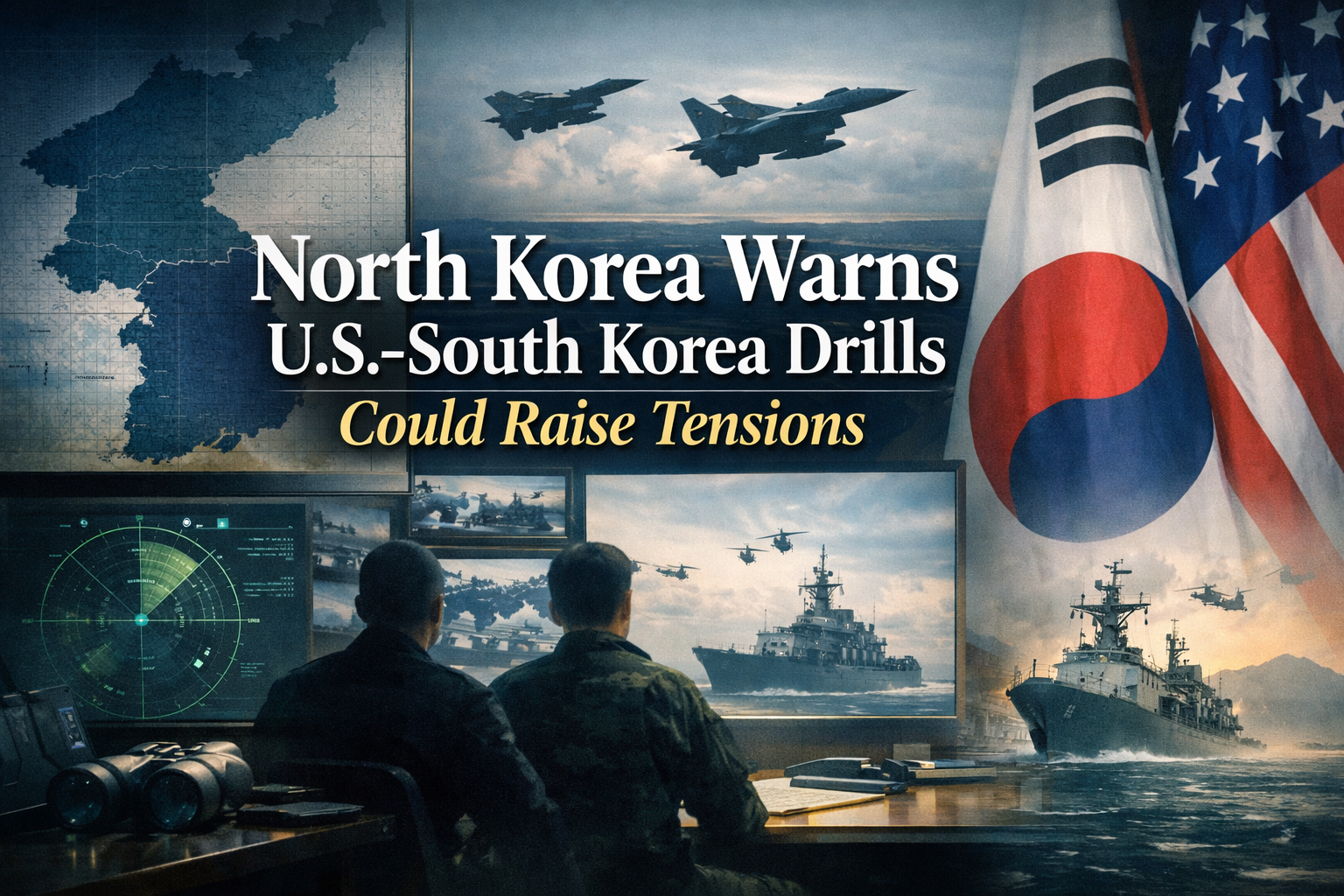
North Korea Warns U.S.-South Korea Drills Could Raise Tensions
Advanced | March 19, 2026
✨ Read the article aloud on your own or repeat each paragraph after your tutor.
North Korea U.S.-South Korea Drills Draw Sharp Warning
North Korea’s Kim Yo Jong, the sister of leader Kim Jong Un, sharply criticized the latest U.S.-South Korea Freedom Shield military exercises. The North Korea U.S.-South Korea drills dispute quickly became one of the biggest security stories in the region this week. In a statement reported by North Korean state media and covered by Reuters, she called the drills a “provocative and aggressive war rehearsal” and said they would damage regional stability (Reuters).
What Are These Drills?
The annual Freedom Shield exercises began on March 9 and are scheduled to continue through March 19. According to Reuters, the drills involve more than 18,000 South Korean and U.S. troops and include operations across land, sea, air, outer space, and cyberspace (Reuters). Seoul and Washington say the exercises are defensive in nature and meant to improve readiness against North Korea’s military threats.
Why North Korea Is Angry
Kim Yo Jong said the exercises show what she called the allies’ “habitual hostile policy” toward North Korea. She also warned that this kind of military display could lead to “terrible consequences that are unimaginable.” For Pyongyang, large military drills near its borders are not seen as routine training. Instead, North Korea often describes them as practice for invasion or regime change.
The Bigger Regional Picture
This situation is especially sensitive right now. Reuters reported that analysts believe North Korea is watching recent military actions involving the United States, Israel, and Iran very closely (Reuters). One South Korean expert said Kim Yo Jong’s comments suggest North Korea is even more convinced that giving up nuclear weapons would be dangerous. In other words, these drills are not just about training. They also affect how North Korea thinks about survival and deterrence.
What the U.S. and South Korea Say
The U.S. and South Korea insist that the drills are not designed for attack. Reuters reported that both governments say the exercises are part of normal defense planning and also support long-term preparations for the possible transfer of wartime operational control to South Korea (Reuters). That handover is one of Seoul’s important military goals in the coming years.
Why This Story Matters
This story matters because the North Korea U.S.-South Korea drills issue shows how quickly military training can become a political message. What one side calls defense, the other side may call provocation. That makes the Korean Peninsula one of the most sensitive places in the world. Even when there is no direct fighting, words, drills, and warnings can raise tension fast.
Vocabulary
- Drill (noun) – a practice exercise, especially for the military.
Example: “The joint military drill lasted several days.” - Regional stability (noun) – peace and balance in a particular area of the world.
Example: “Both sides said their actions were necessary for regional stability.” - Provocative (adjective) – likely to cause anger or a strong reaction.
Example: “North Korea called the drills provocative.” - Aggressive (adjective) – forceful or hostile in action or attitude.
Example: “The statement described the exercise as aggressive.” - Defensive (adjective) – intended to protect, not attack.
Example: “The allies said the drills were defensive in nature.” - Deterrence (noun) – the act of discouraging an attack by showing strength.
Example: “The countries said the exercise supported deterrence.” - Hostile (adjective) – unfriendly or threatening.
Example: “Pyongyang accused the allies of a hostile policy.” - Operational control (noun) – authority to command military forces during action.
Example: “South Korea hopes to gain wartime operational control in the future.” - Analyst (noun) – a person who studies events and explains what they mean.
Example: “An analyst said North Korea may feel more pressure than before.” - Peninsula (noun) – a piece of land surrounded by water on three sides.
Example: “The Korean Peninsula remains a tense region.”
Discussion Questions (About the Article)
- What did Kim Yo Jong say about the U.S.-South Korea drills?
- How many troops were involved in the Freedom Shield exercises?
- Why does North Korea see these drills as dangerous?
- How do the U.S. and South Korea describe the exercises?
- Why do analysts think this moment is especially sensitive?
Discussion Questions (About the Topic)
- Can military drills really help prevent war, or do they increase risk?
- Why do countries often see the same action in completely different ways?
- How important is military readiness in a tense region?
- Should rival countries communicate more during military exercises? Why?
- What role do words and public statements play in international conflict?
Related Idiom
“Walking on thin ice” – being in a risky situation where one mistake could cause serious trouble.
Example: “When military drills and angry warnings happen at the same time, the region can feel like it is walking on thin ice.”
📢 Want more practical English using real news? 👉 Sign up for the All About English Mastery Newsletter! Click here to join us!
Want to finally Master English but don’t have the time? Mastering English for Busy Professionals is the course for you! Check it out now!
Follow our YouTube Channel @All_About_English for more great insights and tips.
This article was inspired by: Reuters


 English
  한국어
한국어