
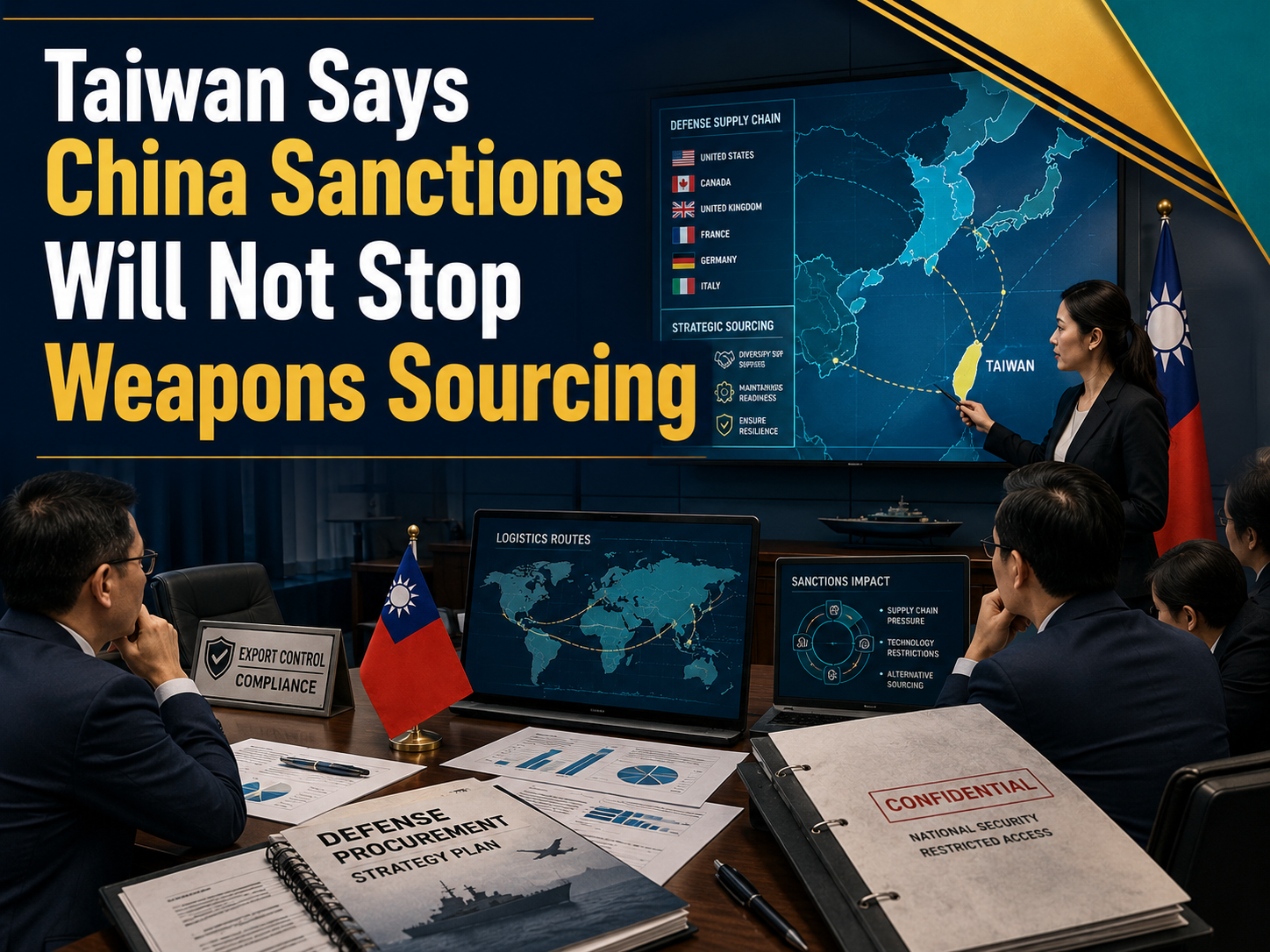
Taiwan Says China Sanctions Will Not Stop Weapons Sourcing
Intermediate | May 8, 2026
✨ Read the article aloud on your own or repeat each paragraph after your tutor.
Taiwan China Sanctions Raise New Questions
Taiwan says new Chinese sanctions on several European arms-related companies will not stop its weapons sourcing. Taiwan’s Defense Minister Wellington Koo told lawmakers that China had taken similar actions before and that the new restrictions would not affect Taiwan’s ability to find weapons and defense equipment. China announced the sanctions after accusing the companies of arms sales or defense cooperation with Taiwan. (Reuters, Taipei Times)
Why the Taiwan China Sanctions Story Matters
The Taiwan China sanctions story matters because it connects defense, trade, and international politics. China claims Taiwan as part of its territory, while Taiwan has its own elected government and builds relationships with international partners. When China places sanctions on companies that work with Taiwan, it sends a clear political message: Beijing wants to make Taiwan’s defense partnerships more difficult. Taiwan’s response also sends a message: Taipei wants to show that it still has options. (Reuters)
China Targets Seven European Entities
China’s Commerce Ministry placed seven European entities on its export control list and banned exports of dual-use items to them. Dual-use items are products, materials, software, or technology that can serve both civilian and military purposes. Reuters reported that the targeted entities include Germany’s Hensoldt AG, Belgium’s FN Browning, and four Czech organizations, including Excalibur Army, which is part of the Czechoslovak Group. This was unusual because China more often targets American defense firms over Taiwan arms sales. (Reuters, The Standard)
Taiwan Says It Has Other Sources
Koo said Taiwan has diversified sourcing channels. In plain English, that means Taiwan does not depend on only one supplier or one country for defense equipment. That idea matters in both business and national security. If you rely on one supplier, you can get stuck when pressure, sanctions, or delays hit the market. If you have several suppliers, you have more flexibility. Taiwan wants people to understand that the Taiwan China sanctions issue will not shut down its military procurement plans. (Reuters, AsiaOne)
Europe’s Role Is Still Complicated
Taiwan gets most of its weapons from the United States, and major European arms sales to Taiwan have been limited for many years. Many European governments want good trade relations with China, so they often move carefully on Taiwan-related defense issues. However, China’s decision to target European entities shows that even smaller defense links with Taiwan can create diplomatic pressure. This is where business meets geopolitics — and nobody gets to enjoy a quiet cup of coffee.
Japan May Be Another Question
Koo also discussed the possibility of buying defense equipment from Japan, especially after Japan eased some restrictions on overseas arms sales. However, he said Taiwan and Japan have not signed a defense equipment transfer agreement, which would be needed before such purchases could happen. He did not completely rule out future possibilities, but for now, the situation remains careful and uncertain. (Reuters)
The Bottom Line
The new sanctions do not appear to stop Taiwan’s weapons sourcing, but they do show how sensitive Taiwan’s defense partnerships remain. China wants to pressure companies and governments that support Taiwan’s military needs. Taiwan wants to show that it can keep building its defense network, even under pressure. For English learners, this story is also a useful example of business and political vocabulary: sanctions, sourcing, export controls, suppliers, and risk management all appear in one real-world situation.
Vocabulary
- Sanctions (noun) – official restrictions or penalties placed on a country, company, or person.
Example: “China announced sanctions on several European companies.” - Weapons sourcing (noun phrase) – the process of finding and buying weapons or defense equipment.
Example: “Taiwan says the sanctions will not stop its weapons sourcing.” - Defense equipment (noun phrase) – tools, systems, or weapons used for national defense.
Example: “The government needs reliable defense equipment.” - Dual-use items (noun phrase) – products or technologies that can be used for both civilian and military purposes.
Example: “Some drone parts and software can be dual-use items.” - Export control list (noun phrase) – an official list that limits who can receive certain goods or technology.
Example: “The companies were placed on China’s export control list.” - Diversified (adjective) – spread across several sources to reduce risk.
Example: “Taiwan says it has diversified sourcing channels.” - Supplier (noun) – a company or country that provides goods or services.
Example: “A country should not depend on only one supplier.” - Procurement (noun) – the process of buying supplies, equipment, or services.
Example: “Military procurement can take years of planning.” - Diplomatic pressure (noun phrase) – political pressure between governments.
Example: “Sanctions are often used as diplomatic pressure.” - Rule out (phrasal verb) – to say that something will not happen or is not possible.
Example: “The minister did not rule out future purchases from Japan.”
Discussion Questions (About the Article)
- What did Taiwan say about China’s new sanctions?
- Who is Wellington Koo, and what did he tell lawmakers?
- What are dual-use items?
- Why is it important for Taiwan to have diversified sourcing channels?
- Why is Europe’s role in Taiwan defense issues complicated?
Discussion Questions (About the Topic)
- Why do countries use sanctions as a political tool?
- Should companies be free to sell defense products to other countries? Why or why not?
- How can a country reduce supply-chain risk?
- Why is Taiwan such a sensitive issue in international politics?
- What can businesses learn from the idea of diversified sourcing?
Related Idiom
“Don’t put all your eggs in one basket” – do not depend on only one plan, person, supplier, or source.
Example: “Taiwan’s diversified weapons sourcing shows why countries should not put all their eggs in one basket.”
📢 Want more practical English through real news stories? Sign up for the All About English Mastery Newsletter here: allaboutenglishmastery.com/newsletter
Want to build stronger English in less time? Check out Mastering English for Busy Professionals.
Follow our YouTube channel @All_About_English for more English tips and practice.
This article was inspired by: Reuters, Reuters, Taipei Times, AsiaOne, and The Standard


 English
  한국어
한국어