

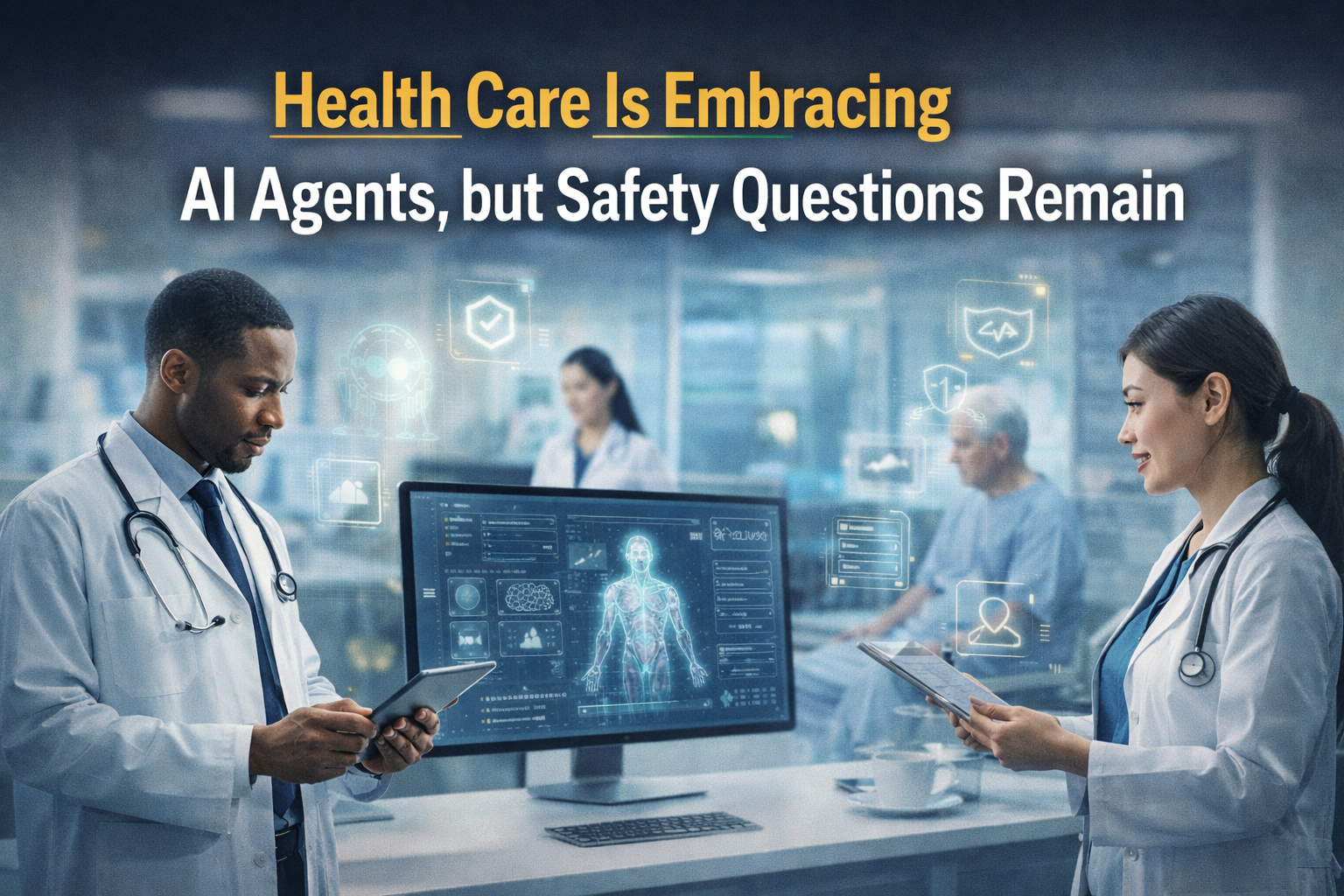
Health Care Is Embracing AI Agents, but Safety Questions Remain
Intermediate | March 22, 2026
✨ Read the article aloud on your own or repeat each paragraph after your tutor.
AI Agents Are Moving Fast in Health Care
AI agents are spreading quickly across health care. STAT reported on March 11, 2026 that new tools were everywhere at the HIMSS health technology conference in Las Vegas. Epic highlighted three agents called Art, Penny, and Emmie. Oracle introduced a clinical AI agent for doctors, and companies like Amazon, Google, and Microsoft also pushed deeper into the space. The message was clear: health care companies want AI agents to do more than chat. They want them to document, schedule, answer questions, and help manage billing. (STAT)
Why AI Agents in Health Care Raise Validation Concerns
The excitement is real, but so is the concern. As AI agents in health care become more common, experts are asking whether hospitals are moving faster than their safety checks. STAT’s main warning was that these tools are spreading faster than they are being properly validated. In simple terms, many experts are asking a very basic question: how do we know these AI agents are safe, accurate, and reliable enough for real health care settings? That question matters even more in medicine, where mistakes can affect patient care, privacy, and trust. (STAT)
What These New AI Agents Actually Do
Many of these systems are aimed at reducing paperwork and administrative overload. Epic said Art helps clinicians draft documentation, Penny supports billing and revenue cycle work, and Emmie helps answer patient questions and schedule appointments. Microsoft said at HIMSS that its Dragon Copilot is designed to reduce administrative burden and bring AI into clinical workflows. Oracle said its new clinical AI agent can help emergency and inpatient physicians draft notes and suggest next steps. In other words, the first big wave of AI agents is not replacing doctors. It is trying to reduce friction around the work that surrounds patient care. (Epic) (Microsoft) (Oracle)
Why Hospitals and Insurers Are Interested
There is a strong business reason for the rush. Reuters reported on March 12, 2026 that hospitals and insurers are using AI in the long-running fight over charges, documentation, and payments. HCA Healthcare said it expected about $400 million in 2026 cost savings from AI initiatives, and Providence said AI tools can help represent medical services more accurately for reimbursement. When money, labor shortages, and heavy paperwork all hit at once, AI starts to look very attractive. (Reuters)
Growth Is Strong, but Governance Has to Catch Up
Deloitte reported that 61% of surveyed health care organizations said they were already building and implementing agentic AI initiatives or had secured budgets, and 85% planned to increase investment over the next two to three years. That is a big signal that adoption is moving beyond small experiments. But Deloitte also stressed that organizations need proper validation and governance in place. That idea matches STAT’s warning almost perfectly: the tools may be moving fast, but responsible oversight has to keep pace. (Deloitte)
Why This Story Matters for English Learners
This article is useful for English learners because it sits right at the intersection of business, technology, and medicine. It also teaches an important modern pattern in business English: a tool can sound efficient and exciting, but leaders still need to ask hard questions about testing, trust, and accountability. In plain English, that means AI agents in health care may save time, but health care cannot afford to guess when people’s well-being is on the line.
Vocabulary
- Validation (noun) – the process of testing whether something works correctly and safely.
Example: “Experts said validation is necessary before AI agents are trusted widely in health care.” - Clinical (adjective) – related to the treatment of patients.
Example: “Clinical AI tools are being added to hospital workflows.” - Workflow (noun) – the sequence of steps used to complete a job.
Example: “Hospitals hope AI can improve workflow and reduce delays.” - Administrative (adjective) – related to office, record, or management tasks.
Example: “Many AI agents are focused on administrative work rather than direct treatment.” - Governance (noun) – the system of rules and oversight used to control something.
Example: “Good governance is necessary when using AI in medicine.” - Reliability (noun) – the quality of being dependable and accurate.
Example: “Doctors need reliability before trusting an AI system.” - Reimbursement (noun) – payment made back to a provider for services.
Example: “Accurate documentation can improve reimbursement.” - Burden (noun) – a heavy duty or difficult responsibility.
Example: “Paperwork is a major burden for many health care workers.” - Oversight (noun) – supervision and careful watching.
Example: “Experts say stronger oversight is needed for AI systems in medicine.” - Adoption (noun) – the act of starting to use something.
Example: “The adoption of AI agents in health care is accelerating.”
Discussion Questions (About the Article)
- Why are AI agents spreading so quickly in health care?
- What kinds of tasks are these tools doing first?
- Why is validation such an important issue in medicine?
- How are hospitals and insurers hoping to benefit from AI agents?
- What could happen if adoption moves faster than oversight?
Discussion Questions (About the Topic)
- Should AI be allowed to handle more patient-related tasks in the future? Why or why not?
- What is the difference between convenience and safety in health care technology?
- How much testing should be required before AI tools are widely used in hospitals?
- Can business pressure sometimes push companies to adopt technology too quickly?
- What kinds of jobs or tasks do you think should always keep a strong human role?
Related Idiom
“Move fast and break things” – to innovate quickly, sometimes without enough caution.
Example: “That approach may work in some industries, but health care cannot simply move fast and break things.”
📢 Want more practical English using real news? 👉 Sign up for the All About English Mastery Newsletter! Click here to join us!
Want to finally Master English but don’t have the time? Mastering English for Busy Professionals is the course for you! Check it out now!
Follow our YouTube Channel @All_About_English for more great insights and tips.
This article was inspired by: STAT, Epic, Microsoft, Oracle, Reuters, and Deloitte.


 English
  한국어
한국어