

World Reacts After Orbán Defeat in Hungary’s Election
Advanced | April 26, 2026
✨ Read the article aloud on your own or repeat each paragraph after your tutor.
A Political Earthquake: Orbán Defeat in Hungary
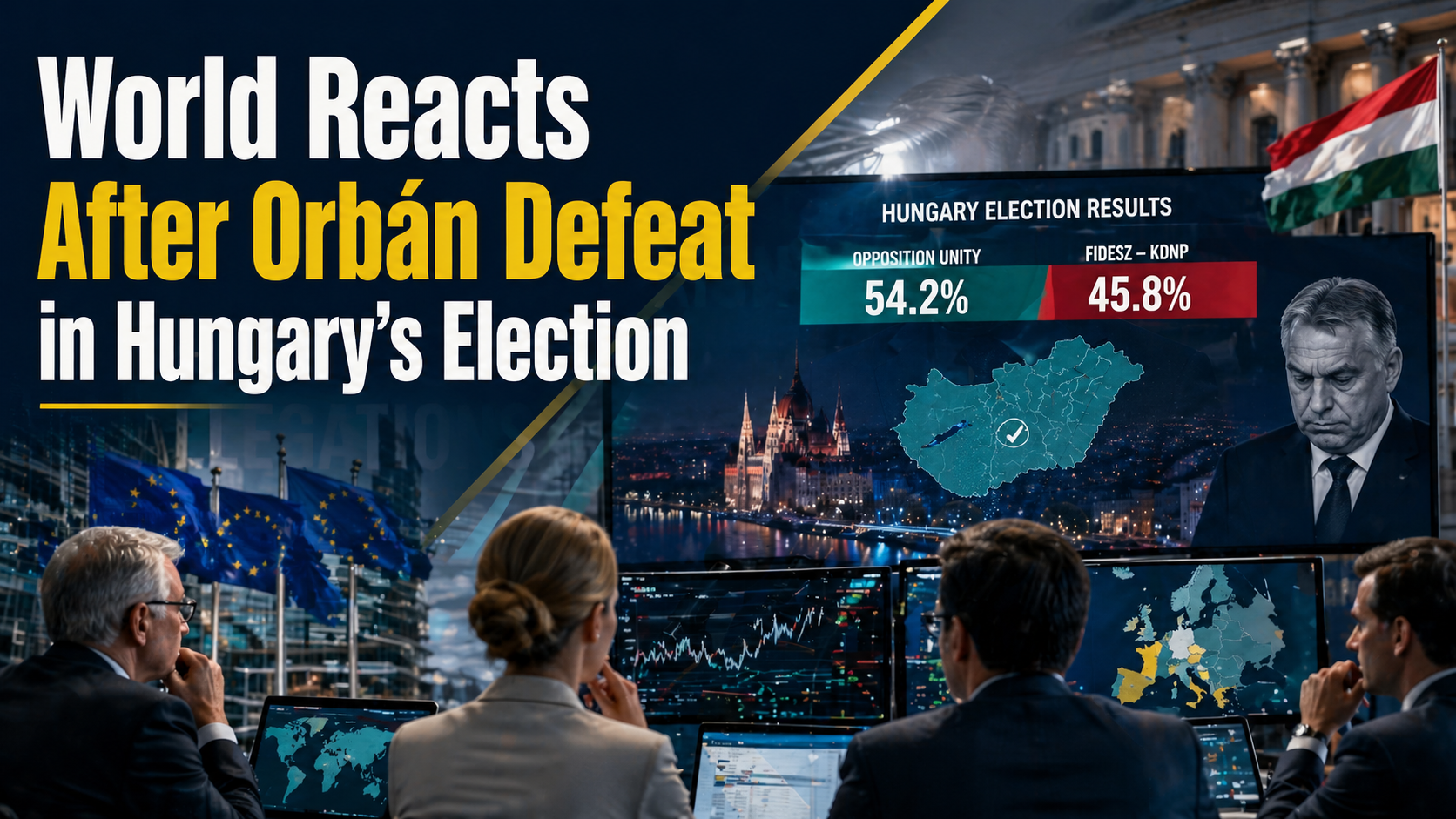
Hungarian Prime Minister Viktor Orbán conceded defeat after a landmark election that ended his 16-year rule. According to Reuters, the center-right opposition Tisza Party, led by Péter Magyar, won a major victory in Hungary’s parliamentary election. Orbán congratulated the opposition, while leaders across Europe and beyond quickly reacted to the result. In plain English, this was not just a normal election loss—it was a political earthquake.
Why the Orbán Defeat in Hungary Story Matters
The Orbán defeat in Hungary story matters because Orbán was one of Europe’s longest-serving and most controversial leaders. He became famous for his nationalist politics, tough line on immigration, close ties with Russia, and frequent clashes with the European Union. Reuters reported that the election result was significant not only for Hungary, but also for the EU, Ukraine, Russia, and the United States. Election officials estimated turnout at 79% or more, which Reuters described as a record. (Reuters)
European Leaders Welcome a New Direction
Many European leaders welcomed the result as a possible turning point. European Commission President Ursula von der Leyen said Hungary was returning to a European path, while leaders from countries such as Germany, France, the United Kingdom, and Nordic countries expressed support for democracy, rule of law, and European unity. This reaction was not surprising. Orbán had often blocked or delayed EU decisions, especially on Ukraine and rule-of-law issues. For Brussels, Magyar’s victory looked like a chance to stop fighting the same political fire every Monday morning. (Reuters)
Ukraine Sees a Chance for Better Cooperation
Ukraine also reacted strongly. Ukrainian President Volodymyr Zelenskiy said he was ready for renewed cooperation with Hungary. That matters because Orbán had often criticized EU support for Ukraine and maintained warmer ties with Moscow than many other EU leaders. A change in Budapest could make EU decision-making on Ukraine smoother. It may also reduce some of the diplomatic tension between Hungary and its neighbors. (Reuters)
The Far Right Loses a Major Symbol
Orbán’s defeat also sent shockwaves through right-wing and populist movements in Europe and the United States. Reuters reported that Orbán had become a kind of blueprint for “illiberal” politics, earning praise from figures such as Donald Trump and Vladimir Putin. After his defeat, analysts said Europe’s far right had lost one of its biggest champions. In business terms, Orbán was not just a local brand—he was an international franchise. And suddenly, the flagship store had closed. (Reuters)
What Voters Wanted to Change
Reuters reported that many Hungarians were concerned about issues such as economic stagnation, inflation, healthcare, corruption, and Hungary’s strained relationship with the EU. Magyar campaigned as a center-right reformer and promised to restore democratic institutions, strengthen the rule of law, and repair ties with Brussels. His party’s strong result could give him the power to reverse some of Orbán’s most controversial changes. (Reuters)
Markets and EU Funds Come Into Focus
The reaction was not only political. Financial markets also watched closely because Hungary has billions of euros in EU funding frozen over rule-of-law concerns. Reuters later reported that Magyar planned to meet European Commission President Ursula von der Leyen to discuss unblocking around 10 billion euros in EU pandemic recovery funds. Magyar said reforms in corruption, media independence, academic independence, and judicial independence would be key priorities. For investors, that raised hopes for a more stable relationship between Hungary and the EU. (Reuters)
A New Chapter, But Not an Easy One
The Orbán defeat in Hungary may mark a major new chapter, but Hungary’s problems will not disappear overnight. Magyar will face high expectations, political division, institutional challenges, and pressure from both supporters and critics. For English learners, this story is useful because it shows how one election can create reactions in many directions: celebration, concern, market optimism, diplomatic hope, and political soul-searching. That is why international politics is rarely simple—but it is always worth talking about.
Vocabulary
- Concede (verb) – to admit that you have lost a contest or election.
Example: “Orbán conceded defeat after the election results became clear.” - Landmark (adjective) – very important or historically significant.
Example: “The election was a landmark moment in Hungarian politics.” - Opposition (noun) – the political parties or groups not currently in power.
Example: “The opposition Tisza Party defeated Orbán’s Fidesz party.” - Turnout (noun) – the number or percentage of people who vote.
Example: “Election turnout reached about 79% or more.” - Rule of Law (noun) – the principle that everyone must follow the law, including leaders.
Example: “Magyar promised to strengthen the rule of law.” - Populist (adjective) – connected to politics that claim to represent ordinary people against elites.
Example: “Orbán became an important populist figure in Europe.” - Illiberal (adjective) – not fully respecting liberal democratic values such as free courts, media, or opposition rights.
Example: “Critics described Orbán’s government as illiberal.” - Frozen Funds (noun) – money that is blocked or temporarily unavailable.
Example: “Hungary wants to unlock frozen EU funds.” - Reform (noun) – a change meant to improve a system.
Example: “Magyar promised reforms in the courts and media.” - Political Soul-Searching (noun) – serious reflection after a political failure or crisis.
Example: “Orbán’s defeat led to political soul-searching inside Fidesz.”
Discussion Questions About the Article
- Why was Orbán’s defeat described as a political earthquake?
- How did European leaders react to the election result?
- Why was Ukraine interested in Hungary’s election outcome?
- What made Orbán important to right-wing and populist movements outside Hungary?
- Why are EU funds important for Hungary’s next government?
Discussion Questions About the Topic
- Why do elections in smaller countries sometimes matter internationally?
- How can one leader influence politics beyond his or her own country?
- Should the EU be able to freeze funds when it believes a member country is weakening the rule of law?
- What challenges does a new leader face after defeating a long-serving government?
- How should voters judge whether a political movement has become too powerful?
Related Idiom
“Turn the page” – to leave the past behind and begin a new phase.
Example: “Many European leaders hope Hungary can turn the page after Orbán’s defeat and rebuild stronger ties with the EU.”
📢 Want more practical English through real news stories? Sign up for the All About English Mastery Newsletter here: allaboutenglishmastery.com/newsletter
Want to build stronger English in less time? Check out Mastering English for Busy Professionals.
Follow our YouTube channel @All_About_English for more English tips and practice.
This article was inspired by: Reuters, Reuters, Reuters, Reuters, and AP News


 English
  한국어
한국어