

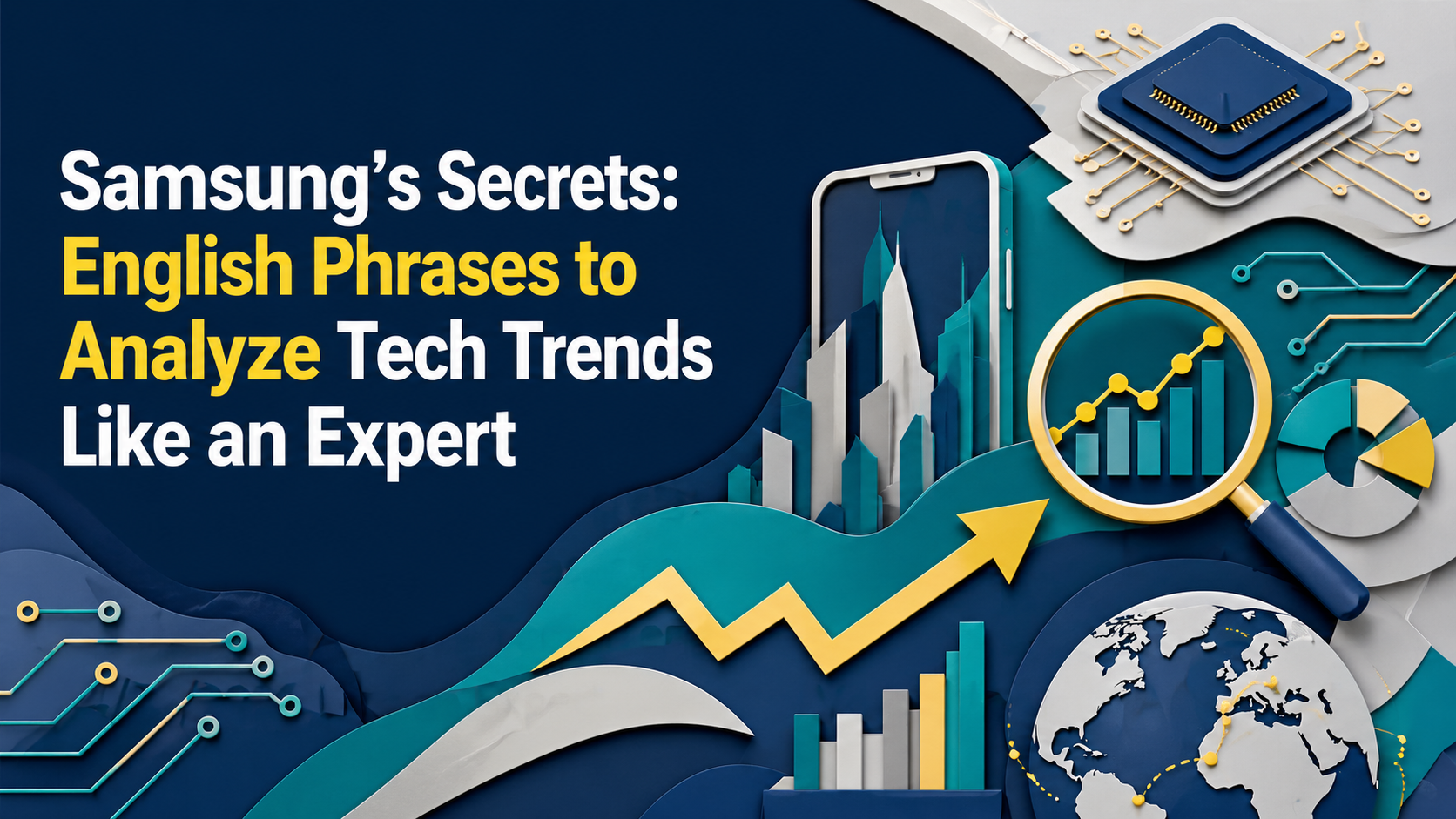
Samsung’s Secrets: English Phrases to Analyze Tech Trends Like an Expert 📱
Advanced Level | April 26, 2026
Read the article aloud on your own or repeat each paragraph after your tutor.
Technology changes fast. One month, everyone is talking about artificial intelligence. The next month, the big story is memory chips, smartphones, electric vehicles, robotics, or semiconductor exports. For busy professionals, especially those working in Korea, Taiwan, tech, finance, or global business, it is not enough to simply read the news. You need to analyze tech trends in English clearly and professionally.
Samsung is a perfect example. When people talk about “Samsung’s secrets,” they are not usually talking about one hidden trick inside a locked laboratory. They are talking about patterns: investment decisions, product strategy, supply chains, chip demand, smartphone competition, and how one company responds to pressure in a global market. If you can discuss these patterns in English, you can sound sharper in meetings, presentations, and professional conversations.
Why You Need English Phrases to Analyze Tech Trends
Many English learners can describe basic news. They can say, “Samsung released a new phone,” or “chip demand is increasing.” That is useful, but it is not enough for advanced professional English. At a higher level, you need to explain why something matters, what it suggests, and how it may affect the market. That is where stronger phrases become powerful.
For example, instead of saying, “Samsung is doing many things,” you could say, “Samsung appears to be positioning itself for long-term growth in AI-related hardware.” That sentence sounds more analytical. It shows that you are not just repeating information. You are interpreting it. And in business, interpretation is where the real value lives.
Phrase 1: “This suggests that…”
One of the most useful phrases for analyzing tech news is “This suggests that…” Use this phrase when you want to explain what a trend, decision, or event may mean. For example: “Samsung is investing heavily in advanced chips. This suggests that the company expects strong demand from AI and data-center customers.”
This phrase helps you move from facts to meaning. It is especially useful in meetings when you want to sound thoughtful without sounding too aggressive. You are not saying, “This proves everything.” You are saying, “This points in a certain direction.” That sounds smart, careful, and professional.
Phrase 2: “The company appears to be…”
Another excellent phrase is “The company appears to be…” This is useful when you are analyzing strategy. For example: “The company appears to be focusing on premium devices instead of competing only on price.” You can also say, “Samsung appears to be strengthening its position in the semiconductor market.”
The phrase “appears to be” is important because it gives you room. In business analysis, we often do not know every private decision inside a company. Unless you have a spy in the boardroom—and if you do, please don’t put that in an email—you should avoid sounding too certain. “Appears to be” lets you make a strong point while staying professional.
Phrase 3: “This could have a major impact on…”
When discussing future results, use “This could have a major impact on…” For example: “Samsung’s chip strategy could have a major impact on global AI development.” Or: “A slowdown in smartphone sales could have a major impact on quarterly earnings.”
This phrase is useful because technology trends rarely stay inside one company. A change at Samsung can affect suppliers, competitors, investors, customers, and even government policy. When you use this phrase, you show that you can connect one business decision to a wider market effect.
How to Sound Like a Tech Trend Analyst
To sound more professional, try using a simple three-step pattern: describe the trend, explain what it suggests, and discuss the possible impact. For example: “Samsung is expanding its focus on high-performance memory chips. This suggests that the company sees AI infrastructure as a major growth area. This could have a major impact on competition with other global chipmakers.”
That pattern is short, clear, and powerful. It works in presentations, business meetings, reports, and even casual conversations with colleagues. You do not need to use complicated grammar to sound advanced. You need clear phrases that help you organize smart thinking.
Phrase 4: “A key factor to watch is…”
When analyzing tech trends, you often need to point people toward the most important issue. That is when you can say, “A key factor to watch is…” For example: “A key factor to watch is whether Samsung can increase production fast enough to meet AI chip demand.” Or: “A key factor to watch is how consumers respond to the next generation of foldable phones.”
This phrase is excellent for professional discussions because it helps you guide the conversation. You are not just reacting to news. You are helping others know what to pay attention to next. That is a strong communication skill for managers, analysts, engineers, marketers, and sales professionals.
Phrase 5: “The bigger question is…”
Finally, use “The bigger question is…” when you want to move the conversation to a deeper level. For example: “The bigger question is whether Samsung can turn its AI hardware investments into long-term profit growth.” Or: “The bigger question is how global competition will shape the next stage of the smartphone market.”
This phrase is especially useful in advanced English because it helps you sound strategic. You are not trapped in small details. You are thinking about the bigger picture. In business English, that is the difference between simply reporting news and leading a serious conversation.
Practice: Analyze Tech Trends in English
Here is a practical exercise. Choose one current tech story about Samsung, AI, semiconductors, smartphones, or another major company. Then use these five phrases to discuss it: “This suggests that…,” “The company appears to be…,” “This could have a major impact on…,” “A key factor to watch is…,” and “The bigger question is…”
You can practice aloud for five minutes. Record yourself if possible. Listen again and check whether your ideas sound clear, organized, and professional. This is how you learn to analyze tech trends in English naturally—not by memorizing random words, but by using clear phrases in real business thinking.
Vocabulary List
- Analyze (verb) — To study something carefully in order to understand it.
Example: We need to analyze the latest tech trends before making a decision. - Trend (noun) — A general direction in which something is developing or changing.
Example: AI is one of the biggest trends in the technology industry. - Position (verb) — To place a company, product, or idea in a strong situation for success.
Example: Samsung is trying to position itself as a leader in AI hardware. - Investment (noun) — Money, time, or resources used to create future value.
Example: The company’s investment in memory chips may support future growth. - Semiconductor (noun) — A material or device used to control electrical signals, especially in computer chips.
Example: Semiconductors are essential for smartphones, cars, and AI systems. - Demand (noun) — The desire or need for a product or service.
Example: Demand for advanced chips has increased because of AI development. - Strategy (noun) — A plan designed to achieve a goal.
Example: The company’s strategy focuses on premium products and advanced technology. - Impact (noun) — A strong effect or influence.
Example: A chip shortage can have a major impact on global electronics companies. - Competitor (noun) — A company or person trying to succeed in the same market as another.
Example: Samsung faces strong competitors in smartphones and semiconductors. - Long-term (adjective) — Continuing or developing over a long period of time.
Example: Long-term growth depends on smart investment and strong market demand.
5 Questions About the Article
- Why is Samsung a useful example for discussing tech trends?
- What is the difference between describing news and analyzing news?
- How can the phrase “This suggests that…” help you sound more professional?
- Why is “appears to be” useful when discussing company strategy?
- What does the phrase “The bigger question is…” help you do in a conversation?
5 Open-Ended Discussion Questions
- What technology trend do you think will have the biggest impact this year? Why?
- How does Samsung influence business or technology in your country?
- What is one tech trend that many people are misunderstanding right now?
- How can professionals use better English to discuss technology more clearly?
- Which phrase from today’s article would be most useful in your next meeting?
📢 Want more tips like this? 👉 Sign up for the All About English Mastery Newsletter! Click here to join us!
Want to finally Master English but don’t have the time? Mastering English for Busy Professionals is the course for you! Check it out now!
Follow our YouTube Channel @All_About_English for more great insights and tips.

 English
  한국어
한국어