

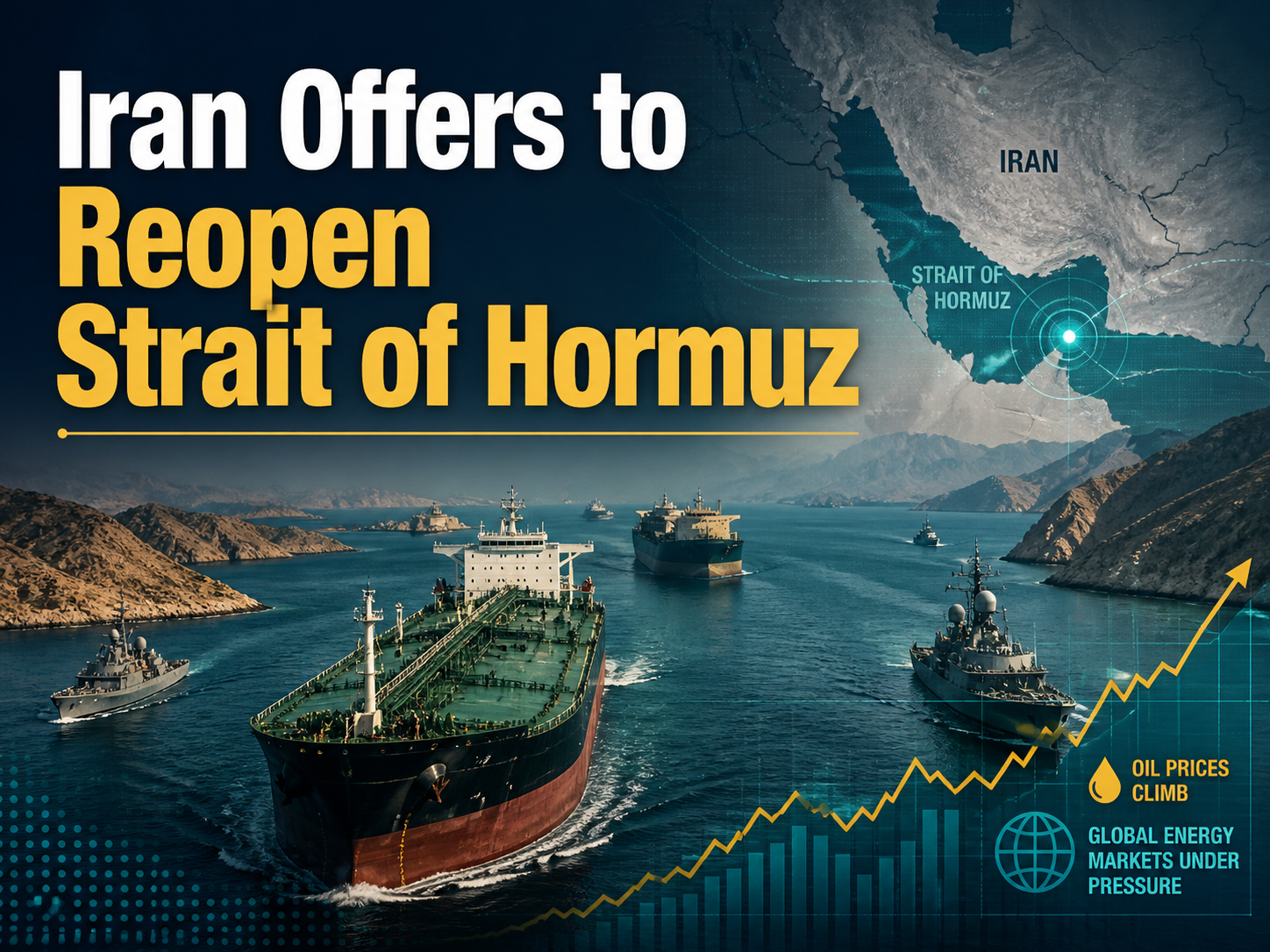
Iran Offers to Reopen Strait of Hormuz
Advanced | May 1, 2026
✨ Read the article aloud on your own or repeat each paragraph after your tutor.
A New Offer in a Dangerous Standoff
Iran has offered to reopen the Strait of Hormuz if the United States lifts its naval blockade and the war ends, according to AP News. Two regional officials said the proposal would delay talks about Iran’s nuclear program until later. That detail is important because the nuclear issue has been one of the main reasons the United States has kept pressure on Iran. (AP News)
Why the Strait of Hormuz Offer Matters
The Strait of Hormuz offer matters because this narrow waterway is one of the most important shipping routes in the world. AP News reported that about one-fifth of the world’s traded oil and gas passes through the strait in peacetime. Reuters also reported that the closure has choked off about 20% of the world’s oil and gas supplies, pushing energy prices higher and raising concerns about a wider economic slowdown. (AP News) (Reuters)
What Iran Is Asking For
Under the proposal, Iran would end its chokehold on the Strait of Hormuz if Washington lifts its blockade and formally ends the conflict. The U.S. blockade is designed to stop Iran from selling oil, which cuts off a major source of revenue for Tehran. AP News said the blockade may also create a storage problem for Iran because the country could be forced to reduce production if it cannot export enough oil. In business terms, Iran is trying to turn shipping access into a bargaining chip. (AP News)
The Nuclear Question Is Still the Roadblock
The biggest problem is what the proposal leaves out: Iran’s nuclear program. Axios reported that Iran’s plan would reopen the strait and end the war first, while pushing nuclear negotiations to a later stage. The Trump administration has made Iran’s nuclear program a central issue, including demands that Iran stop uranium enrichment and move enriched uranium out of the country. Axios also reported that the White House received the proposal, but it was unclear whether the U.S. would explore it. (Axios)
Oil Prices and Global Pressure
The economic pressure is growing. Reuters reported that Brent crude briefly topped $125 a barrel, reaching its highest level since March 2022. AP News said Brent closed above $108 a barrel on Monday, about 50% higher than when the war began. Higher oil prices can quickly affect gasoline, shipping, fertilizer, food, and other basic goods. That means the Strait of Hormuz offer is not just a diplomatic story. It is also a business, consumer, and inflation story. (Reuters) (AP News)
Pakistan’s Role Behind the Scenes
Pakistan has been working as a backchannel between Iran and the United States. The Guardian reported that Pakistan is passing proposals between the two sides and trying to keep negotiations alive after direct talks stalled. Pakistani officials are also worried about the global economic impact, especially because Pakistan’s monthly energy import bill has almost tripled as a result of the war. This shows how a regional conflict can quickly become a worldwide pocketbook problem. (The Guardian)
What Happens Next
For now, the standoff continues. Reuters reported that the United States is pushing for an international coalition called the Maritime Freedom Construct, which would help restore freedom of navigation through the strait. France, Britain, and other countries have discussed helping, but Reuters said they were only willing to help open the strait after hostilities end. In plain English: everyone wants the waterway open, but nobody wants to jump into a bigger war by mistake. (Reuters)
The situation is still fragile. Iran wants sanctions and blockades lifted first. The United States wants the nuclear issue handled first. Between those two positions is a very narrow diplomatic path—almost as narrow as the strait itself. For English learners, this story is useful because it includes advanced vocabulary about diplomacy, trade, energy markets, military pressure, and negotiation strategy.
Vocabulary
- Strait (noun) – a narrow passage of water connecting two larger bodies of water.
Example: “The Strait of Hormuz connects the Persian Gulf with the Gulf of Oman.” - Blockade (noun) – an action that stops goods, ships, or people from entering or leaving a place.
Example: “The U.S. blockade is designed to stop Iran from selling oil.” - Ceasefire (noun) – an agreement to stop fighting for a period of time.
Example: “A fragile ceasefire is in place, but the crisis is not over.” - Chokehold (noun) – strong control that limits someone’s ability to move or act.
Example: “Iran’s chokehold on the strait has affected global shipping.” - Negotiation (noun) – a discussion aimed at reaching an agreement.
Example: “The proposal could restart negotiation between the two sides.” - Bargaining chip (noun) – something used to gain an advantage in a negotiation.
Example: “Shipping access has become a bargaining chip in the talks.” - Uranium enrichment (noun) – the process of increasing the concentration of uranium for nuclear use.
Example: “Uranium enrichment remains one of the biggest disputes.” - Economic slowdown (noun) – a period when economic growth becomes weaker.
Example: “Higher energy prices can increase the risk of an economic slowdown.” - Backchannel (noun) – a private or unofficial way of communicating between groups.
Example: “Pakistan is acting as a backchannel between Iran and the United States.” - Freedom of navigation (noun) – the right of ships to travel safely through international waters.
Example: “The coalition would try to restore freedom of navigation.”
Discussion Questions (About the Article)
- What did Iran offer to do if the United States lifts its blockade?
- Why is the Strait of Hormuz important for the world economy?
- What nuclear issue is still blocking a possible agreement?
- How has the closure of the strait affected oil prices?
- What role is Pakistan playing in the talks?
Discussion Questions (About the Topic)
- Should countries use blockades as a negotiation tool? Why or why not?
- How do higher oil prices affect ordinary people and businesses?
- What should be more important in this situation: ending the war quickly or solving the nuclear issue first?
- How can smaller countries act as mediators between powerful countries?
- What are the risks of forming an international maritime coalition during a conflict?
Related Idiom
“A bargaining chip” – something used to gain an advantage during a negotiation.
Example: “Iran is using access to the Strait of Hormuz as a bargaining chip in talks with the United States.”
📢 Want more practical English through real news stories? Sign up for the All About English Mastery Newsletter here: allaboutenglishmastery.com/newsletter
Want to build stronger English in less time? Check out Mastering English for Busy Professionals.
Follow our YouTube channel @All_About_English for more English tips and practice.
This article was inspired by: AP News, Reuters, Axios, The Guardian, and Al Jazeera


 English
  한국어
한국어