

Empty CU Shelves Show How Logistics Problems Hit Daily Life
Intermediate | May 4, 2026
✨ Read the article aloud on your own or repeat each paragraph after your tutor.
Why Empty CU Shelves Are Getting Attention
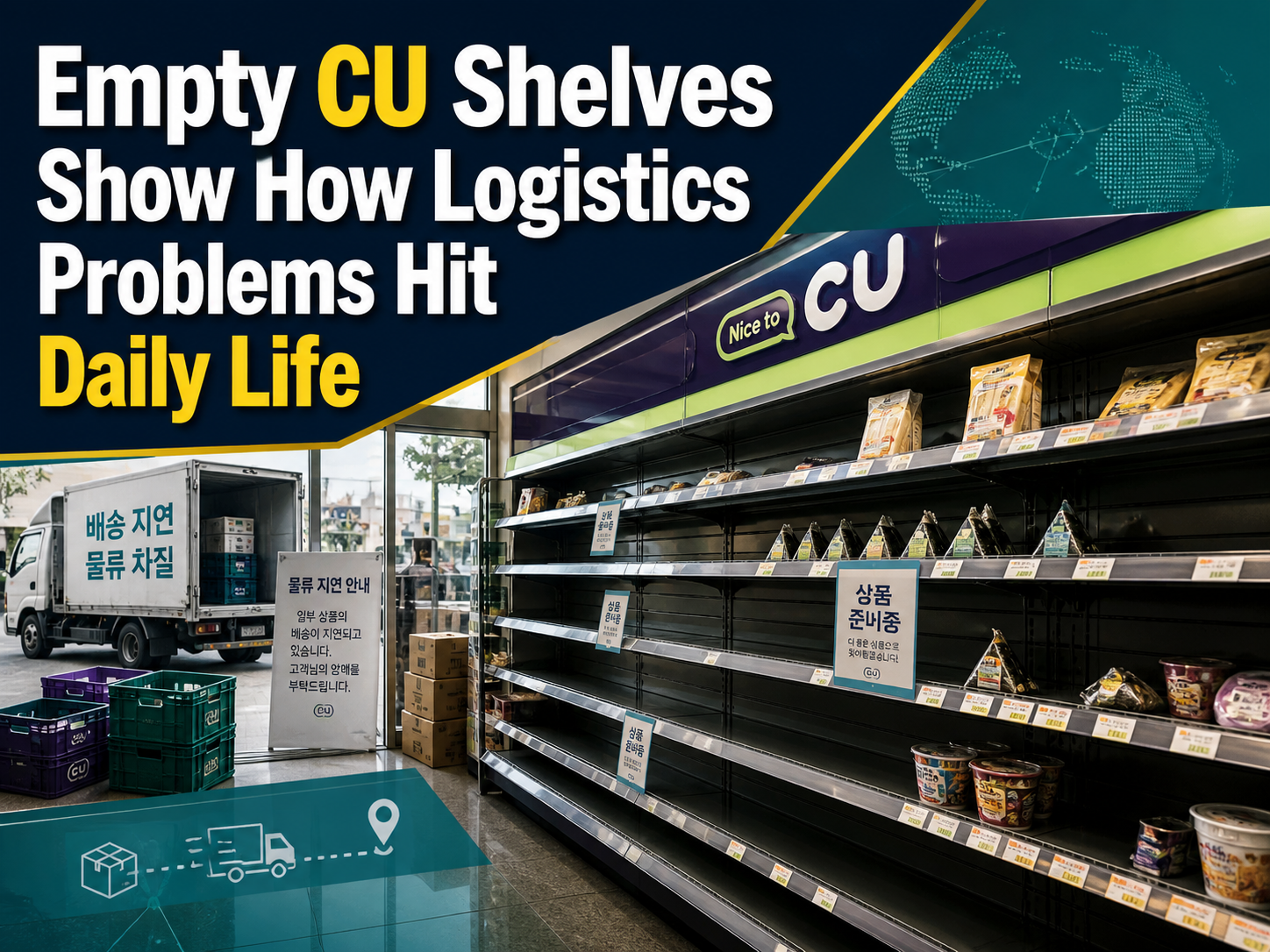
If you live in Korea, you may have noticed something unusual at some CU convenience stores: empty spaces where lunch boxes, gimbap, sandwiches, rice balls, noodles, drinks, or daily necessities usually sit. For many customers, CU is part of the daily routine. People stop there before work, after school, or during a short lunch break. So when the shelves look empty, it becomes more than a small store problem. For customers, empty CU shelves are a clear sign that a delivery problem has reached everyday life. (The Korea Herald)
According to The Korea Herald, some CU stores across South Korea have been running low on food and daily necessities because a logistics strike has disrupted deliveries. The strike began in early April, and members of Cargo Truckers Solidarity, under the Korean Confederation of Trade Unions, blocked access to important BGF Retail distribution centers in areas including Jinju, Hwaseong, Anseong, and Naju. These blockades slowed or stopped shipments to stores. (The Korea Herald via Daum)
How the Strike Hit Ready-to-Eat Food
The biggest issue for many customers is ready-to-eat food. These are the quick meals people buy when they do not have time to cook or sit down at a restaurant. The Korea Herald reported that the disruption spread to a major food manufacturing plant in Jincheon, cutting off supplies of about 18 ready-to-eat items, including gimbap, sandwiches, and rice balls, from April 17. In some areas, stores reduced orders from six days a week to three, while other stores stopped receiving some orders completely. (The Korea Herald via Daum)
This may sound like a simple supply problem, but convenience stores depend on fast, regular deliveries. Fresh food cannot just sit in a warehouse for weeks. It has to move quickly from production to the store shelf. When the system slows down, the customer sees the result almost immediately: fewer lunch options, fewer snacks, and a store that feels strangely unfinished.
Why Franchise Owners Are Frustrated
The problem also hurts CU franchise owners. Seoul Economic Daily reported that about 3,000 CU stores were affected by the strike, with estimated total damage of 600 million to 1.6 billion won per day. The same report said some franchisees believe their losses could reach up to 30% of sales because fresh food, dairy products, general goods, and even some beer supplies were affected. (Seoul Economic Daily)
For store owners, this is not just about missing products. It is about customer trust. If customers hear that a CU store has no food coming in, they may go somewhere else before they even check the store. Kim Mi-yeon, head of the CU Franchise Owners Association, told Seoul Economic Daily that the biggest damage is not only the missing products, but also the fact that customers may stop visiting CU at all. (Seoul Economic Daily)
What the Truckers Want
The truckers say the issue is not just about deliveries. According to The Korea Herald, union officials said they had asked for negotiations for months. They are calling for higher delivery fees, guaranteed rest days, and the withdrawal of legal actions against drivers. They also reject the idea that the dispute should be seen simply as a fight between drivers and store owners. (The Korea Herald via Daum)
The situation became more serious after a union member died in an accident at a BGF Retail logistics center in Jinju on April 20. A Yonhap report carrying a Korea Herald editorial said the accident happened during strike activity near a replacement cargo truck. After that, tensions grew, and the union continued rallies and memorial gatherings while talks with the company continued. (Yonhap News Agency)
Why Empty CU Shelves Matter for English Learners
This story is useful for English learners because it connects everyday life with business vocabulary. Words like logistics, supply chain, franchisee, disruption, and negotiation appear often in business news. But this story makes them easier to understand because you can connect them to something simple: walking into a convenience store and seeing empty shelves.
It is also a good reminder that businesses depend on many people behind the scenes. Customers see the store. Store owners see the missing sales. Drivers see the working conditions. The company sees the costs. One problem in the supply chain can spread quickly, like knocking over the first domino. In business, small delays can create big consequences. And yes, apparently even your triangle gimbap has a supply-chain drama. Who knew lunch could be this complicated?
Vocabulary
- Logistics (noun) – the process of moving goods, supplies, or people from one place to another.
Example: “The strike caused logistics problems for CU stores.” - Disruption (noun) – a problem that stops something from working normally.
Example: “The delivery disruption left many shelves empty.” - Supply Chain (noun) – the system that moves products from producers to customers.
Example: “A supply chain problem can affect many stores at the same time.” - Franchisee (noun) – a person who owns and operates a store under a larger company’s brand.
Example: “Some CU franchisees said their sales dropped because of the strike.” - Blockade (noun) – an action that stops people or goods from entering or leaving a place.
Example: “The truckers’ blockade slowed deliveries to CU stores.” - Distribution Center (noun) – a place where goods are stored and sent to stores.
Example: “BGF Retail uses distribution centers to send products to CU stores.” - Ready-to-Eat (adjective) – prepared and ready for customers to eat immediately.
Example: “Gimbap and sandwiches are popular ready-to-eat foods.” - Negotiation (noun) – a discussion where people try to reach an agreement.
Example: “The union and company continued negotiation talks.” - Daily Necessities (noun) – basic things people use or need every day.
Example: “Some stores ran low on food and daily necessities.” - Compensation (noun) – money or support given because of loss, damage, or extra work.
Example: “Some store owners wanted compensation for lost sales.”
Discussion Questions (About the Article)
- Why did some CU stores have empty shelves?
- Which ready-to-eat foods were affected by the disruption?
- How did the logistics strike hurt CU franchise owners?
- What are the truckers asking for in the dispute?
- Why did the situation become more serious after April 20?
Discussion Questions (About the Topic)
- How important are convenience stores in daily life in Korea?
- What products would you miss most if your local convenience store had empty shelves?
- Who do you think suffers most during a logistics strike: customers, store owners, drivers, or the company?
- How can companies prepare better for supply chain problems?
- Have you ever changed where you shop because one store did not have enough products?
Related Idiom
“A domino effect” – when one event causes a series of other events to happen.
Example: “The logistics strike created a domino effect: deliveries slowed, shelves emptied, customers left, and store owners lost sales.”
📢 Want more practical English through real news stories? Sign up for the All About English Mastery Newsletter here: allaboutenglishmastery.com/newsletter
Want to build stronger English in less time? Check out Mastering English for Busy Professionals.
Follow our YouTube channel @All_About_English for more English tips and practice.
This article was inspired by: The Korea Herald, The Korea Herald via Daum, Seoul Economic Daily, and Yonhap News Agency


 English
  한국어
한국어