

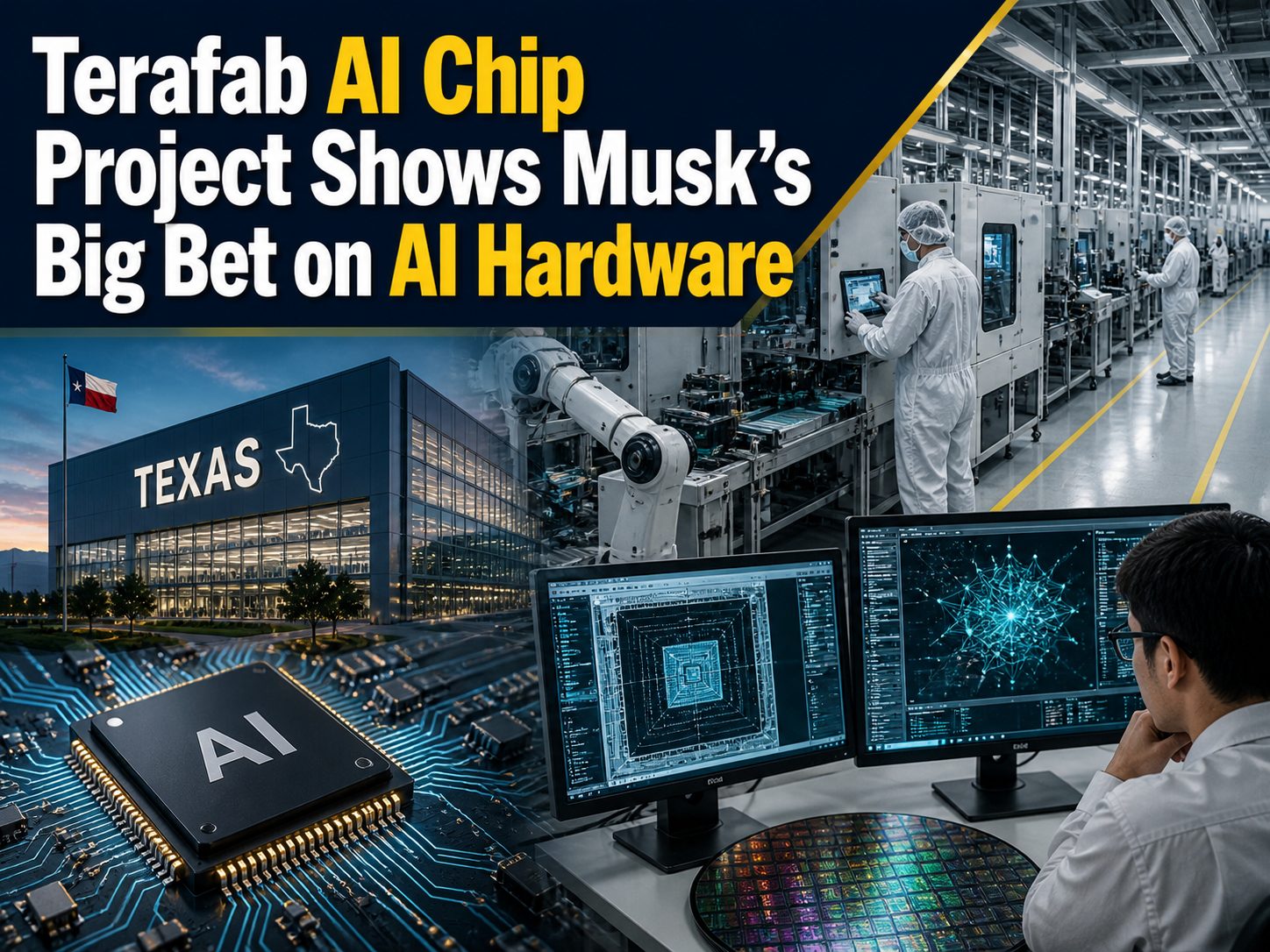
Terafab AI Chip Project Shows Musk’s Big Bet on AI Hardware
Intermediate | May 4, 2026
✨ Read the article aloud on your own or repeat each paragraph after your tutor.
Why the Terafab AI Chip Project Matters
Elon Musk has a new big idea, and this one is not a car, a rocket, or a social media platform. It is a giant AI chipmaking plan called Terafab. According to Reuters, Musk said Tesla plans to use Intel’s next-generation 14A manufacturing process to make chips for the Terafab AI chip project, an advanced artificial-intelligence chip complex planned for Texas. (Reuters)
The basic idea is simple, even if the project is wildly complex: Musk’s companies want more control over the chips they need for AI. Tesla needs chips for vehicles and Optimus humanoid robots. SpaceX and xAI may need chips for future AI data centers, including space-based systems. Musk said in March that his companies either build Terafab or they do not have enough chips. That is a bold statement, but, well, this is Elon Musk. “Bold” is usually the starting line, not the finish line. (Reuters)
Two Factories for Cars, Robots, and Space AI
The Terafab plan includes two advanced chip factories at a large facility in the Austin, Texas area. One factory would support chips for Tesla vehicles and Optimus robots. The other would focus on chips for AI data centers in space. That second part sounds like science fiction, but it fits Musk’s larger world of Tesla, SpaceX, and xAI working together around AI, robotics, and space technology. (Reuters)
In the short term, Tesla plans to build a research fab on its Giga Texas campus near Austin. Musk said this smaller research facility may cost about $3 billion and could handle a few thousand wafers per month. A wafer is a thin round slice of semiconductor material used to make chips. The goal is not mass production yet. The goal is to test ideas, learn faster, and improve chipmaking technology before trying to scale up. (Reuters)
Intel Gets a Big Opportunity
The Intel part of the story is also important. Reuters reported that using Intel’s 14A process would make Tesla Intel’s first major customer for that technology. This matters because Intel has been trying to grow its contract chipmaking business and compete more directly with TSMC, the world’s leading contract chipmaker. Intel joined the Terafab effort in April, bringing established chip manufacturing experience to the project. (Reuters, Reuters)
Musk said Intel’s 14A technology is not completely finished yet, but he expects it to be more mature by the time Terafab grows. Tom’s Hardware reported that Tesla would handle the early research fab, while SpaceX would take responsibility for the first stage of larger-scale manufacturing. That division sounds clear on paper, but cooperation between different Musk-led companies could still create difficult questions about money, control, and responsibility. (Tom’s Hardware)
The Scale Is Almost Hard to Imagine
The long-term numbers are huge. Reuters reported that Musk has said Terafab could eventually produce one terawatt of computing capacity per year. For comparison, Reuters said that is about twice the current computing capacity generated across the United States. Bernstein analysts estimated that building enough chip capacity for one terawatt of annual compute could require $5 trillion to $13 trillion in capital spending. Yes, trillion with a “t.” At that point, your calculator starts sweating. (Reuters)
There are also many unknowns. Reuters noted that Musk has not given a clear timeline for the full project. It is still unclear who will pay for the expensive equipment, who will operate the factory, and when the full facility could come online. Musk has a history of announcing very ambitious projects, and some of them have faced delays or never fully developed. So investors and industry experts may be excited, but they will also watch carefully. (Reuters)
Suppliers Are Already Part of the Conversation
A separate Reuters report, based on Bloomberg News, said Musk’s staff had already contacted chip industry suppliers such as Applied Materials, Tokyo Electron, and Lam Research. The team also reportedly asked Samsung Electronics for support. They were looking for price quotes and delivery times for tools such as photomasks, substrates, etchers, cleaning devices, testers, and other chipmaking equipment. The report said the goal was to begin silicon manufacturing by 2029 and then scale up. (Reuters)
For English learners, this story is useful because it connects technology, business strategy, and supply chains. The Terafab AI chip project is not only about chips. It is about control. Companies that depend on AI need huge amounts of computing power. If they cannot get enough chips from outside suppliers, they may try to build their own supply. That is risky, expensive, and difficult — but if it works, it could give Musk’s companies more independence in the AI race.
Vocabulary
- Semiconductor (noun) – a material used to make computer chips and electronic parts.
Example: “A semiconductor factory can produce chips for cars, phones, and AI systems.” - Fab (noun) – short for fabrication plant; a factory where computer chips are made.
Example: “Tesla plans to build a research fab in Texas.” - Manufacturing Process (noun) – the method or technology used to make a product.
Example: “Intel’s 14A manufacturing process may be used for Terafab chips.” - Wafer (noun) – a thin round slice of semiconductor material used to make chips.
Example: “The research fab may process a few thousand wafers per month.” - Scale Up (phrasal verb) – to increase production or operations to a much larger size.
Example: “The companies want to scale up chip production after the research phase.” - Capital Spending (noun) – money spent on buildings, equipment, or long-term business projects.
Example: “The full Terafab plan could require massive capital spending.” - Contract Chipmaking (noun) – making chips for another company as a manufacturing service.
Example: “Intel wants to grow its contract chipmaking business.” - Supplier (noun) – a company that provides parts, materials, or services.
Example: “Musk’s team contacted several chipmaking suppliers.” - Data Center (noun) – a building or system that stores and processes large amounts of digital information.
Example: “AI data centers need powerful chips to train and run models.” - Ambitious (adjective) – very large, difficult, or challenging, but possibly valuable.
Example: “The Terafab plan is an ambitious project.”
Discussion Questions (About the Article)
- What is the Terafab AI chip project?
- Why does Musk want more control over AI chip production?
- How could Intel benefit from working with Tesla and SpaceX?
- What is the purpose of Tesla’s smaller research fab in Texas?
- What are some major unknowns about the Terafab plan?
Discussion Questions (About the Topic)
- Why are AI chips so important for modern technology companies?
- Should large companies build their own chips, or should they buy from outside suppliers?
- What risks come with a project that may cost trillions of dollars?
- How could chip shortages affect cars, robots, and AI services?
- Do you think it is better for companies to move fast or plan carefully with projects like this?
Related Idiom
“A moonshot” – a very ambitious project that is difficult but could create huge results.
Example: “The Terafab AI chip project is a moonshot because it could change AI hardware, but it may also be extremely difficult to build.”
📢 Want more practical English through real news stories? Sign up for the All About English Mastery Newsletter here: allaboutenglishmastery.com/newsletter
Want to build stronger English in less time? Check out Mastering English for Busy Professionals.
Follow our YouTube channel @All_About_English for more English tips and practice.
This article was inspired by: Reuters, Reuters on Intel’s 14A customer news, Reuters on supplier outreach, and Tom’s Hardware


 English
  한국어
한국어