

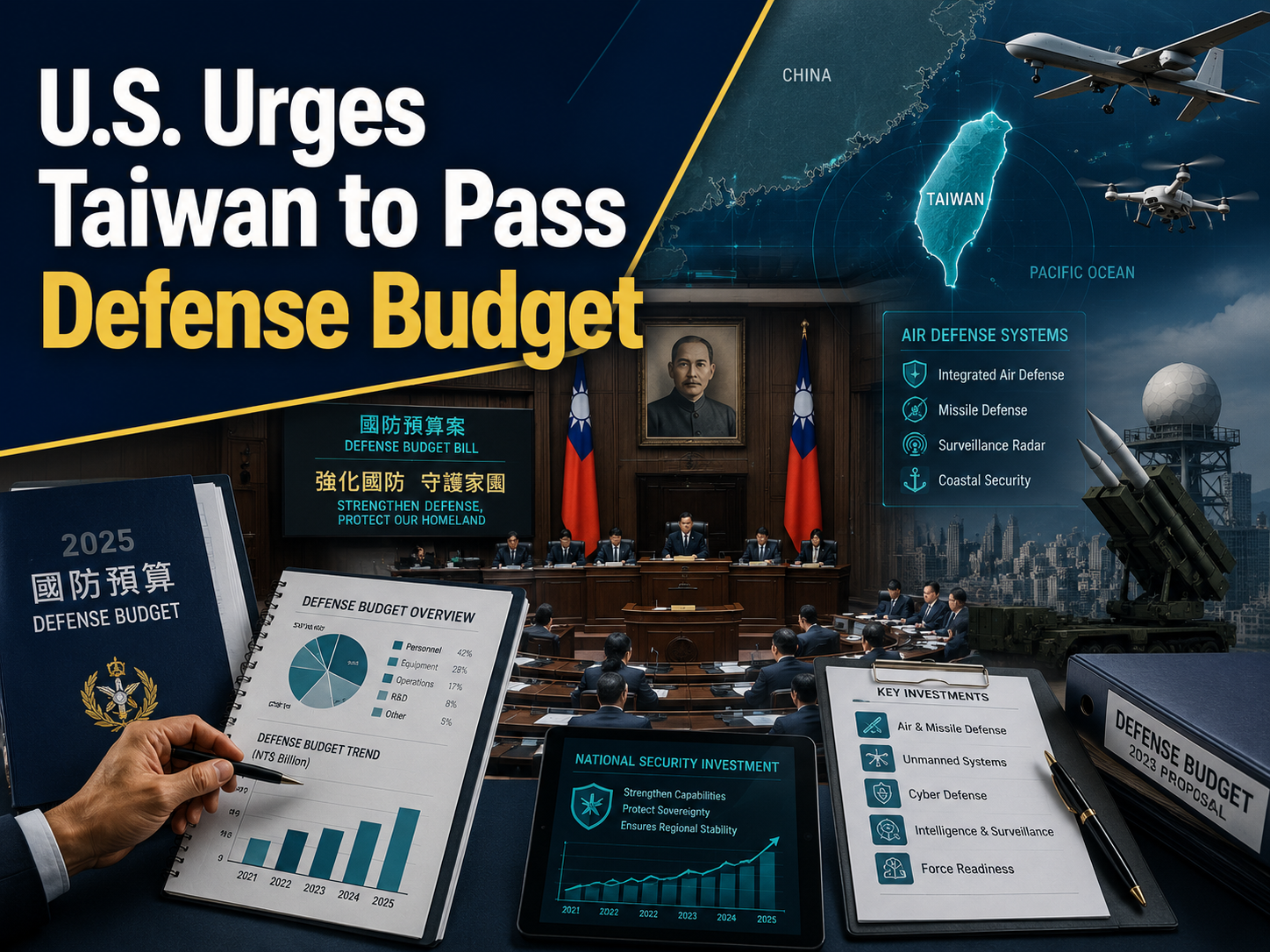
U.S. Urges Taiwan to Pass Defense Budget
Intermediate | May 6, 2026
✨ Read the article aloud on your own or repeat each paragraph after your tutor.
A Push for Taiwan Defense Budget Approval
The United States is pressing Taiwan’s parliament to move faster on a major defense spending plan. Reuters reported that Raymond Greene, the head of the American Institute in Taiwan and the top U.S. diplomat on the island, urged Taiwan’s opposition-majority parliament to pass a “comprehensive” defense budget. He said Taiwan needs important systems such as integrated air and missile defense and drones, which are in high demand around the world. (Reuters)
Why the Taiwan Defense Budget Matters
Taiwan President Lai Ching-te proposed about $40 billion in supplemental defense spending last year. The package includes new U.S. weapons and Taiwan-made weapons, including drones. The goal is to help Taiwan deter China, which claims Taiwan as its own territory. Lai has repeatedly said that only Taiwan’s people can decide the island’s future. In business-casual English, Taiwan is trying to “strengthen its position” before the situation gets worse. (Reuters)
Parliament Has Not Reached a Deal Yet
The problem is politics. Taiwan’s parliament has an opposition majority, and the main opposition party, the Kuomintang, or KMT, says it supports defense spending but does not want to sign what it calls “blank cheques.” In other words, the KMT wants more details, more accountability, and clearer spending plans before approving such a large package. The latest talks ended without an agreement, and Reuters reported that the next talks were scheduled for May 6. (Reuters)
The U.S. Worries About Long Waiting Lines
Greene warned that delays could create a practical problem. Taiwan may lose its place in the production and delivery line for U.S. weapons if the budget moves too slowly. That matters because defense systems such as drones, missiles, and air-defense equipment are already in high demand after wars in Ukraine and the Middle East. If Taiwan waits too long, it may have to wait even longer later. That is not exactly a great shopping experience — more like standing in line at Costco while everyone else is buying the same emergency supplies. (Reuters, Taipei Times)
Different Numbers Are on the Table
The size of the package is still a major issue. Reuters reported that the government’s proposal is about NT$1.25 trillion, while KMT lawmaker Hsu Chiao-hsin suggested a smaller figure of NT$800 billion, or about $25.46 billion. That is still a large amount of money, but it is much lower than the government’s request. For lawmakers, the question is not only “Should Taiwan spend more?” but also “How much, and on exactly what?” (Reuters)
A Bigger Security Picture
This debate is not happening in a quiet neighborhood. Taiwan’s Defense Minister Wellington Koo told parliament that the threat Taiwan faces is not just “random talk.” He pointed to Chinese warships spotted near the Penghu islands in the Taiwan Strait. Reuters also reported earlier in April that U.S. Senator Jim Banks told Taiwan’s leaders that passing the special defense budget would send a signal to China and the world that Taiwan is serious about “peace through strength.” (Reuters, Reuters)
What This Means for Everyday People
For English learners, this story is useful because it shows how words like budget, deterrence, accountability, and security appear in real global news. A Taiwan defense budget is not just a financial document. It is also a political signal, a military plan, and a message to allies and opponents. The big question now is whether Taiwan’s leaders can agree on the details before delays become more expensive.
Vocabulary
- Defense budget (noun) – money a government plans to spend on military and security needs.
Example: “Taiwan’s defense budget has become a major political issue.” - Comprehensive (adjective) – complete and including many parts.
Example: “The U.S. urged Taiwan to pass a comprehensive budget package.” - Supplemental (adjective) – added to something that already exists.
Example: “Lai proposed supplemental defense spending beyond the normal budget.” - Deter (verb) – to discourage someone from taking action by making the cost too high.
Example: “Taiwan wants to deter China by improving its defenses.” - Opposition (noun) – the political party or group not currently leading the government.
Example: “The opposition wants more details before approving the budget.” - Accountability (noun) – responsibility for decisions, actions, and spending.
Example: “Lawmakers asked for more accountability in the spending plan.” - Drone (noun) – an unmanned aircraft or machine that can be used for many purposes, including defense.
Example: “The package includes Taiwan-made drones.” - Air defense (noun) – systems used to protect against attacks from aircraft or missiles.
Example: “Integrated air defense systems are in high demand.” - Delivery line (noun) – the order in which products or equipment are produced and sent.
Example: “Taiwan could lose its place in the weapons delivery line.” - Signal (noun) – a message sent through words, actions, or decisions.
Example: “Passing the budget would send a signal to China and the world.”
Discussion Questions (About the Article)
- What did Raymond Greene urge Taiwan’s parliament to do?
- Why does the U.S. want Taiwan to pass a comprehensive defense budget quickly?
- Why has the KMT hesitated to approve the full spending package?
- What kinds of defense systems are included in the proposed plan?
- Why could delays hurt Taiwan’s ability to receive U.S. weapons?
Discussion Questions (About the Topic)
- Should a country spend more on defense when it faces a serious threat? Why or why not?
- How can governments balance national security with careful spending?
- Why do allies sometimes pressure each other to act faster?
- What does “peace through strength” mean to you?
- How can political disagreement help or hurt national security decisions?
Related Idiom
“Get the ball rolling” – to start making progress on a plan or project.
Example: “The U.S. wants Taiwan’s parliament to get the ball rolling on the defense budget before delays create bigger problems.”
📢 Want more practical English through real news stories? Sign up for the All About English Mastery Newsletter here: allaboutenglishmastery.com/newsletter
Want to build stronger English in less time? Check out Mastering English for Busy Professionals.
Follow our YouTube channel @All_About_English for more English tips and practice.
This article was inspired by: Reuters, Taipei Times, and AP News


 English
  한국어
한국어