

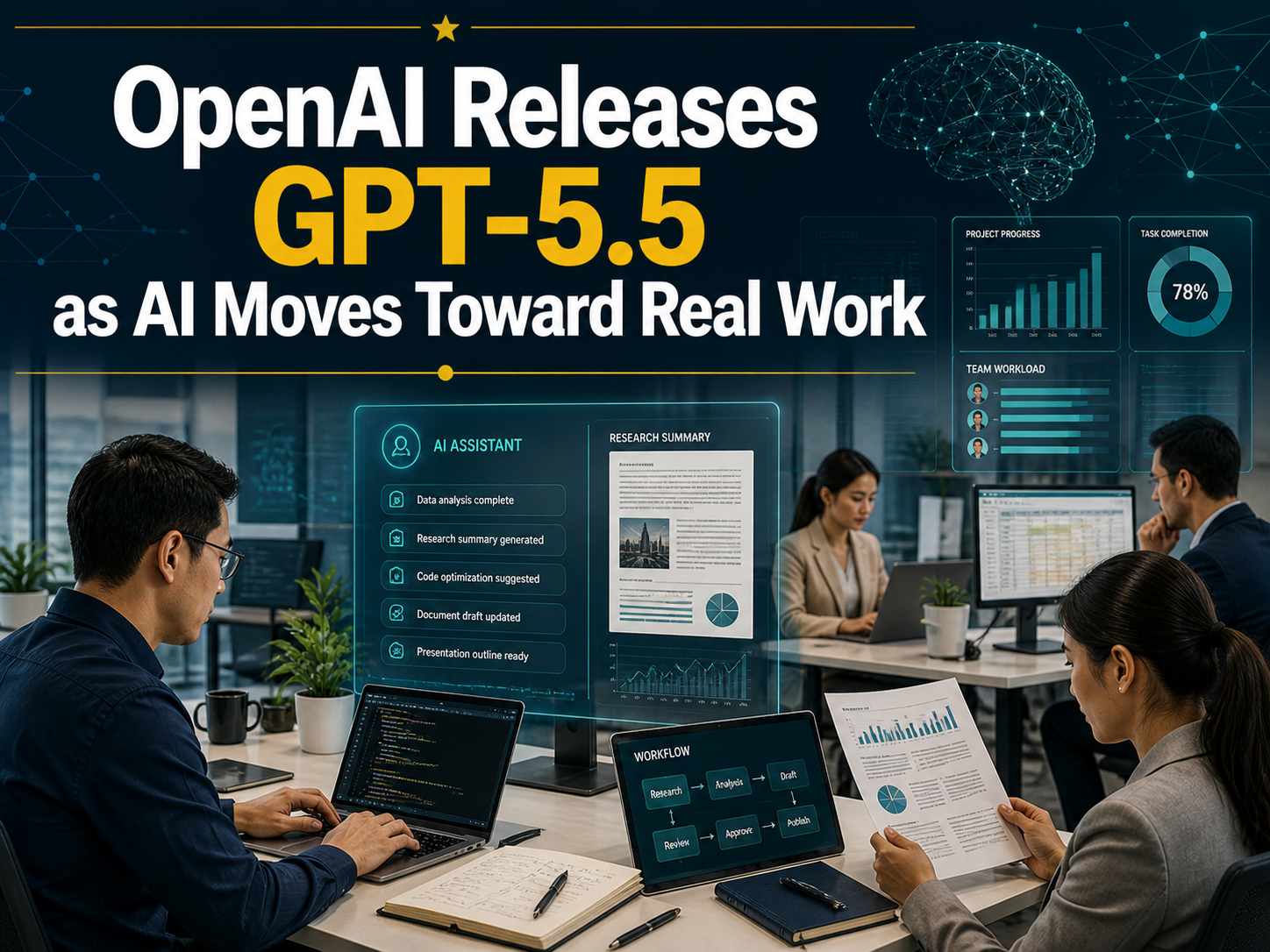
OpenAI Releases GPT-5.5 as AI Moves Toward Real Work
Advanced | May 5, 2026
✨ Read the article aloud on your own or repeat each paragraph after your tutor.
OpenAI Launches Its Newest Model
OpenAI released GPT-5.5 on April 23, 2026, calling it its “smartest and most intuitive to use model yet.” According to TechCrunch, OpenAI co-founder and president Greg Brockman said the model brings the company one step closer to building an AI “super app.” In simpler terms, OpenAI wants ChatGPT to become less like a chatbot that only answers questions and more like a digital work partner that can help complete complicated tasks across different tools.
Why the GPT-5.5 Release Matters
The GPT-5.5 release matters because OpenAI is clearly pushing AI toward more practical, work-focused uses. In its official announcement, OpenAI described GPT-5.5 as “a new class of intelligence for real work.” The company said the model is better at coding, research, information analysis, document-heavy tasks, and using tools. That matters for professionals because the goal is not just better answers. The goal is better help with real projects, messy problems, and long workflows.
A Step Toward Agentic Computing
TechCrunch reported that Brockman called GPT-5.5 a major step toward “more agentic and intuitive computing.” This phrase sounds like Silicon Valley hired a poet, a robot, and a consultant, then locked them in a conference room. But the idea is useful. “Agentic” AI means a model can plan, use tools, check its work, and keep going with less step-by-step instruction. Bloomberg reported that GPT-5.5 can help with complex tasks involving email, spreadsheets, calendars, and other applications.
Stronger Results in Coding and Professional Work
OpenAI says GPT-5.5 improved on several professional benchmarks. In coding, the company reported that GPT-5.5 scored 82.7% on Terminal-Bench 2.0, compared with 75.1% for GPT-5.4. For professional work, OpenAI reported 84.9% on GDPval, a benchmark that tests knowledge work across many occupations. The model also scored 78.7% on OSWorld-Verified, which measures whether an AI can operate real computer environments. Those numbers do not mean the model is perfect, but they suggest that OpenAI wants GPT-5.5 to handle more serious workplace tasks.
Scientific Research Gets Attention Too
The GPT-5.5 release also focuses heavily on scientific and technical research. OpenAI said GPT-5.5 improved on GeneBench, a benchmark for genetics and quantitative biology, and performed strongly on BixBench, which tests real-world bioinformatics and data analysis. OpenAI also said an internal version of GPT-5.5 helped discover a new mathematical proof about Ramsey numbers, later verified in Lean. For English learners, this is a good example of how AI stories often mix technology, business, science, and big promises in one package.
Availability, Pricing, and Safety Questions
OpenAI said GPT-5.5 is rolling out to Plus, Pro, Business, and Enterprise users in ChatGPT and Codex, while GPT-5.5 Pro is available to Pro, Business, and Enterprise users. The OpenAI API documentation lists GPT-5.5 as a frontier model for complex professional work with a 1,050,000-token context window and API pricing of $5 per 1 million input tokens and $30 per 1 million output tokens. OpenAI also said it treats GPT-5.5’s biological/chemical and cybersecurity capabilities as High under its Preparedness Framework, which means the company sees serious safety questions alongside the business opportunity.
What Happens Next
The GPT-5.5 release shows where the AI race is going: more tools, more autonomy, more workplace integration, and more pressure on businesses to adapt. For professionals, this could mean faster coding, better research support, smarter document analysis, and more automated workflows. But it also means workers need stronger judgment, better prompts, and clearer communication skills. AI may do more of the heavy lifting, but humans still need to decide what work matters and whether the output is actually useful.
Vocabulary
- Intuitive (adjective) – easy to understand or use without much explanation.
Example: “OpenAI says GPT-5.5 is more intuitive than earlier models.” - Super App (noun phrase) – an app that combines many tools or services in one place.
Example: “OpenAI wants ChatGPT to move closer to becoming an AI super app.” - Agentic (adjective) – able to act with more independence, planning, and tool use.
Example: “Agentic AI can complete tasks with less step-by-step instruction.” - Workflow (noun) – the series of steps used to complete a task or project.
Example: “GPT-5.5 may help professionals manage longer workflows.” - Benchmark (noun) – a test used to compare performance.
Example: “OpenAI reported stronger benchmark scores for GPT-5.5.” - Frontier Model (noun phrase) – a highly advanced AI model near the leading edge of the field.
Example: “OpenAI describes GPT-5.5 as a frontier model for professional work.” - Context Window (noun phrase) – the amount of information an AI model can consider at one time.
Example: “GPT-5.5 has a very large context window for long documents and complex tasks.” - Autonomy (noun) – the ability to act independently.
Example: “The new model shows more autonomy when handling work tasks.” - Heavy Lifting (idiom) – the difficult or demanding part of a task.
Example: “AI can help with the heavy lifting, but humans still need judgment.” - Preparedness Framework (noun phrase) – a safety system for evaluating advanced AI risks.
Example: “OpenAI used its Preparedness Framework to assess GPT-5.5 risks.”
Discussion Questions (About the Article)
- When did OpenAI release GPT-5.5?
- What does OpenAI mean by calling GPT-5.5 useful for “real work”?
- Why is “agentic computing” important for the future of AI?
- What benchmark results did OpenAI highlight?
- What safety concerns did OpenAI mention about GPT-5.5?
Discussion Questions (About the Topic)
- How could AI tools change the way professionals work?
- What kinds of tasks should people still do themselves instead of using AI?
- Should companies use AI more quickly or more carefully? Why?
- How can workers prepare for more powerful AI tools?
- What communication skills become more important when working with AI?
Related Idiom
“Do the heavy lifting” – to do the hardest or most demanding part of a job.
Example: “GPT-5.5 may do more of the heavy lifting in research and coding, but people still need to guide the work.”
📢 Want more practical English through real news stories? Sign up for the All About English Mastery Newsletter here: allaboutenglishmastery.com/newsletter
Want to build stronger English in less time? Check out Mastering English for Busy Professionals.
Follow our YouTube channel @All_About_English for more English tips and practice.
This article was inspired by: TechCrunch, OpenAI, OpenAI API Docs, OpenAI System Card, and Bloomberg


 English
  한국어
한국어