

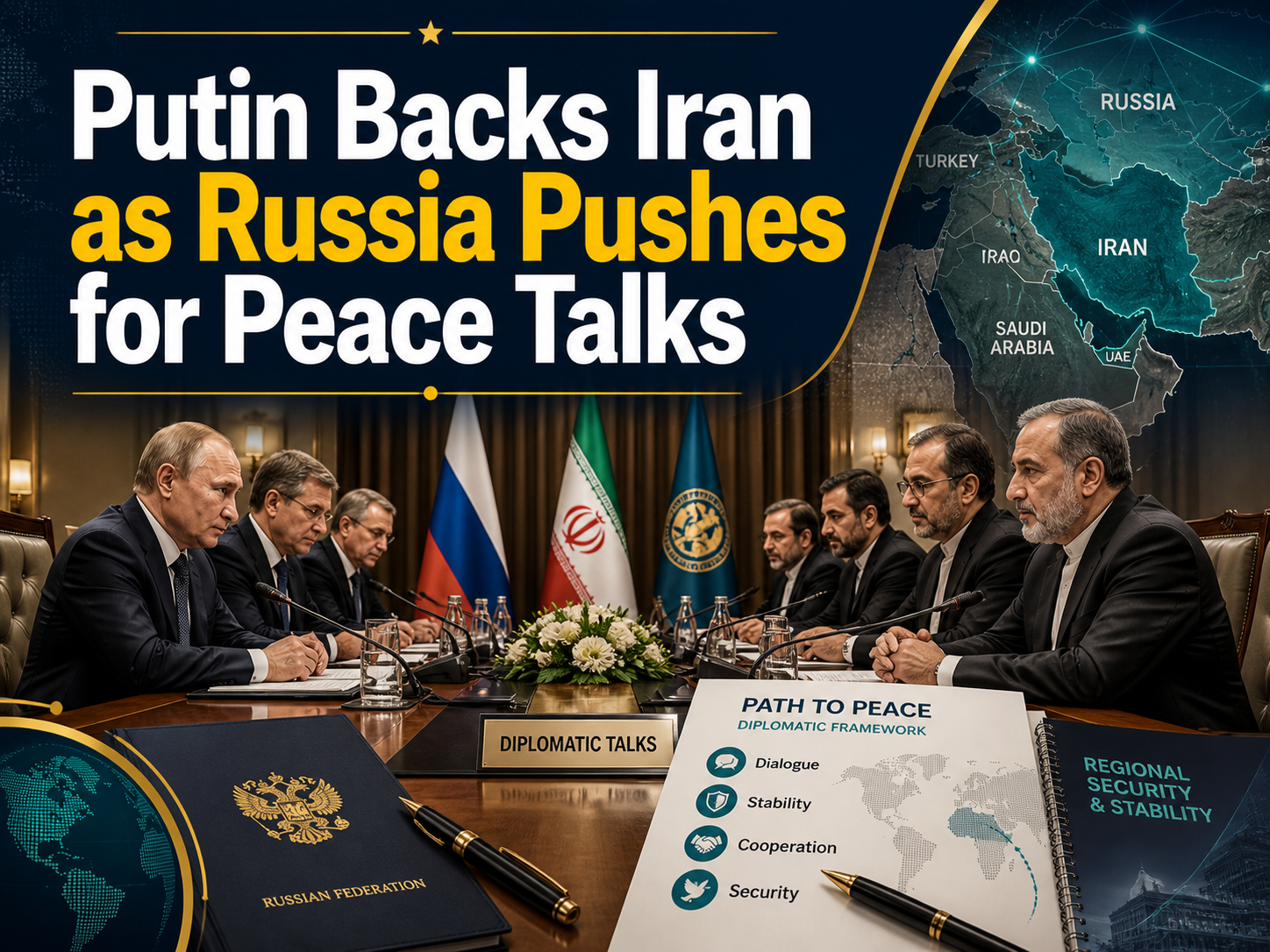
Putin Backs Iran as Russia Pushes for Peace Talks
Advanced | May 5, 2026
✨ Read the article aloud on your own or repeat each paragraph after your tutor.
A High-Level Meeting in St. Petersburg
Russian President Vladimir Putin met with Iranian Foreign Minister Abbas Araqchi in St. Petersburg on April 27, 2026, during a tense moment in the Middle East. According to Reuters, Putin praised the Iranian people for resisting U.S. and Israeli pressure and said Russia would do what it could to help Tehran. The meeting gave Moscow a chance to show support for Iran while also presenting itself as a possible peacemaker.
Why the Russia Iran Support Story Matters
The Russia Iran support story matters because it shows how alliances can shape a crisis. Russia has condemned recent U.S. and Israeli strikes on Iran and has offered to mediate in hopes of calming the region. Putin told Araqchi that Russia would do what served Iran’s interests and the interests of people across the region so peace could come as quickly as possible. That is a strong diplomatic message, but it also sends a signal to Washington, Jerusalem, and other capitals watching the conflict closely.
Moscow Offers Mediation and a Nuclear Proposal
Reuters reported that Russia has repeatedly offered to store Iran’s enriched uranium as one way to reduce tensions, but the United States has not accepted that proposal. This detail is important because uranium enrichment sits at the center of many arguments about Iran’s nuclear program. In business English, we might say Russia is trying to put an option on the table. Whether that option is practical or political, it gives Moscow a larger role in the conversation.
A Strategic Partnership Behind the Meeting
This meeting did not happen in a vacuum. Iran and Russia sealed a 20-year strategic partnership agreement last year. Reuters also reported that Russia is building two new nuclear units at Bushehr, the site of Iran’s only nuclear power plant. At the same time, Iran has supplied Russia with Shahed drones for use in Ukraine, and Moscow has since localized production. These details show that the two countries are not just talking politely. They have built a deeper political, military, and energy relationship.
Araqchi Thanks Russia for Standing With Iran
Araqchi thanked Putin for Moscow’s support and said Iran had friends and allies, including Russia, who stood by the country during difficult times. According to The Business Standard, Araqchi said relations between Russia and Iran would continue to strengthen. For English learners, this is a useful example of diplomatic language. Leaders often use words like “support,” “partnership,” and “stability” to express political alignment without promising every specific action.
Russia Wants Talks, Not More Strikes
Kremlin spokesman Dmitry Peskov said Moscow wanted the United States and Iran to continue negotiations and warned against returning to military action. Reuters reported that Peskov said renewed military action was not in anyone’s interests. That message lets Russia appear responsible and diplomatic, even while it remains clearly aligned with Iran. In geopolitics, countries often try to support an ally while also looking like the adult in the room. Fancy trick, isn’t it?
What Happens Next
The Russia Iran support issue will likely remain important as the Middle East crisis continues. Russia wants to keep its strategic partnership with Iran strong, but it also wants a seat at the negotiating table. Iran wants support from powerful allies while facing U.S. and Israeli pressure. The United States, meanwhile, has not accepted Russia’s uranium-storage proposal. For now, Putin’s meeting with Araqchi shows that Moscow wants influence, Tehran wants backing, and everyone claims they want peace.
Vocabulary
- Pledge (verb) – to promise or strongly commit to something.
Example: “Putin pledged support for Iran during the meeting.” - Mediation (noun) – the act of helping two sides talk and reach an agreement.
Example: “Russia offered mediation to reduce tensions in the region.” - Strategic Partnership (noun phrase) – a long-term relationship between countries based on shared interests.
Example: “Russia and Iran have a 20-year strategic partnership.” - Enriched Uranium (noun phrase) – uranium processed for use in nuclear energy or weapons programs.
Example: “Russia offered to store Iran’s enriched uranium.” - Condemn (verb) – to strongly criticize something.
Example: “Moscow condemned the U.S. and Israeli strikes.” - Diplomatic Message (noun phrase) – a carefully worded public statement between governments.
Example: “Putin’s comments sent a diplomatic message to other countries.” - Alignment (noun) – agreement or cooperation between people, groups, or countries.
Example: “The meeting showed political alignment between Russia and Iran.” - Put an Option on the Table (phrase) – to suggest an idea for discussion.
Example: “Russia put an option on the table by offering to store uranium.” - In a Vacuum (phrase) – without connection to other events or facts.
Example: “The meeting did not happen in a vacuum because Russia and Iran already had strong ties.” - A Seat at the Table (idiom) – a position where someone can take part in important decisions.
Example: “Russia wants a seat at the table in Middle East peace talks.”
Discussion Questions (About the Article)
- Where did Putin meet Iranian Foreign Minister Abbas Araqchi?
- What did Putin say about the Iranian people?
- What mediation role has Russia offered to play?
- Why is the uranium-storage proposal important?
- What does the 20-year partnership show about Russia and Iran’s relationship?
Discussion Questions (About the Topic)
- Why do countries offer to mediate during international conflicts?
- Can a country support one side and still act as a neutral peacemaker?
- How do strategic partnerships affect global politics?
- Why do nuclear issues create so much international tension?
- What makes diplomatic language different from everyday speech?
Related Idiom
“A seat at the table” – a chance to participate in important decisions.
Example: “By offering to mediate, Russia is trying to secure a seat at the table in Middle East diplomacy.”
📢 Want more practical English through real news stories? Sign up for the All About English Mastery Newsletter here: allaboutenglishmastery.com/newsletter
Want to build stronger English in less time? Check out Mastering English for Busy Professionals.
Follow our YouTube channel @All_About_English for more English tips and practice.
This article was inspired by: Reuters, The Business Standard, and Al-Monitor


 English
  한국어
한국어