

Artemis II Astronauts Return Safely After Historic Moon Mission
Advanced | April 15, 2026
✨ Read the article aloud on your own or repeat each paragraph after your tutor.
Artemis II Astronauts Return After a History-Making Journey
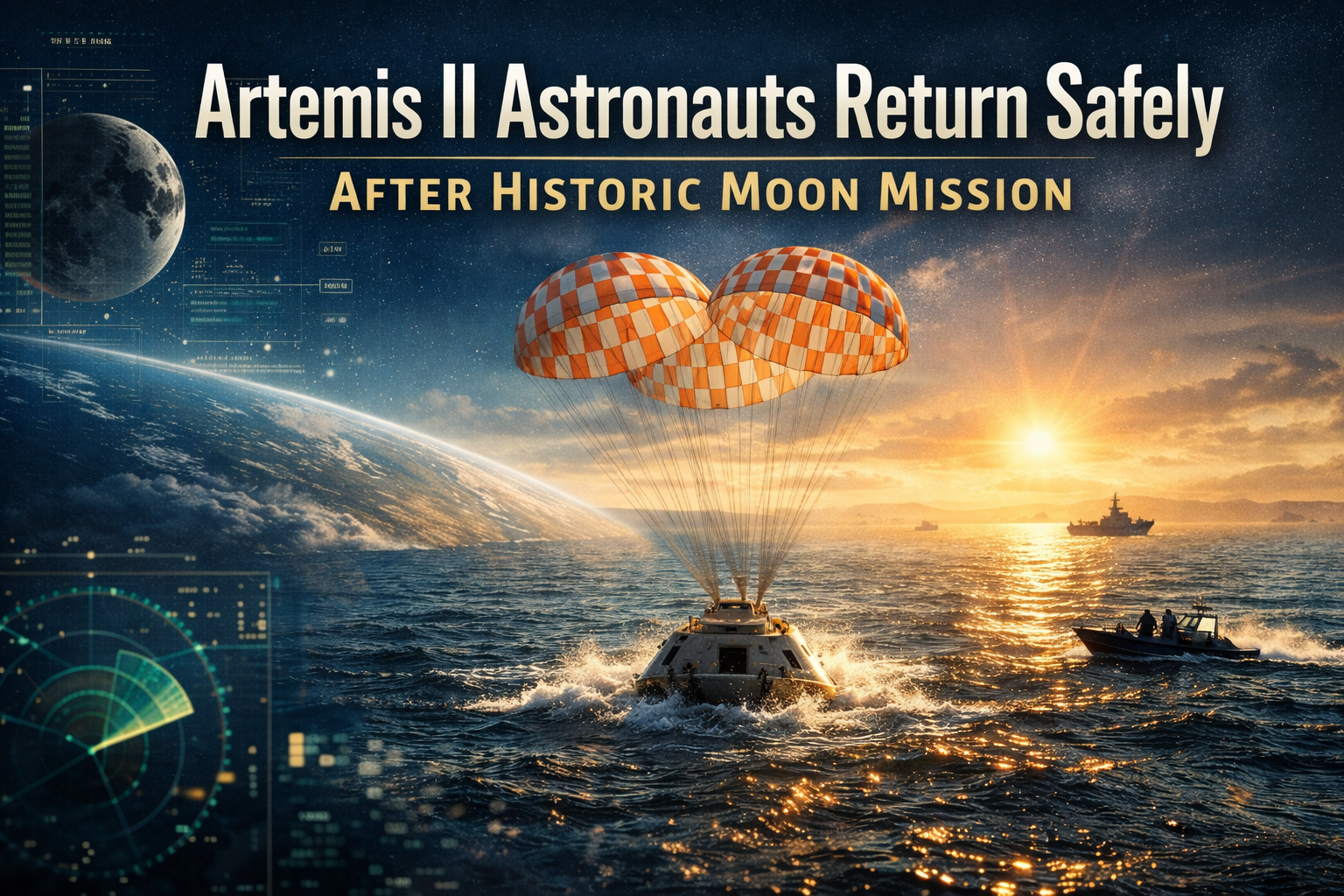
The Artemis II astronauts return story gave the world a rare piece of good news. On April 10, 2026, NASA’s Orion capsule, Integrity, safely splashed down in the Pacific Ocean off the coast of San Diego at 5:07 p.m. Pacific Time, bringing four astronauts home after nearly 10 days in space. The crew included Reid Wiseman, Victor Glover, Christina Koch, and Jeremy Hansen of Canada. Their mission marked the first human trip to the moon’s vicinity in more than half a century. (Reuters) (NASA)
Why This Mission Was Such a Big Deal
This was not a moon landing, but it was still a huge milestone. Reuters reported that the crew flew as far as 252,756 miles from Earth, farther than any humans had ever traveled before. NASA said the mission covered nearly 10 days and proved that Orion could safely take astronauts into deep space and bring them back home. In plain English, this was a major test flight, and NASA needed it to work before trying something even more ambitious later. (Reuters) (NASA)
A Fast and Risky Trip Back to Earth
The trip home was no casual commute. Reuters reported that Orion hit Earth’s atmosphere at about 32 times the speed of sound, while NASA said the spacecraft re-entered with a planned communications blackout as superheated plasma built up around the capsule. For a few minutes, mission control had to wait it out and trust the engineering. Then communications returned, the parachutes opened, and the capsule came down smoothly. NASA officials described the landing as a textbook success, and Reuters quoted a NASA commentator calling it a “perfect bull’s eye splashdown.” (Reuters) (NASA)
Records, Firsts, and Unforgettable Views
The mission checked a lot of boxes. AP News reported that the crew saw never-before-glimpsed views of the moon’s far side, watched a total solar eclipse from space, and set a new distance record for humanity. The flight also carried symbolic weight. Christina Koch became the first woman to travel that far from Earth, Victor Glover became the first Black astronaut to do so, and Jeremy Hansen became the first Canadian on a lunar mission. That gave the mission a strong sense of history, but also a sense that space exploration is entering a new chapter. (AP News) (AP News)
What Comes Next for NASA
Now that the Artemis II astronauts return safely, the obvious question is: what comes next? AP reported that NASA is already looking toward Artemis III, which is expected to test docking with lunar landers in orbit around Earth before later missions aim for a landing near the moon’s south pole. In other words, Artemis II was not the finish line. It was a proof-of-concept mission, a confidence builder, and a very expensive way of saying, “So far, so good.” (AP News)
More Than a Technical Win
Part of the reason this mission connected with so many people is that it was not just about hardware. The astronauts spoke about wonder, perspective, and seeing Earth from deep space. AP described the mood around the homecoming as joyful and peaceful, while NASA highlighted the mission as a key step toward a long-term return to the moon and eventually missions to Mars. That mix of technical success and human emotion gave the story real staying power. It reminded people that exploration is still one of the few things that can make the whole world look up at the same time. (AP News) (NASA)
Vocabulary
- Splashdown (noun) – a landing in the ocean by a spacecraft.
Example: The Orion capsule made a safe splashdown in the Pacific Ocean. - Vicinity (noun) – the area near a particular place.
Example: Artemis II was the first human trip to the moon’s vicinity in over 50 years. - Milestone (noun) – an important stage or achievement.
Example: The mission was a major milestone for NASA’s moon program. - Re-entry (noun) – the return of a spacecraft into Earth’s atmosphere.
Example: Re-entry was one of the riskiest parts of the mission. - Trajectory (noun) – the path an object follows through space or the air.
Example: Orion followed a lunar-return trajectory back to Earth. - Blackout (noun) – a temporary loss of communication or power.
Example: The spacecraft experienced a planned communications blackout during re-entry. - Textbook (adjective) – done exactly as planned or in the ideal way.
Example: NASA called the landing a textbook success. - Far side (noun) – the side of the moon that does not normally face Earth.
Example: The astronauts captured rare views of the moon’s far side. - Docking (noun) – the process of connecting two spacecraft in space.
Example: Future Artemis missions will practice docking with lunar landers. - Proof of concept (noun phrase) – a test that shows an idea or plan can work.
Example: Artemis II was a proof of concept for deeper lunar missions.
Discussion Questions (About the Article)
- Why was the safe splashdown such an important moment for NASA?
- What made Artemis II different from earlier moon missions?
- Why was the re-entry phase considered so risky?
- Which records or “firsts” made this mission especially historic?
- How does Artemis II prepare NASA for future missions?
Discussion Questions (About the Topic)
- Why do space missions still capture public attention so strongly?
- Do you think governments should continue spending heavily on space exploration? Why or why not?
- What are the benefits of international cooperation in space missions?
- How can major scientific missions inspire students and younger generations?
- What do you think matters more in space exploration: scientific progress, national prestige, or human inspiration?
Related Idiom
“Stick the landing”
This phrase means to finish something difficult successfully, especially at the final moment.
Example: NASA really stuck the landing with Artemis II after such a high-pressure return to Earth.
📢 Want more useful English practice with real-world science and global news? Sign up for the All About English Mastery Newsletter! Click here to join us.
Want to finally Master English but don’t have the time? Mastering English for Busy Professionals is built for busy learners. Check it out now.
Follow our YouTube Channel @All_About_English for more English tips and real-world practice.
This article was inspired by: Reuters, AP News, AP News, NASA, and NASA.


 English
  한국어
한국어