

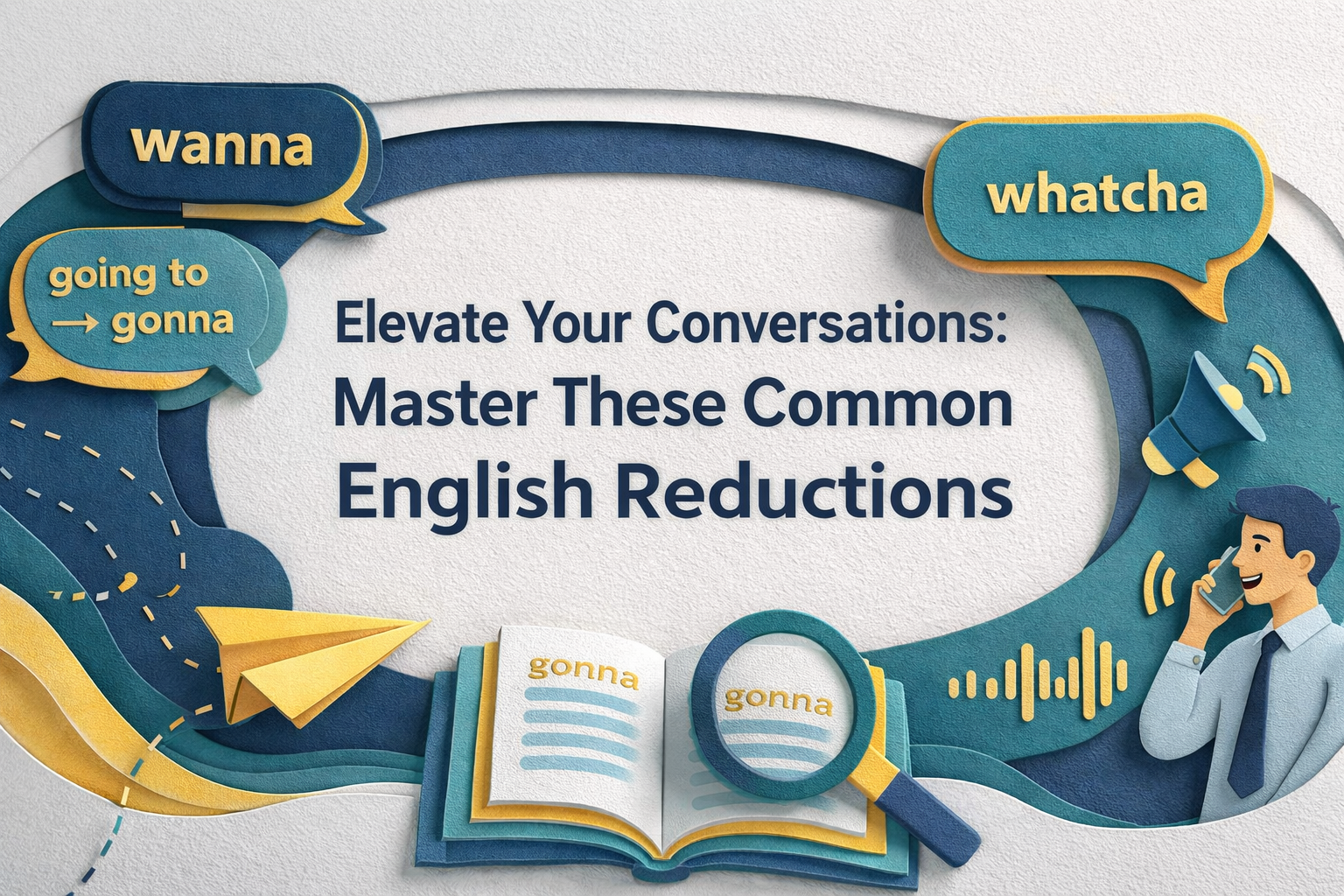
Elevate Your Conversations: Master These Common English Reductions 🎧
Beginner Level | February 13, 2026
Read the article aloud on your own or repeat each paragraph after your tutor.
If you’ve ever listened to a native English speaker and thought, “Wait… did they skip half the words?” you’re not crazy. In real conversation—especially at work—English gets compressed. We blend sounds, drop letters, and connect words to speak faster and smoother.
These changes are called English reductions—and today we’ll focus on common English reductions you’ll hear (and use) at work. The good news? You don’t need advanced grammar to use them. You just need to recognize a few common patterns—and practice them out loud.
What Are Common English Reductions?
An English reduction happens when we say words in a shorter, faster way. This isn’t “lazy English.” It’s normal spoken English. Reductions help conversations sound natural, friendly, and confident—especially in quick moments like small talk, meetings, or phone calls.
Reduction 1: “Gonna / Wanna / Kinda”
These are super common in casual workplace conversation.
- going to → gonna (“I’m gonna send it today.”)
- want to → wanna (“Do you wanna join the call?”)
- kind of → kinda (“I’m kinda busy right now.”)
Use these in friendly situations. In a very formal presentation, you might say the full version—but in daily conversation, these sound natural.
Reduction 2: “Did you / Do you” → “Didja / D’ya”
When words collide, sounds merge.
- Did you → Didja (“Didja get my email?”)
- Do you → D’ya (“D’ya have a minute?”)
This is why listening can feel hard: you’re waiting to hear “did” and “you” separately, but they arrive as one sound.
Reduction 3: “Want to / Have to / Got to” → “Wanna / Havta / Gotta”
These reductions show up constantly in fast speech.
- have to → havta (“I havta finish this today.”)
- got to → gotta (“I gotta run to another meeting.”)
If you learn just these three, your listening will improve fast.
Reduction 4: “And” becomes “’n”
In natural speech, and often becomes a quick ’n.
- “sales and marketing” → “sales ’n marketing”
- “I’ll call you and update you” → “I’ll call you ’n update you”
It’s a tiny change, but it makes your English sound smoother.
How to Practice (Without Making It Weird)
Here’s a simple routine you can do in 3 minutes:
- Read one sentence slowly.
- Read it again naturally, connecting words.
- Record yourself once.
- Listen back and notice: Did you reduce anything? Did it sound smooth?
Start small. The goal isn’t to sound like a movie actor. The goal is to sound clear, relaxed, and natural—like someone who belongs in the room.
Vocabulary List
- reduction (noun) — A shorter way of pronouncing words in fast, natural speech.
Example: “Gonna” is a common reduction of “going to.” - blend (verb) — To mix sounds together so they feel like one.
Example: Native speakers blend words when they talk quickly. - connect (verb) — To link sounds between words.
Example: Try to connect “did you” so it sounds like “didja.” - casual (adjective) — Relaxed and not formal.
Example: “Wanna” sounds casual, so use it in friendly situations. - formal (adjective) — More serious and professional.
Example: In a formal presentation, you may choose the full pronunciation. - pattern (noun) — A repeated way something happens.
Example: Reductions follow patterns you can learn and practice. - natural (adjective) — Sounding normal and smooth, like real conversation.
Example: Reductions can make your English sound more natural. - rhythm (noun) — The beat and flow of speech.
Example: English rhythm improves when you reduce and connect words. - confident (adjective) — Feeling sure and comfortable.
Example: You’ll sound more confident when your speech flows smoothly. - practice (noun) — Repeating something to improve.
Example: A few minutes of daily practice can change your speaking fast.
5 Questions About the Article
- What is an English reduction?
- Why do reductions make listening difficult for learners?
- What are three common reductions from the article?
- In what situations should you avoid reductions?
- What is the 3-minute practice routine suggested in the article?
5 Open-Ended Discussion Questions
- When do you notice reductions the most: meetings, movies, or casual chats? Why?
- Which reduction feels easiest for you to use right away?
- What situations at work make you speak faster—or more carefully?
- How could reductions help you feel more included in English conversations?
- If you record yourself speaking, what do you want to improve first: speed, clarity, or confidence?
📢 Want more practical English like this? 👉 Sign up for the All About English Mastery Newsletter! Click here to join us!
Want to finally Master English but don’t have the time? Mastering English for Busy Professionals is the course for you! Check it out now!
Follow our YouTube Channel @All_About_English for more great insights and tips
 English
  한국어
한국어