

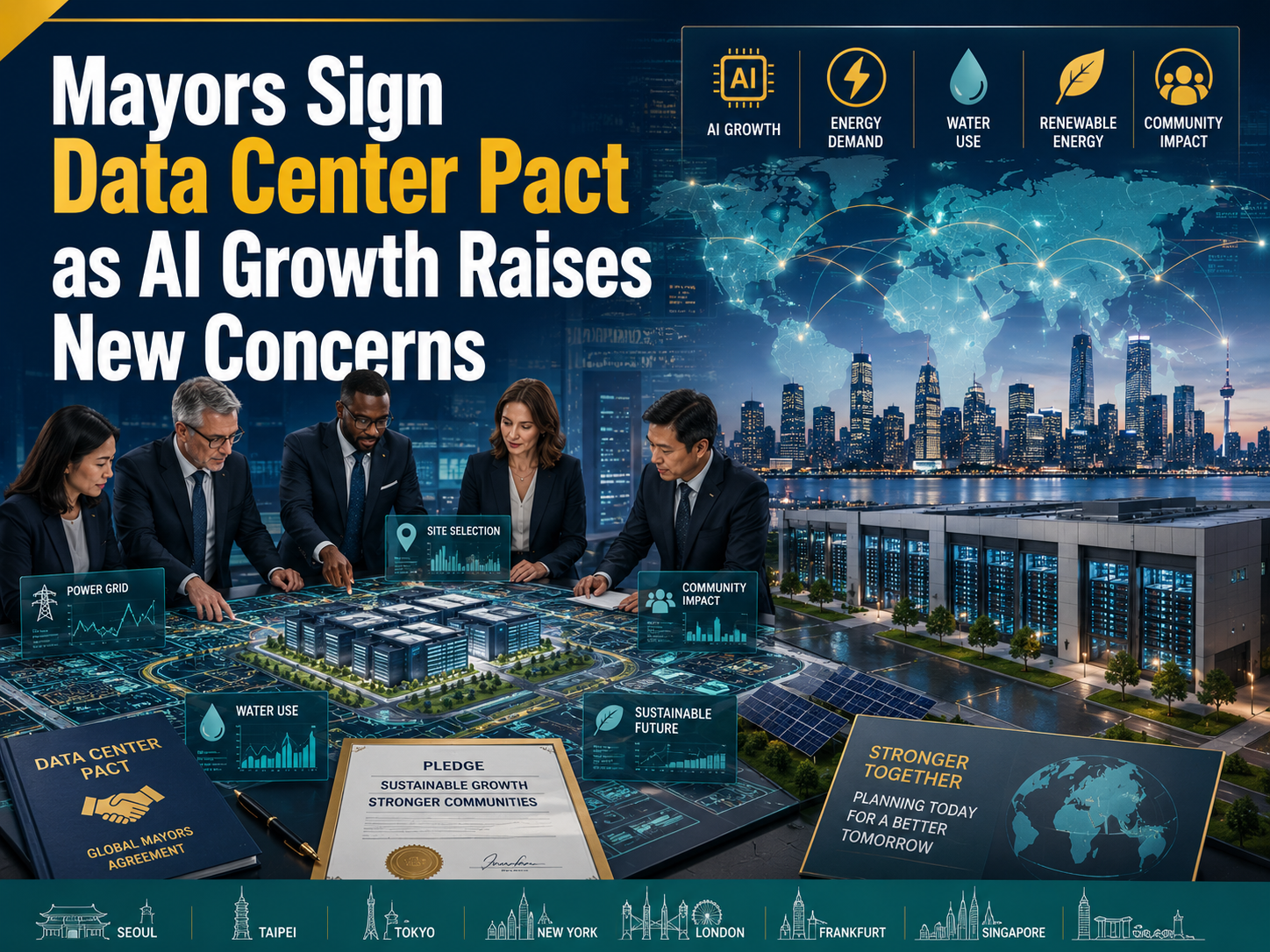
Mayors Sign Data Center Pact as AI Growth Raises New Concerns
Intermediate | June 30, 2026
✨ Read the article aloud on your own or repeat each paragraph after your tutor.
Mayors Join a Global Data Center Pact
A group of mayors from around the world has joined a new data center pact to shape how cities handle the rapid growth of digital infrastructure. According to AP News, forty mayors signed onto the agreement, which aims to influence how urban data centers are built and operated.
The pact comes as artificial intelligence, cloud computing, and digital services create huge demand for more data centers. These buildings store computer systems, process information, and help power the apps and online services people use every day. In short, they are the behind-the-scenes engine room of the digital economy.
Why the Data Center Pact Matters
The new data center pact focuses on a basic business problem: cities want the benefits of digital growth, but they do not want the costs to fall unfairly on local residents. Data centers can bring investment and jobs, but they also use large amounts of electricity, water, and land.
C40 Cities launched the Global Urban Data Centres Pact during London Climate Action Week. The group said the pact does not reject data centers. Instead, it asks companies and governments to build them in ways that protect communities, manage energy use, and support local development.
Cities Want More Control Over Growth
Many cities feel pressure because data centers are growing quickly, especially as AI tools become more common. AP reported that about 1,700 data centers already operate inside C40’s network of cities, and data center development could grow by more than 40% in 50 of those cities.
Mayors from places like Phoenix and Melbourne helped push the issue forward. They worried that data centers could compete with residents and businesses for electricity, water, and available land. That is where the local politics get spicy — because everyone loves “innovation” until the power bill starts doing push-ups.
The Pact Focuses on Energy, Water, Land, and Communities
The pact calls for data centers to fit better into city planning. According to C40’s official pact page, the agreement focuses on four big ideas: strategic city planning, better resource efficiency, community engagement, and shared prosperity.
AP reported that mayors want data centers built on abandoned or underused land when possible. They also want developers to reduce noise, heat, air pollution, water use, and emissions. The pact also encourages renewable energy, battery storage, waste heat reuse, local jobs, local purchasing, and community feedback.
Phoenix and Melbourne Show the Challenge
Phoenix gives one clear example of the pressure. AP reported that the Phoenix metropolitan area has pending data center permit requests that could double electricity demand if all projects move forward. Phoenix Mayor Kate Gallego said the city understands the importance of digital innovation, but wants to “get it right” for local residents.
Melbourne shows another side of the issue. Reuters reported that data centers could account for around 10% of Melbourne’s local power demand by 2030 and as much as 20% by 2040. Melbourne’s Lord Mayor Nicholas Reece also said planned data centers could use about 20 billion liters of water per year, equal to roughly 4% of the city’s drinking water supply.
Southeast Asia Is Still a Big Question
The pact also matters for Asia. AP reported that no Southeast Asian cities had endorsed the pact as of the announcement, even though the region wants to become a major data center hub. Some cities said national policies or other complications made it difficult to join.
This is important because Southeast Asia’s data center demand continues to rise. AP cited the think tank Ember, which said Indonesia, Malaysia, Singapore, Thailand, Vietnam, and the Philippines together have more than 2,000 data centers. AP also reported that the International Energy Agency expects the annual energy demand from these data centers to more than double in the next five years.
What This Means for English Learners
This story is useful for English learners because it connects business, technology, city planning, and public policy. You will often hear words like infrastructure, demand, regulation, sustainability, investment, and community impact in business news and workplace discussions.
The big takeaway is simple: mayors are not trying to stop the digital economy. They are trying to shape it. The data center pact shows that cities want growth, but they also want companies to pay attention to electricity, water, land, costs, and local residents. In business English, this is a great example of “balancing growth with responsibility.”
Vocabulary
- Data center (noun) – a building that holds computer systems and stores or processes digital information.
Example: “The city is reviewing plans for a new data center.” - Pact (noun) – an agreement between people, groups, or governments.
Example: “The mayors signed a pact to guide data center growth.” - Infrastructure (noun) – the basic systems a place needs to operate, such as power, roads, water, and internet.
Example: “Data centers put pressure on city infrastructure.” - Digital economy (noun) – economic activity connected to online services, data, software, and technology.
Example: “AI is becoming a major part of the digital economy.” - Electricity demand (noun) – the amount of electricity people or businesses need.
Example: “New data centers could increase electricity demand.” - Resource efficiency (noun) – using energy, water, land, or materials carefully without wasting them.
Example: “The pact encourages better resource efficiency.” - Urban planning (noun) – the process of deciding how land, buildings, roads, and services should develop in a city.
Example: “Data centers need to fit into urban planning.” - Community engagement (noun) – the process of listening to and involving local people in decisions.
Example: “The mayors want stronger community engagement.” - Permit (noun) – official permission to build or do something.
Example: “The company applied for a permit to build a new data center.” - Shared prosperity (noun) – growth that benefits many people, not just a few companies or investors.
Example: “The pact says data centers should support shared prosperity.”
Discussion Questions About the Article
- What is the main goal of the new data center pact?
- Why are cities worried about rapid data center growth?
- What problems did mayors in Phoenix and Melbourne raise?
- What standards does the pact encourage for future data centers?
- Why is Southeast Asia important in this story?
Discussion Questions About the Topic
- Should cities have more control over where data centers are built?
- How can data centers help a local economy?
- What problems can happen if data centers use too much electricity or water?
- Should tech companies pay for infrastructure upgrades when they build large data centers?
- How can cities support AI growth without hurting local residents?
Related Idiom
“Get ahead of the problem” – to act early before a problem becomes worse.
Example: “The mayors created the data center pact to get ahead of the problem before cities face bigger pressure on power and water.”
📢 Want more practical English through real news stories? Sign up for the All About English Mastery Newsletter here: allaboutenglishmastery.com/newsletter
Want to build stronger English in less time? Check out Mastering English for Busy Professionals.
Follow our YouTube channel @All_About_English for more English tips and practice.
This article was inspired by: AP News, C40 Cities, The Global Urban Data Centres Pact, Reuters, and Climate Mayors.


 English
  한국어
한국어