

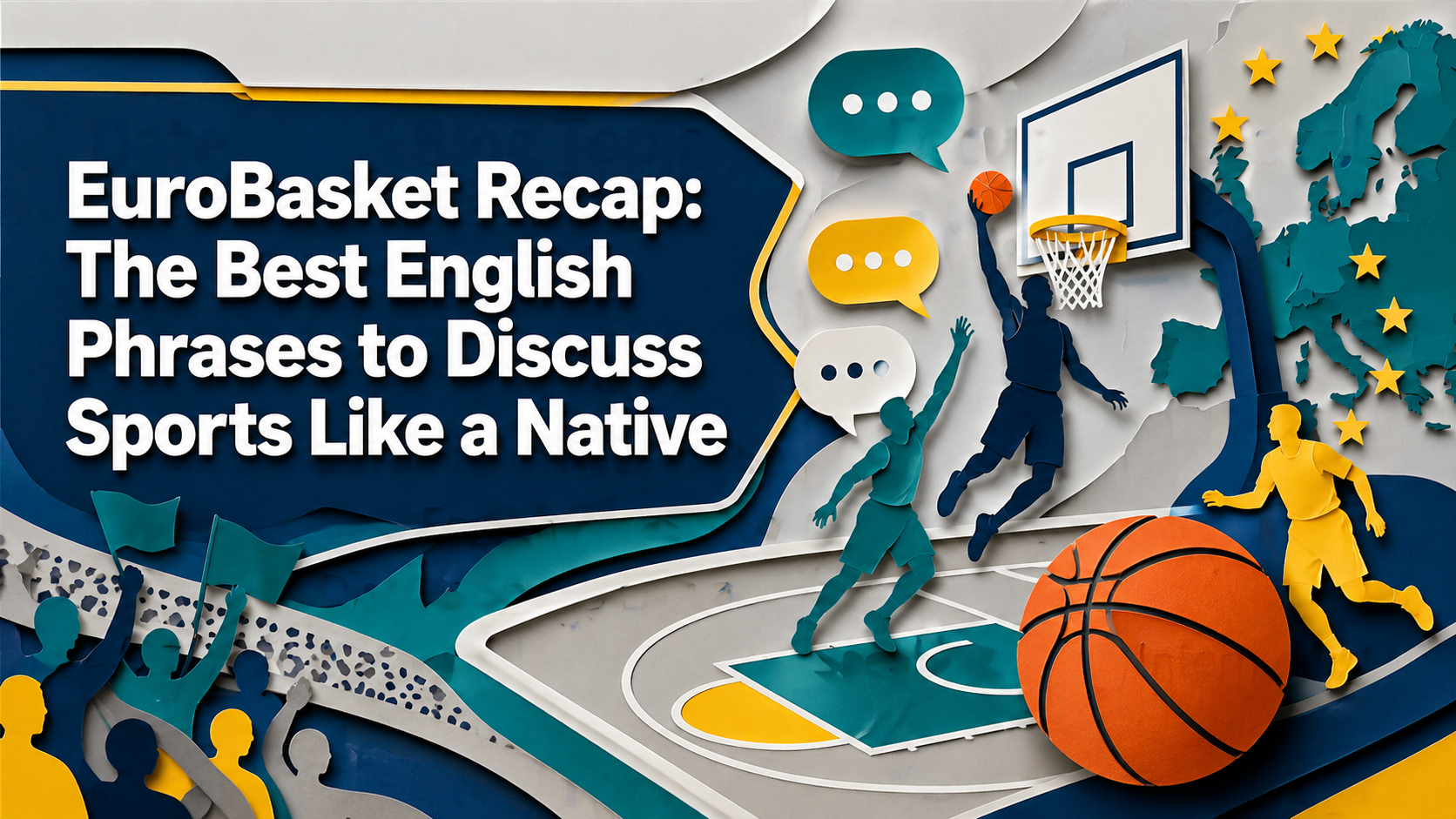
EuroBasket Recap: The Best English Phrases to Discuss Sports Like a Native 🏀
Intermediate Level | April 27, 2026
Read the article aloud on your own or repeat each paragraph after your tutor.
Sports are one of the easiest ways to start a conversation in English. You do not need to be a basketball expert. You do not need perfect grammar. You just need a few natural phrases that help you talk about the game, the players, and the big moments.
Why Sports Are Great for Conversation
After a big tournament like EuroBasket, people often want to discuss what happened, who played well, and which team surprised everyone. That makes sports a useful topic for casual conversation, workplace small talk, and friendly debates.
Start With a Simple Recap
If you want to discuss sports in English, a recap is a great place to start. A recap means a short review of what happened. You can talk about the final score, the best player, the turning point, or even the team that almost won but fell short. These are simple ideas, but they can lead to great conversations.
How to Discuss Sports in English After a Big Game
Phrase 1: “What a Game!”
The first phrase you need is “What a game!” This is short, emotional, and very natural. Native speakers use it when a game is exciting, surprising, or close until the end. For example, after a close EuroBasket match, you could say, “What a game! I thought they were going to lose in the fourth quarter.” This shows excitement and gives the other person something to respond to.
Phrase 2: “They Really Showed Up”
Another useful phrase is “They really showed up.” This means a team or player performed well, especially when it mattered. Imagine a team that struggled early in the tournament but played strongly in the semifinals. You could say, “They really showed up when the pressure was on.” This phrase works well in sports, but you can also use it at work when someone performs well during an important meeting or project.
Talk About the Turning Point
A strong sports recap usually includes the turning point. The turning point is the moment when the game started to change. Maybe one player hit three shots in a row. Maybe the defense suddenly became stronger. Maybe the coach changed the strategy. You can say, “The turning point was that steal in the third quarter.” This sounds much more natural than saying, “The game changed at that time.” It is short, clear, and specific.
Use the Word “Momentum”
You can also use the phrase “That shifted the momentum.” Momentum means the energy or direction of the game. If one team was losing but suddenly started playing better, you could say, “That three-pointer shifted the momentum.” This phrase is very common in sports conversations and makes you sound more natural when you discuss sports in English.
Praise Players Naturally
When talking about players, avoid only saying, “He was good.” That is correct, but it is not very interesting. Instead, try phrases like “He was on fire,” “She controlled the game,” or “He came through in the clutch.” If a player scores many points, you can say, “He was on fire tonight.” If a point guard manages the team well, you can say, “She controlled the game from start to finish.”
Use “Clutch” for Big Moments
The phrase “came through in the clutch” is especially useful. It means someone performed well in a high-pressure moment. For example, “He came through in the clutch with that final shot.” This phrase is common in American sports talk, and it can also be used in business. You might say, “Our sales team came through in the clutch before the deadline.” Sports English sneaks into business English more often than people realize. Sneaky little rascal.
How to Talk About Winning and Losing
When a Team Wins Clearly
When a team wins clearly, you can say “They dominated the game.” This means they controlled the match and were much stronger.
When a Team Wins a Close Game
For a close win, say “They pulled it off.” This means they managed to win, often in a difficult situation. For example, “They were down by ten points, but they pulled it off in overtime.”
When a Team Loses Respectfully
For losing, be careful with your tone. Sports fans can be passionate, and nobody wants to sound like a villain in a bad sports movie. You can say “They came up short,” which means they tried but did not win.
You can also say “They just couldn’t close it out,” which means they had a chance to win but failed at the end. These phrases sound natural and respectful.
Use Sports Phrases at Work Too
Many sports phrases are useful in professional English. You can say a team showed up, shifted momentum, came through in the clutch, or pulled it off in a business situation.
Sports Phrases in Business English
For example, after a successful presentation, you could say, “The team really showed up today.” After solving a problem late in a project, you could say, “We came through in the clutch.”
That is why sports are such a powerful topic for English learners. When you learn how to talk about basketball, football, or any other sport, you are also learning phrases that help you talk about teamwork, pressure, performance, and results.
Your Next Conversation Challenge
So the next time someone mentions EuroBasket or another big game, do not stay quiet. Try one phrase. Ask one question. Keep the conversation moving.
Vocabulary List
- Recap (noun) — A short review or summary of what happened.
Example: The sports show gave a quick recap of the EuroBasket final. - Tournament (noun) — A sports competition with several games or rounds.
Example: EuroBasket is an exciting tournament for basketball fans. - Turning point (noun) — The moment when a situation begins to change.
Example: The turning point came when the team scored ten points in two minutes. - Momentum (noun) — The energy or force that helps something continue moving forward.
Example: The team gained momentum after the big three-pointer. - Pressure (noun) — Stress or difficulty in an important situation.
Example: The player stayed calm under pressure. - Clutch (adjective/noun) — Connected to an important high-pressure moment in sports.
Example: He made a clutch shot in the final seconds. - Dominate (verb) — To control or be much stronger than others.
Example: They dominated the game from the first quarter. - Overtime (noun) — Extra playing time added when the score is tied.
Example: The game went into overtime after both teams finished with 88 points. - Defensive (adjective) — Related to stopping the other team from scoring.
Example: Their defensive strategy helped them win the match. - Strategy (noun) — A plan used to achieve a goal.
Example: The coach changed the strategy after halftime.
5 Questions About the Article
- Why are sports useful for starting conversations in English?
- What does the phrase “What a game!” usually express?
- What is a turning point in a game?
- What does “came through in the clutch” mean?
- How can sports phrases also be useful at work?
5 Open-Ended Discussion Questions
- What is the most exciting sports game you have ever watched?
- Which sport is easiest for you to discuss in English? Why?
- Who is a player you think often performs well under pressure?
- What sports phrases could you use in your workplace?
- How do sports conversations help people build relationships?
📢 Want more tips like this? 👉 Sign up for the All About English Mastery Newsletter! Click here to join us!
Want to finally Master English but don’t have the time? Mastering English for Busy Professionals is the course for you! Check it out now!
Follow our YouTube Channel @All_About_English for more great insights and tips.
 English
  한국어
한국어