

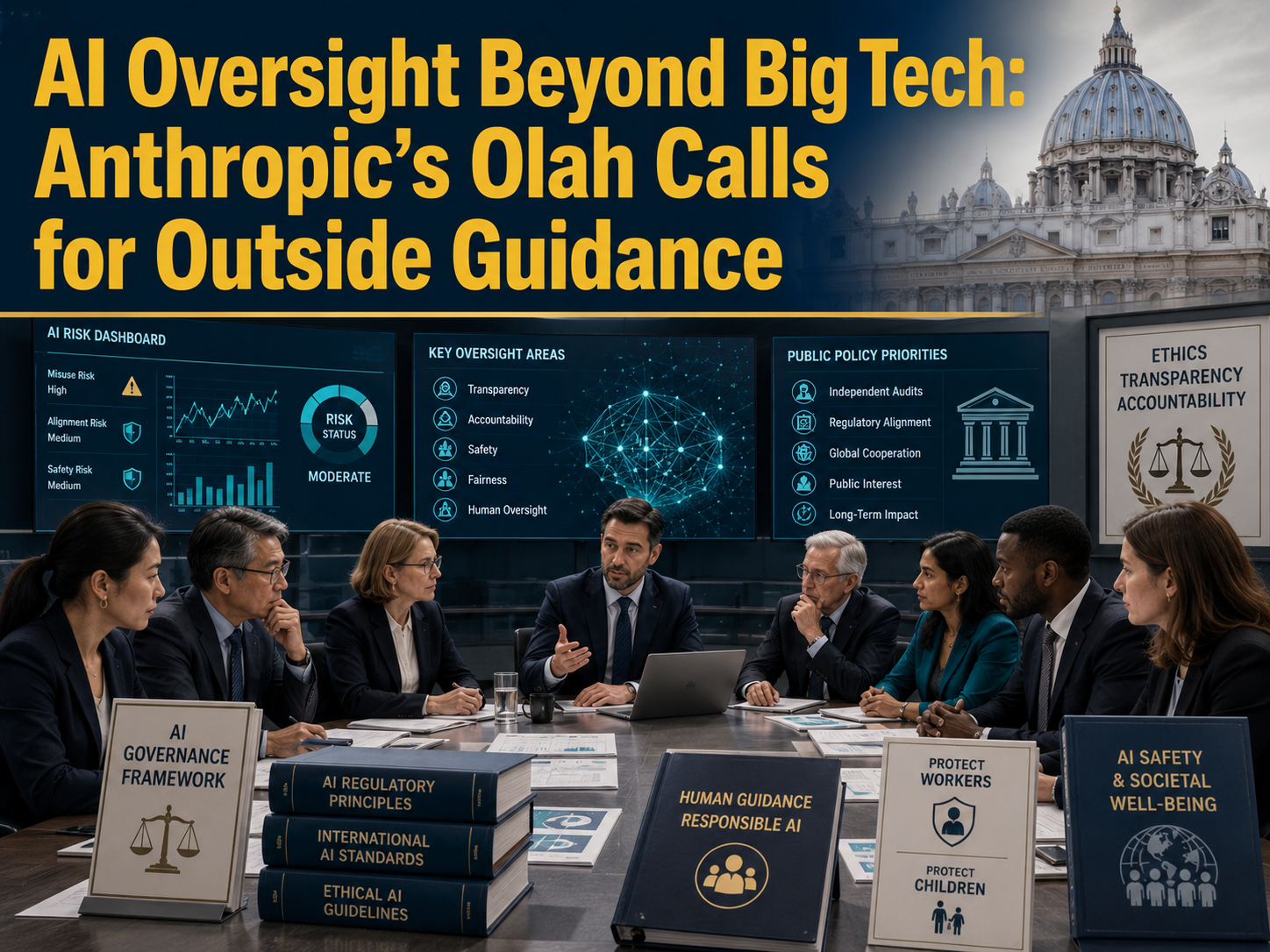
AI Oversight Beyond Big Tech: Anthropic’s Olah Calls for Outside Guidance
Intermediate | June 8, 2026
✨ 혼자서 기사를 소리 내어 읽거나 튜터를 따라 각 단락을 반복해서 읽으세요. 레벨...
A Warning from Inside the AI Industry
Anthropic co-founder Chris Olah says the future of artificial intelligence should not be guided only by technology companies. Speaking at the Vatican during the presentation of Pope Leo’s first AI-focused encyclical, Olah called for greater oversight from religious leaders, governments, and civil society. According to Reuters, he warned that even well-meaning AI companies face pressures that can make it harder to always do the right thing. (Reuters)
Why AI Oversight Beyond Big Tech Matters
The idea of AI oversight beyond Big Tech matters because artificial intelligence is no longer just a software story. It affects jobs, education, security, business, politics, and even religion. Olah said there is a real possibility that AI could displace human labor “at very large scale.” In plain English, that means many workers could lose jobs or see their work change quickly. That is not exactly a small update to the office printer. (Reuters)
Big Tech Has Big Pressure
Olah said every frontier AI lab, including Anthropic, operates under incentives and constraints that may sometimes conflict with the greater good. These pressures can be commercial, geopolitical, or personal. A company may want to move fast to beat competitors. A government may want better AI for national power. Investors may want growth. Put all that together, and you can see why Olah believes outside scrutiny is necessary. (Reuters)
Pope Leo Enters the AI Debate
The Vatican event was connected to Pope Leo’s first major document, or encyclical, called “Magnifica Humanitas.” Reuters reported that the pope called for stronger regulation of AI systems and warned that some autonomous weapons may already be moving beyond human control. He also called for robust legal frameworks, independent oversight, informed users, and political leaders who do not avoid responsibility. (Reuters)
Workers, Children, and Society
Pope Leo also urged policymakers to protect workers’ rights and keep children safe from AI technology. He said AI data ownership should not be left only in private hands and called on AI companies to cool their competition. This connects closely with Olah’s warning. If AI changes work at a massive scale, society will need plans for training, income support, and new opportunities. The technology may be powerful, but people still have to live in the real world — rent, groceries, school fees, the whole circus. (Reuters)
Why Olah’s Role Is Interesting
Olah was an unusual speaker at the Vatican because he works inside the AI industry, not outside it. Anthropic is the U.S.-based company behind the Claude AI tools, and it was founded in 2021 by Olah and other former OpenAI employees. WIRED reported that the Vatican has spent years building conversations with technology leaders and ethicists about artificial intelligence. That makes Olah’s appearance part of a larger effort to bring moral, social, and technical voices into the same room. (Reuters) (WIRED)
The Bigger Picture
This story is important because it shows a new stage in the AI debate. The question is no longer only, “What can AI do?” The bigger question is, “Who gets to decide how AI is used?” The call for AI oversight beyond Big Tech suggests that companies, governments, religious leaders, workers, parents, and citizens may all need a seat at the table. For English learners, this is a useful topic because it combines technology, ethics, business, and public policy — four areas that are becoming harder to separate.
Vocabulary
- Oversight (noun) – the act of watching or checking something to make sure it is done properly.
Example: “Olah called for more oversight of artificial intelligence.” - Artificial intelligence (noun) – computer systems that can perform tasks usually requiring human thinking.
Example: “Artificial intelligence is changing many industries.” - Big Tech (noun) – large technology companies with major influence.
Example: “Some people believe Big Tech should not control AI development alone.” - Civil society (noun) – groups and organizations outside government and business, such as charities, churches, and community groups.
Example: “Civil society can help guide ethical debates about AI.” - Displace (verb) – to replace someone or something, especially in a job or role.
Example: “AI could displace some workers in the future.” - Incentive (noun) – a reason or reward that pushes someone to act.
Example: “Companies have strong incentives to release new AI tools quickly.” - Scrutiny (noun) – careful examination or inspection.
Example: “Advanced AI systems may need outside scrutiny.” - Regulation (noun) – rules made by governments or official bodies.
Example: “The pope called for stronger AI regulation.” - Autonomous (adjective) – able to act or operate without direct human control.
Example: “Autonomous weapons raise serious ethical questions.” - Ethical (adjective) – connected to what is morally right or wrong.
Example: “AI companies face many ethical decisions.”
Discussion Questions (About the Article)
- What did Chris Olah say about leaving AI development only to technology companies?
- Why does Olah think outside scrutiny is necessary?
- What did Pope Leo warn about in his AI-focused encyclical?
- How could AI affect workers in the future?
- Why was Olah’s appearance at the Vatican unusual?
Discussion Questions (About the Topic)
- Who should have the most influence over AI development: companies, governments, or citizens?
- How can society balance innovation with safety?
- What kinds of jobs do you think AI may change the most?
- Should religious or ethical leaders have a role in technology debates? Why or why not?
- What rules would you create for powerful AI systems?
Related Idiom
“Not leave the fox guarding the henhouse” – not let someone control something when they may have a conflict of interest.
Example: “Olah’s message was that AI companies should not be left guarding the henhouse when the future of AI affects all of society.”
📢 Want more practical English through real news stories? Sign up for the All About English Mastery Newsletter here: allaboutenglishmastery.com/newsletter
Want to build stronger English in less time? Check out Mastering English for Busy Professionals.
Follow our YouTube channel @All_About_English for more English tips and practice.
This article was inspired by: Reuters, Reuters, and WIRED


 한국어
한국어  English