

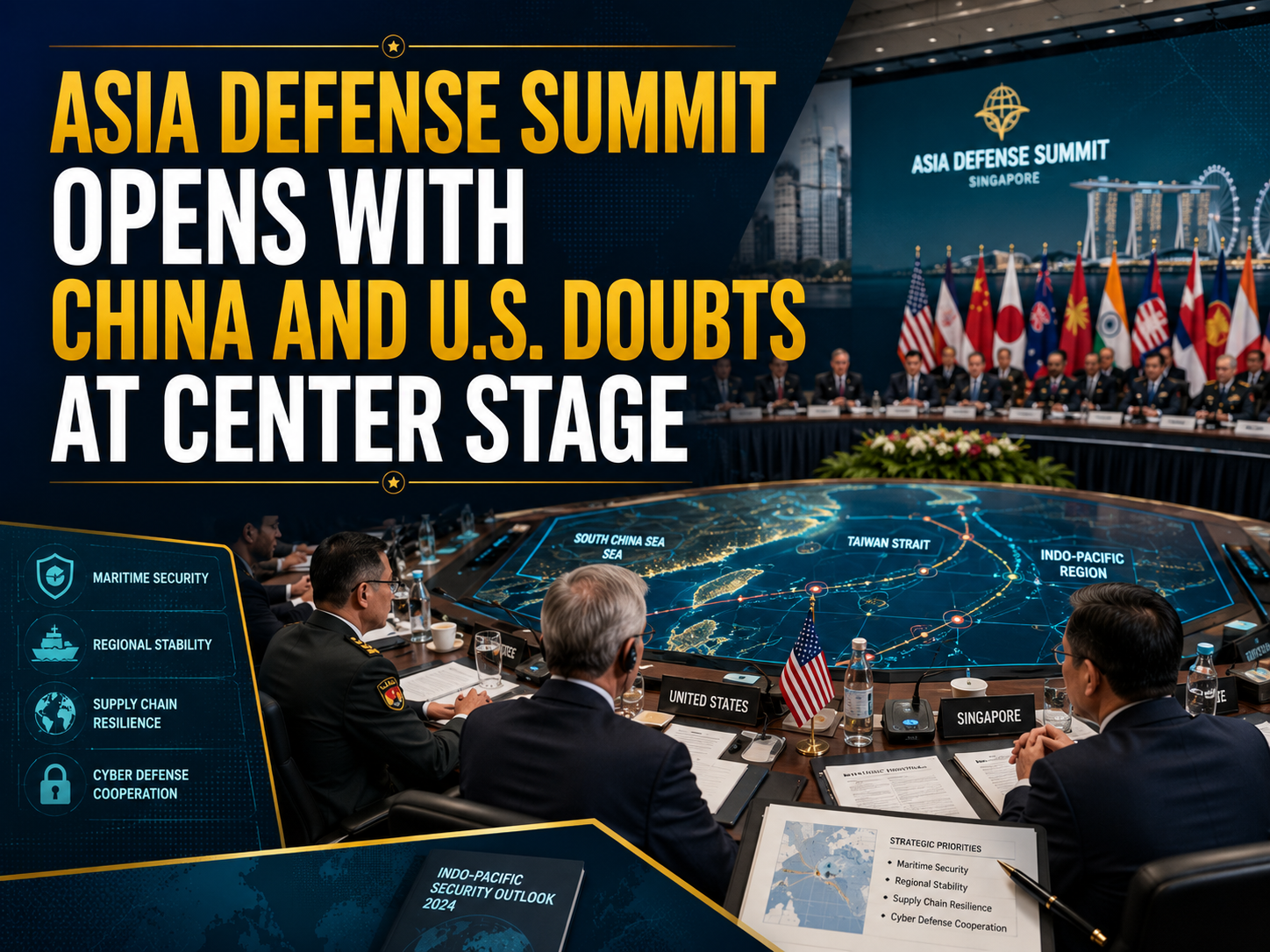
Asia Defense Summit Opens With China and U.S. Doubts at Center Stage
Advanced | June 7, 2026
✨ 혼자서 기사를 소리 내어 읽거나 튜터를 따라 각 단락을 반복해서 읽으세요. 레벨...
Asia Defense Summit China Concerns Take Center Stage
Asia’s top defense forum, the IISS Shangri-La Dialogue, opened in Singapore from May 29–31, 2026, with two major issues dominating the room: China’s growing military power and questions about America’s long-term priorities in Asia. The event brings together defense ministers, military leaders, diplomats, and security experts to discuss the region’s biggest security problems. This year, the mood was businesslike but tense — like a board meeting where everyone smiles, but nobody forgets who controls the budget. (IISS, Japan Today/AP)
Why the Asia Defense Summit China Concerns Story Matters
The Asia defense summit China concerns story matters because countries across the Indo-Pacific are trying to plan for an uncertain future. China has been expanding and modernizing its military, while also becoming more assertive in places like the South China Sea and around Taiwan. At the same time, many U.S. allies are asking a simple but serious question: Will Washington stay focused on Asia, or will other global problems pull its attention away? (Japan Today/AP, Reuters)
China Sends a Lower-Level Delegation
One detail got a lot of attention before the summit even began: China’s defense minister did not attend. Reuters reported that China sent a delegation from the People’s Liberation Army National Defence University, led by Meng Xiangqing, instead of sending Defense Minister Dong Jun. This was the second year in a row that Dong did not attend the forum. For other countries, that raised questions about whether Beijing wanted serious dialogue or preferred to keep some distance from a Western-led security forum. (Reuters)
U.S. Allies Want Reassurance
U.S. Defense Secretary Pete Hegseth used the summit to tell Asian partners that America remains committed to the region. But he also said allies need to do more for their own defense. According to Reuters, Hegseth urged regional partners to take more responsibility while concerns grew that Washington could be distracted by conflicts in other parts of the world. The Wall Street Journal also reported that Hegseth pushed Asian allies to increase defense spending to strengthen deterrence against China. In plain English: America is still in the room, but it wants others to help carry the furniture. (Reuters, WSJ)
Countries Are Building More Defense Partnerships
Many Indo-Pacific countries are not waiting for a perfect answer from Washington. Reuters described a “great Indo-Pacific hedge,” meaning countries are strengthening ties with each other while still wanting U.S. support. The Philippines is deepening defense partnerships with Japan, Australia, Canada, and New Zealand. Japan is also taking a bigger regional role and has eased rules on defense exports. This does not mean countries are abandoning America. It means they are trying to avoid putting all their security eggs in one basket. (Reuters)
Undersea Cables Become a New Security Issue
The summit also showed that modern defense is not only about ships, missiles, and fighter jets. Australian Defence Minister Richard Marles warned that the seabed has become a new battlefield because undersea cables carry critical internet and communication traffic. The Guardian reported that the U.S., U.K., and Australia announced a new AUKUS project to develop underwater drone technology to help protect critical undersea cables. That may sound like science fiction, but for modern economies, internet cables are as important as highways, ports, and power lines. (The Guardian)
What Happens Next?
For now, the Asia defense summit China concerns story shows a region trying to stay flexible. Countries want the U.S. involved, but they also want more options. They are watching China closely, investing more in defense, and building stronger regional partnerships. The main message from Singapore was not panic. It was preparation. In business terms, Asia’s defense leaders are updating their risk management plan — because hoping everything works out is not exactly a strategy.
Vocabulary
- Summit (noun) – a high-level meeting between leaders or officials.
Example: “The defense summit brought together leaders from across the Indo-Pacific.” - Modernization (noun) – the process of making something newer, stronger, or more advanced.
Example: “China’s military modernization is a major concern for nearby countries.” - Assertive (adjective) – confident and forceful, sometimes in a way that creates tension.
Example: “China has become more assertive in regional waters.” - Priorities (noun) – the most important goals or concerns.
Example: “Some allies are unsure about America’s long-term priorities in Asia.” - Delegation (noun) – a group sent to represent a country or organization.
Example: “China sent a lower-level delegation to the summit.” - Reassurance (noun) – words or actions that make people feel less worried.
Example: “U.S. allies wanted reassurance that America would remain committed to the region.” - Deterrence (noun) – the act of preventing an attack by showing strength.
Example: “Many countries want stronger deterrence against possible threats.” - Partnership (noun) – a relationship where people or countries work together.
Example: “The Philippines is building new defense partnerships.” - Undersea cable (noun) – a cable laid under the ocean that carries internet or communication data.
Example: “Undersea cables are critical for global communication.” - Risk management (noun) – the process of preparing for possible problems.
Example: “Defense leaders are thinking carefully about risk management.”
Discussion Questions About the Article
- What were the two main concerns at the Shangri-La Dialogue?
- Why did China’s lower-level delegation attract attention?
- What kind of reassurance did U.S. allies want from Washington?
- Why are countries like the Philippines and Japan building more defense partnerships?
- Why are undersea cables becoming an important security issue?
Discussion Questions About the Topic
- Should Asian countries rely mainly on the United States for security, or build more regional partnerships?
- How can countries prepare for China’s military rise without creating unnecessary conflict?
- Why do defense alliances matter in business and trade?
- How should small and medium-sized countries respond when larger powers compete?
- What lessons can business professionals learn from international risk management?
Related Idiom
“Don’t put all your eggs in one basket” – do not depend on only one plan, person, or option.
Example: “Many Indo-Pacific countries are strengthening regional defense partnerships because they do not want to put all their eggs in one basket.”
📢 Want more practical English through real news stories? Sign up for the All About English Mastery Newsletter here: allaboutenglishmastery.com/newsletter
Want to build stronger English in less time? Check out Mastering English for Busy Professionals.
Follow our YouTube channel @All_About_English for more English tips and practice.
This article was inspired by: AP via Japan Today, IISS, Reuters, The Guardian, and The Wall Street Journal.


 한국어
한국어  English