

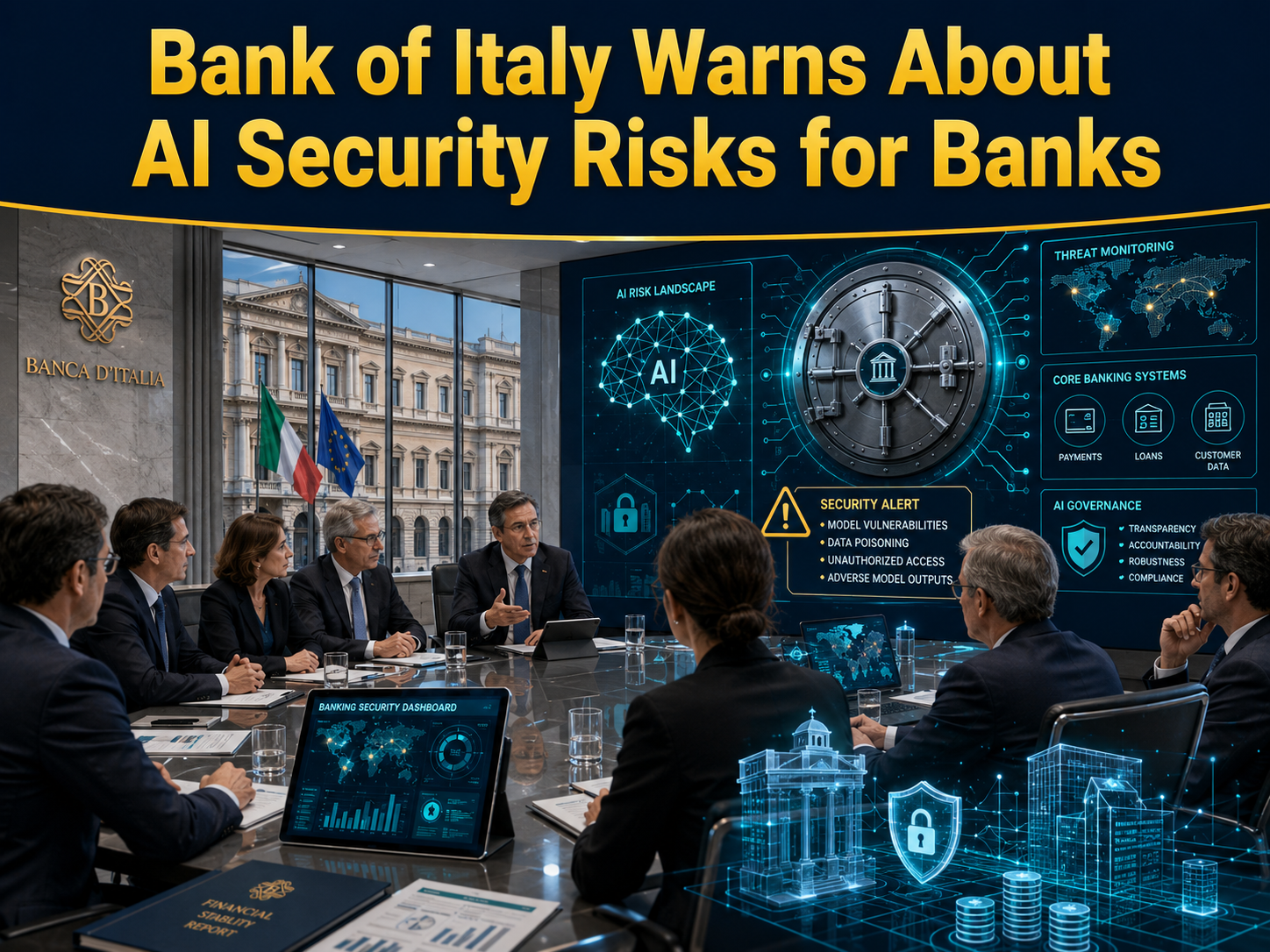
Bank of Italy Warns About AI Security Risks for Banks
Intermediate | June 6, 2026
✨ 혼자서 기사를 소리 내어 읽거나 튜터를 따라 각 단락을 반복해서 읽으세요. 레벨...
A Central Bank Takes AI Risk Seriously
Artificial intelligence is quickly moving into the financial world. Banks are using AI to detect fraud, improve customer service, analyze data, and strengthen cybersecurity. But the same technology that can protect banks may also create new dangers. That is why the Bank of Italy is now talking with global AI companies about AI security risks for banks.
According to Reuters, Bank of Italy Governor Fabio Panetta said on May 29, 2026, that the central bank is in contact with global artificial intelligence providers before new AI models are released to the financial sector. Panetta made the comments during his annual keynote speech. The goal is simple but serious: make sure powerful AI tools are introduced into banking safely and responsibly. (Reuters)
Why AI Security Risks for Banks Are Getting Attention
The Bank of Italy has started discussions with national authorities, financial players, and IT service providers. This shows that the issue is not only about banks or tech companies. It involves regulators, financial institutions, software providers, and outside vendors that support bank systems.
One major concern is that advanced AI models can find weaknesses in computer code very quickly. That can help banks improve their defenses. But it can also help attackers find and exploit those same weaknesses. In business English, this is a classic “double-edged sword.” The same tool that helps you protect your system could also help someone break into it. (Reuters)
The Anthropic Mythos Model
Reuters reported that bank supervisors’ recent concerns have focused on Anthropic’s Mythos model. Mythos is designed to find flaws in computer code and help strengthen defenses against cyberattacks. That sounds helpful, and it can be. But cybersecurity experts are also worried that this kind of tool could “turbo-charge” attacks on banks’ technology systems.
This is where the situation gets tricky. If a powerful AI model can find software problems faster than human teams, defenders can use it to fix problems. But criminals might use similar tools to attack faster too. That means banks need to think not only about what AI can do, but also about who has access to it and how it is controlled. (Reuters)
Banks Cannot Outsource Responsibility
Panetta made another important point: banks are still responsible for protecting their systems and keeping services running. Even if they use third-party AI or IT providers, they cannot simply blame an outside company if something goes wrong.
This matters because modern banks depend on many outside partners. They use cloud services, payment systems, cybersecurity tools, customer platforms, and data providers. Panetta said that if banks use third-party providers, those companies also carry responsibility. But the bank itself must still manage the risk. In plain English: outsourcing a service does not mean outsourcing the problem. (Reuters)
European Regulators Are Watching Closely
Italy is not the only country paying attention. The Bank of Spain warned in May that new AI tools could make it easier to exploit software weaknesses. It said these tools could sharply reduce the time between finding a vulnerability and using it in an attack. The Bank of Spain also called for stronger international cooperation and better access to protective AI models. (Reuters)
The European Central Bank also met with commercial lenders to discuss AI risks. Reuters reported that ECB official Frank Elderson said the ECB would send banks a “dear CEO letter” asking them to take proactive measures to keep their systems secure. Elderson also warned that important infrastructure such as cloud providers, telecom networks, payment systems, electricity, and water supplies could become targets. That is a cheerful little bedtime story for bankers, isn’t it? (Reuters)
What Banks Need to Do Next
Panetta said banks should keep IT risks under control and prepare plans so they can act quickly when needed. He also said banks should use part of their recent record profits to support the necessary investments. That means stronger cybersecurity systems, better planning, clearer responsibilities, and faster response teams.
He also said the answer cannot be only technological. Bank executives need strong governance and control frameworks. In other words, this is not just a job for the IT department. Senior leaders must understand the risk, assign responsibility, and make sure the organization is ready before a crisis happens. (Reuters)
AI Can Help Banks — But It Must Be Managed
The big takeaway is that AI is not simply good or bad. It is powerful. It can help banks find fraud, improve service, and protect systems. But it can also increase AI security risks for banks if criminals use similar tools to find weaknesses and attack faster.
For English learners, this story is useful because it connects technology, finance, and risk management. It also gives us practical business vocabulary: cybersecurity, third-party provider, governance, vulnerability, and continuity. The basic idea is easy to understand: banks want the benefits of AI, but they cannot ignore the risks. In finance, trust is everything. And when money, data, and technology meet, trust needs very strong locks. (IMF)
Vocabulary
- Cybersecurity (noun) – protection of computer systems, networks, and data from digital attacks.
Example: “Banks are investing more money in cybersecurity because of new AI risks.” - Regulator (noun) – an official organization that watches an industry and makes sure rules are followed.
Example: “The Bank of Italy is a financial regulator.” - Provider (noun) – a company or person that supplies a service or product.
Example: “Banks often work with outside technology providers.” - Vulnerability (noun) – a weakness in a system that could be attacked or damaged.
Example: “Advanced AI tools can find software vulnerabilities very quickly.” - Exploit (verb) – to use a weakness for an advantage, often in a harmful way.
Example: “Hackers may try to exploit weaknesses in bank systems.” - Third-party (adjective) – connected to an outside company or service provider.
Example: “A bank may use a third-party provider for cloud services.” - Continuity (noun) – the ability to keep operating without interruption.
Example: “Banks must protect the continuity of their payment systems.” - Governance (noun) – the way an organization is directed, controlled, and managed.
Example: “Strong governance helps banks respond to technology risks.” - Framework (noun) – a structure or system used to organize actions or decisions.
Example: “The bank needs a clear risk-management framework.” - Proactive (adjective) – taking action before a problem happens.
Example: “Regulators want banks to take proactive measures against AI threats.”
Discussion Questions About the Article
- Why is the Bank of Italy talking with global AI companies?
- What is Anthropic’s Mythos model designed to do?
- Why can advanced AI tools be both helpful and dangerous for banks?
- What did Fabio Panetta say about banks using third-party providers?
- Why do regulators say this issue is not only a technology problem?
Discussion Questions About the Topic
- Should banks use powerful AI tools if those tools can also be misused?
- Who should be responsible if a third-party AI provider creates a security problem?
- How can banks balance innovation and safety?
- What kinds of financial services do you think AI can improve?
- Would you trust a bank more or less if it used AI heavily? Why?
Related Idiom
“A double-edged sword” – something that has both advantages and disadvantages.
Example: “Advanced AI is a double-edged sword for banks because it can improve cybersecurity, but it can also help attackers find weaknesses faster.”
📢 Want more practical English through real news stories? Sign up for the All About English Mastery Newsletter here: allaboutenglishmastery.com/newsletter
Want to build stronger English in less time? Check out Mastering English for Busy Professionals.
Follow our YouTube channel @All_About_English for more English tips and practice.
This article was inspired by: Reuters, Reuters on the Bank of Spain, Reuters on the ECB, and IMF


 한국어
한국어  English