

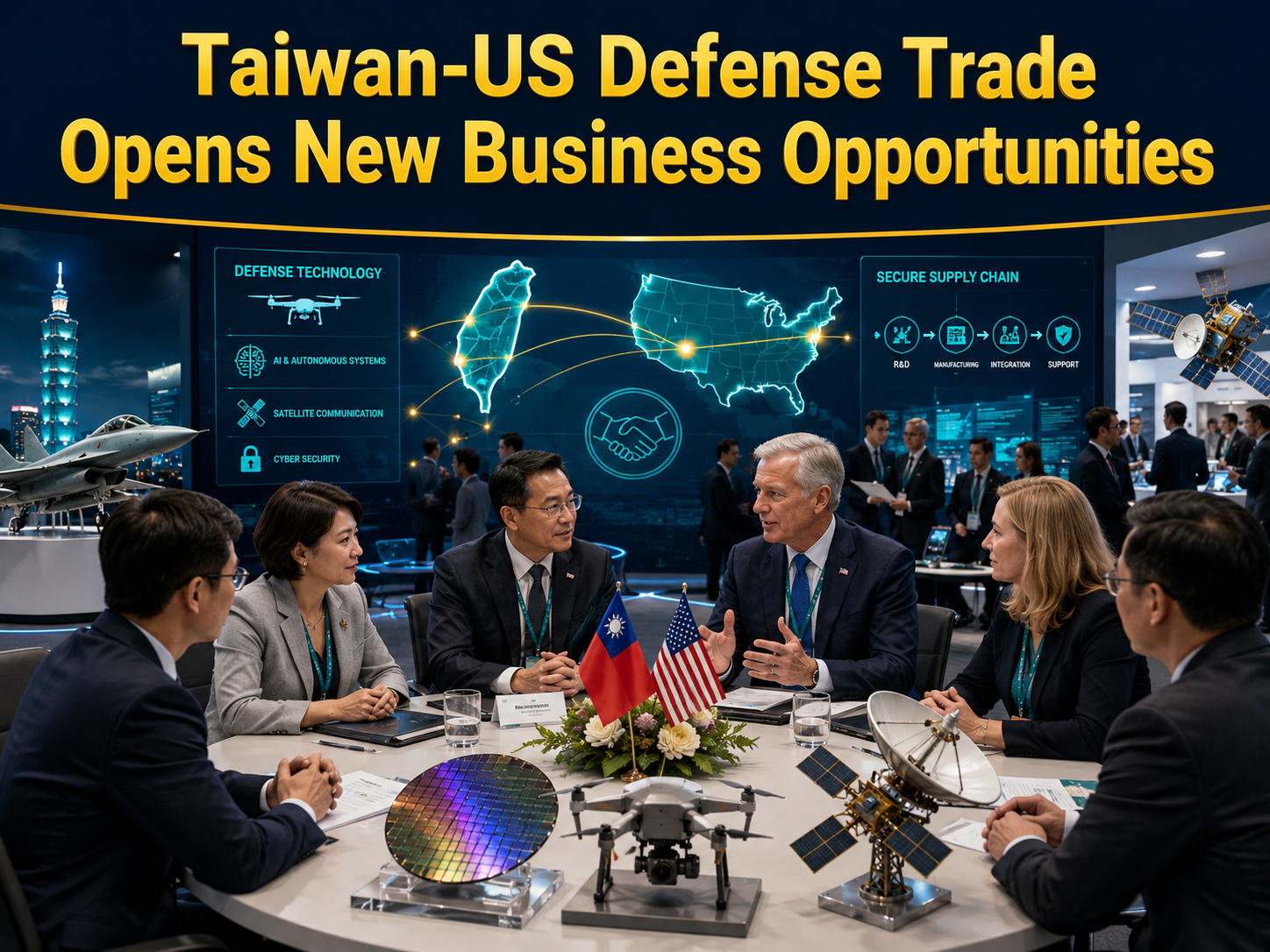
Taiwan-US Defense Trade Opens New Business Opportunities
Intermediate | June 6, 2026
✨ 혼자서 기사를 소리 내어 읽거나 튜터를 따라 각 단락을 반복해서 읽으세요. 레벨...
A Bigger Defense Forum in Taipei
Taiwan and the United States are looking for more ways to work together in the defense industry. On May 29, 2026, the Taipei Times reported that retired U.S. Army General Charles Flynn praised Taiwan’s growing defense investments during the Taiwan-US Defense Industry Forum in Taipei.
The forum was cohosted by the US-Taiwan Business Council and the Taiwan External Trade Development Council, also known as TAITRA. This year’s event had the largest delegation in the forum’s history. Flynn led a 41-member U.S. delegation to Taiwan, showing that American defense companies are paying close attention to Taiwan’s market and industrial strengths. (Taipei Times)
Why Taiwan-US Defense Trade Is Getting Attention
The main idea behind Taiwan-US defense trade is not only buying and selling weapons. The bigger goal is to build a stronger defense supply chain between the two sides. That means Taiwan and the United States want to work together on technology, manufacturing, logistics, and long-term industrial cooperation.
According to the US-Taiwan Business Council, the 2026 delegation visited Taiwan from May 26 to 29. The group planned to meet senior Taiwan government officials and discuss important issues such as speeding up U.S. weapons deliveries, supporting Taiwan’s own defense systems, and improving cooperation in new military technologies. In plain business English, this was not just a sales trip. It was a relationship-building trip. (US-Taiwan Business Council)
From Arms Sales to Industrial Partnership
One of the most important comments came from TAITRA chairman James Huang. He said the Taiwan-U.S. defense relationship is shifting from a traditional model based on arms sales and procurement toward a strategic industrial partnership.
That is a big change. In the past, many people thought of defense cooperation as Taiwan buying military equipment from the United States. Now, the discussion is becoming broader. Taiwan has strong industries in semiconductors, information and communications technology, and low Earth orbit satellites. Huang said these strengths can be used for defense applications such as drones, AI identification, and satellite communications. (Taipei Times)
Why Taiwan’s Tech Industry Matters
Taiwan is already famous for its technology supply chain, especially semiconductors and advanced manufacturing. That matters because modern defense is becoming more connected to technology. Drones need chips. Satellite systems need communication networks. AI tools need strong hardware and software. In other words, modern defense is not only about tanks and fighter jets anymore.
This creates business opportunities for Taiwanese companies that already know how to build complex electronics, manage supply chains, and integrate systems. USTBC president Rupert Hammond-Chambers said the partnership is not aimed only at Taiwan’s market, but also at the U.S. and global markets. He added that pairing U.S. defense technology with Taiwan’s ICT integration abilities creates an “alliance of strengths.” (Taipei Times)
Lessons From Ukraine and Other Conflicts
Recent wars have also changed how countries think about defense. The US-Taiwan Business Council said General Flynn pointed to conflicts in Europe and the Middle East as examples of why countries need both conventional and asymmetric capabilities. That includes systems such as unmanned vehicles, better logistics, and dual-use technologies that can serve both commercial and defense needs.
Reuters later reported that Raymond Greene, director of the American Institute in Taiwan, said Taiwan needs to “spend smarter” on defense. He especially emphasized unmanned systems, saying drones are changing modern warfare and could help Taiwan strengthen deterrence across the Taiwan Strait. This shows why drones and smart defense technology are becoming such important topics for Taiwan-US defense trade. (Reuters)
The Political Background
Of course, defense trade does not happen in a quiet room. It happens in a complicated political environment. The Taipei Times reported that some people were concerned about talks between U.S. President Donald Trump and Chinese President Xi Jinping, as well as Trump’s comments about arms sales to Taiwan. However, Flynn said he did not sense hesitation from the business sector.
Reuters also reported that Taiwan’s parliament had approved only about two-thirds of President William Lai’s requested US$40 billion in extra defense spending. Some of the cut funds were connected to domestically made systems such as drones and missiles. That means Taiwan’s defense plans are not only about international trade. They are also about local politics, budget decisions, and how quickly Taiwan can build its own capabilities. (Reuters)
A Promising but Serious Opportunity
The big takeaway is simple: Taiwan-US defense trade is becoming more active, more technical, and more business-focused. Taiwan brings strong manufacturing, semiconductor, and ICT experience. The United States brings advanced defense technology and a large defense industry. Together, the two sides see room for cooperation that goes beyond traditional arms sales.
For English learners, this story is useful because it includes real business and policy vocabulary: supply chain, procurement, industrial partnership, dual-use technology, and market opportunity. It also shows how business, technology, and national security can overlap. That may sound complicated, but the basic idea is easy to understand: when the world becomes more uncertain, countries look for stronger partners. Taiwan and the United States are doing exactly that. (Taipei Times)
Vocabulary
- Delegation (noun) – a group of people sent to represent an organization or country.
Example: “A 41-member U.S. delegation visited Taiwan for the defense forum.” - Defense industry (noun) – companies and organizations that produce military equipment, technology, and services.
Example: “The defense industry is becoming more connected to advanced technology.” - Supply chain (noun) – the system of companies, materials, and processes used to make and deliver products.
Example: “Taiwan and the United States want to build a stronger defense supply chain.” - Procurement (noun) – the process of buying goods or services, especially for a company or government.
Example: “Military procurement can take a long time because the systems are complex.” - Industrial partnership (noun) – cooperation between companies or countries to build products or technology together.
Example: “Taiwan and the United States are moving toward a strategic industrial partnership.” - Semiconductor (noun) – a material or chip used in electronic devices and computers.
Example: “Taiwan is a global leader in semiconductor manufacturing.” - Drone (noun) – an unmanned aircraft or vehicle controlled remotely or by software.
Example: “Drones are becoming more important in modern defense planning.” - Dual-use technology (noun) – technology that can be used for both civilian and military purposes.
Example: “Satellite communication can be a dual-use technology.” - Deterrence (noun) – the act of preventing an attack by showing strength or readiness.
Example: “Taiwan hopes stronger defense systems will improve deterrence.” - Capability (noun) – the ability or power to do something.
Example: “Taiwan wants to improve its defense capabilities through new technology.”
Discussion Questions About the Article
- Who led the 41-member U.S. defense delegation to Taiwan?
- What was the main purpose of the Taiwan-US Defense Industry Forum?
- How is the Taiwan-U.S. defense relationship changing, according to James Huang?
- Why are semiconductors, ICT, and satellites important for modern defense?
- What did Raymond Greene say Taiwan should focus on when spending money on defense?
Discussion Questions About the Topic
- Do you think defense cooperation should focus more on buying weapons or building technology together?
- Why are drones becoming so important in modern defense?
- How can Taiwan’s technology industry support its national security?
- What risks can appear when business, politics, and defense are closely connected?
- How can smaller countries build strong partnerships with larger countries?
Related Idiom
“Join forces” – to work together to achieve a shared goal.
Example: “Taiwan and the United States are joining forces to build stronger defense technology and supply chains.”
📢 Want more practical English through real news stories? Sign up for the All About English Mastery Newsletter here: allaboutenglishmastery.com/newsletter
Want to build stronger English in less time? Check out Mastering English for Busy Professionals.
Follow our YouTube channel @All_About_English for more English tips and practice.
This article was inspired by: Taipei Times, US-Taiwan Business Council, and Reuters

 한국어
한국어  English