

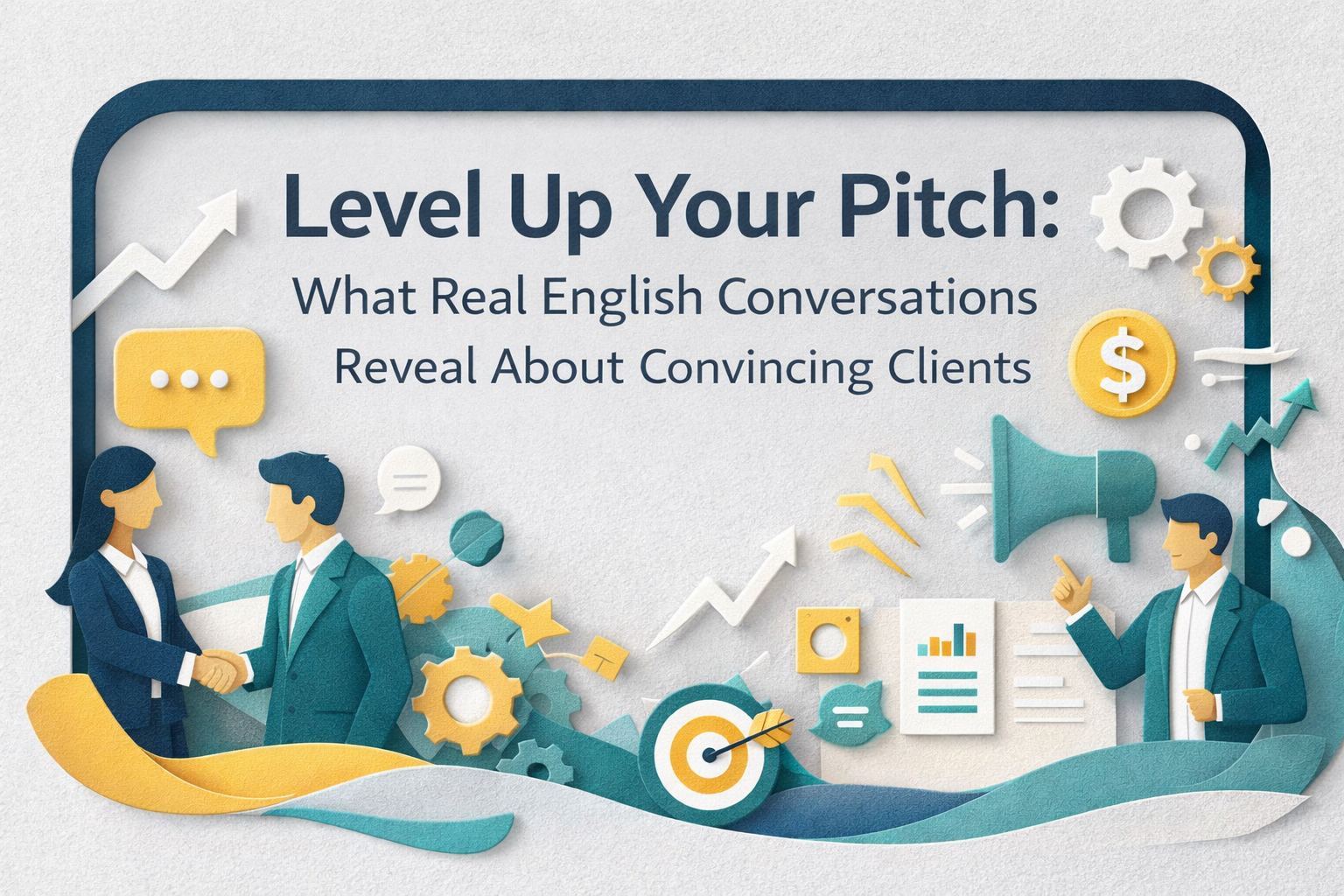
Level Up Your Pitch: What Real English Conversations Reveal About Convincing Clients 🎯
Advanced Level | March 3, 2026
혼자서 기사를 소리 내어 읽거나 튜터를 따라 각 단락을 반복해서 읽으세요. 레벨...
Convincing Clients in English: Why Real Conversations Win
Most professionals think a “pitch” is a perfect speech: polished slides, strong numbers, and a confident ending. But real clients don’t decide inside your PowerPoint.
They decide in the small moments—your first two sentences, the way you answer a tough question, and whether you sound like someone they can trust.
A Great Pitch Feels Like a Calm Conversation
In real English conversations, the strongest pitch usually feels less like a performance and more like a helpful, calm conversation—and this mindset is the foundation of convincing clients in English.
You’re not trying to “sell.” You’re trying to understand the client’s situation and guide them toward a clear next step.
Start With Their Problem, Not Your Product
One big difference is how you talk about their problem.
Weak pitches talk about the product first: “We offer…” Strong pitches start with the client’s world: “From what you described, it sounds like the main issue is…”
That shift makes the client feel heard—and when people feel heard, they become easier to persuade.
Use Simple Certainty (Not Complicated English)
Another clue from real conversations: convincing speakers use simple certainty, not complicated vocabulary.
They don’t hide behind long sentences. They say things like, “Here’s what I recommend,” or “The safest next step is…” Clear language sounds confident. Confident language sounds trustworthy.
Handle Objections Without Arguing
Also, notice how skilled professionals handle objections. They don’t argue. They reframe.
If a client says, “Your price is high,” a strong response might be: “Totally fair question. Let’s zoom out—what would it cost if this problem stays unsolved for six more months?” Now you’re talking about value, not just price.
Guide the Conversation With Micro-Agreements
Here’s the secret sauce: they invite micro-agreements. They check alignment without sounding insecure.
Instead of “Does that make sense?” they use, “Is that the same challenge you’re seeing?” or “Are we aligned so far?” These questions keep the tone professional while guiding the client to say “yes” in small, natural steps.
Make It Memorable With One Short Story
Finally, real persuasion often comes from one short story.
A simple case: “We worked with a team in a similar situation. At first, they were stuck in delays. After we changed X, their timeline improved within a month.” Clients don’t remember your features—they remember the picture you painted.
Your Goal: Sound Like the Problem-Solver
So if you want to level up your pitch, stop chasing “perfect English.” Focus on useful English: clarity, calm structure, strong questions, and a next step that feels easy.
Your goal is not to sound impressive. Your goal is to sound like the person who can solve the problem—and that’s what convincing clients in English really sounds like.
Vocabulary List
- convince (verb) — to make someone believe or agree.
Example: I convinced the client by explaining the risks clearly. - trustworthy (adjective) — reliable and honest; easy to trust.
Example: A calm tone can make you sound more trustworthy. - objection (noun) — a reason someone disagrees or hesitates.
Example: She handled the objection without getting defensive. - reframe (verb) — to change how something is understood by presenting it differently.
Example: He reframed the price question as a value discussion. - alignment (noun) — shared understanding or agreement.
Example: We checked alignment before moving to the next step. - recommendation (noun) — a suggestion based on experience or judgment.
Example: My recommendation is to start with a small pilot project. - value (noun) — the benefit something provides compared to its cost.
Example: The client cared more about value than the cheapest option. - clarity (noun) — being easy to understand.
Example: Clarity wins when your audience is busy. - follow-up (noun) — a message or action after the first conversation.
Example: I sent a follow-up email with the next steps. - next step (phrase) — the immediate action to move forward.
Example: The next step is a 15-minute call with your operations lead.
5 Questions About the Article
- Where do clients usually make decisions—inside slides or in small moments?
- What is the difference between a weak pitch opening and a strong one?
- What does “simple certainty” mean in a client conversation?
- How can you reframe a price objection?
- Why are short stories effective in persuasion?
5 Open-Ended Discussion Questions
- What part of pitching feels most difficult for you in English, and why?
- What is one client question that often makes you nervous? How could you answer calmly?
- What phrases help you sound confident without sounding aggressive?
- When should you ask an alignment question in a pitch?
- What short success story could you use in your own work?
📢 Want more practical English you can actually use at work? 👉 Sign up for the All About English Mastery Newsletter! Click here to join us!
Want to finally Master English but don’t have the time? Mastering English for Busy Professionals is the course for you! Check it out now!
Follow our YouTube Channel @All_About_English for more great insights and tips

 한국어
한국어  English