
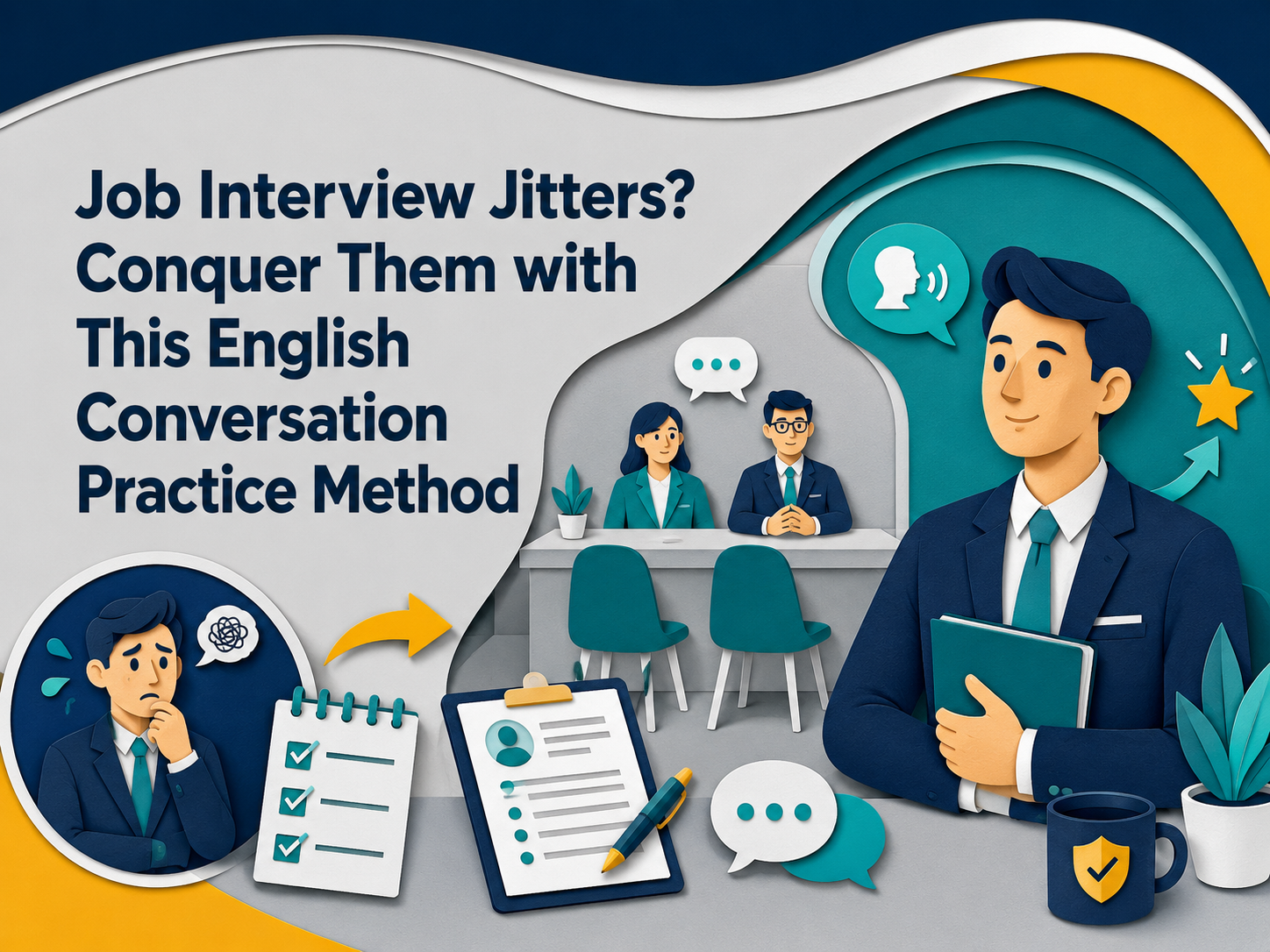
Job Interview Jitters? Conquer Them with This English Conversation Practice Method 💼
Intermediate Level | June 3, 2026
혼자서 기사를 소리 내어 읽거나 튜터를 따라 각 단락을 반복해서 읽으세요. 레벨...
Job interviews can make even confident professionals feel nervous. Your heart beats faster, your mouth gets dry, and suddenly the English words you know disappear like they’ve gone on vacation without permission. If you have ever felt this way, you are not alone. Many English learners can write strong emails and understand meetings, but job interviews feel different because the pressure is higher.
The good news is that you do not need perfect English to do well in an interview. You need preparation, structure, and practice. Today, let’s look at a simple English conversation practice method that can help you feel calmer, answer clearly, and show your real value.
Why Job Interviews Feel So Difficult
A job interview is not just a test of English. It is also a test of confidence, storytelling, listening, and quick thinking. That is a lot to manage at the same time. No wonder many people freeze when the interviewer asks, “Can you tell me about yourself?”
The problem is that many learners prepare by memorizing long answers. That seems smart at first, but it can cause trouble. If the interviewer asks the question in a slightly different way, the memorized answer may not fit. Then the speaker feels lost. Instead of memorizing full scripts, it is better to practice flexible answers that you can adjust in real time.
The English Conversation Practice Method for Interviews
A strong English conversation practice method for interviews has three parts: prepare your stories, practice speaking them aloud, and answer with a clear structure. Think of it like training for a sport. You do not wait until game day to learn the rules. You practice before the pressure arrives.
Start by choosing three to five professional stories from your experience. These stories should show your skills, personality, and problem-solving ability. For example, prepare one story about a challenge, one about teamwork, one about leadership, and one about learning from a mistake. These stories become your “interview toolbox.” When the interviewer asks a question, you can choose the right tool.
Step 1: Prepare Short Story Answers
Interviewers love stories because stories show who you are. Instead of saying, “I am responsible,” tell a short story that proves it. For example, you might explain how you handled a difficult deadline, supported a teammate, or solved a customer problem.
A useful structure is: situation, action, result. First, explain the situation briefly. Then describe what you did. Finally, explain the result. Keep it short and focused. You do not need a Hollywood movie plot. No explosions. No dramatic music. Just a clear professional example.
Step 2: Practice Out Loud
Reading your answer silently is helpful, but it is not enough. Interviews happen out loud, so your practice should happen out loud too. Choose one common interview question and answer it while speaking. Then repeat it again, but make it shorter. Then repeat it one more time, but make it more natural.
This kind of practice trains your mouth, brain, and confidence at the same time. It also helps you find difficult words before the real interview. If a sentence feels too hard to say, simplify it. Clear and simple English is usually stronger than complicated English.
Step 3: Use the Answer-Add-Ask Method
One of the best ways to keep interview answers natural is to use a simple conversation structure: answer, add, and ask. First, answer the question directly. Then add one useful detail or example. Finally, when appropriate, ask a professional follow-up question.
For example, if the interviewer asks, “Have you worked with international clients?” you might say, “Yes, I worked with clients from Singapore and Germany in my last role. I usually prepared short project updates and joined weekly calls to explain our progress. May I ask what kinds of international clients your team works with most often?”
This answer sounds confident because it is clear, specific, and conversational. It also shows that you are not just trying to survive the interview. You are thinking about the company’s needs.
How to Practice Before the Interview
Set a timer for 10 minutes and practice one interview question each day. You can start with simple questions like, “Tell me about yourself,” “Why are you interested in this role?” or “What is one challenge you handled at work?”
Record yourself if possible. Yes, hearing your own voice can feel strange. Almost everyone thinks, “Do I really sound like that?” Welcome to the club. But recording yourself helps you notice your speed, pronunciation, and confidence. After listening, choose one thing to improve. Do not try to fix everything at once.
Build Confidence Through Repetition
The purpose of practice is not to create a perfect answer. The purpose is to make your answer feel familiar. When your answer feels familiar, your stress goes down. When your stress goes down, your English usually improves.
Before your next interview, practice your strongest stories several times. Say them in different ways. Make one version formal, one version casual, and one version very short. This will help you adapt during the real conversation instead of sounding like a robot reading a company brochure.
Final Thoughts
Job interviews are stressful, but they are also opportunities. You are not there to beg for a job. You are there to show how your skills, experience, and personality can help the company solve problems. That shift in mindset can make a big difference.
Use this English conversation practice method to prepare your stories, practice out loud, and answer with structure. The more you practice, the more natural you will sound. You do not need perfect English to succeed. You need clear ideas, real examples, and the courage to speak.
Vocabulary List
- Jitters (noun) — Nervous feelings before an important event.
Example: She had job interview jitters before meeting the hiring manager. - Pressure (noun) — Stress caused by an important or difficult situation.
Example: He speaks well in meetings, but interviews create more pressure. - Flexible (adjective) — Able to change or adjust easily.
Example: Flexible answers are better than memorized scripts. - Toolbox (noun) — A set of useful tools, ideas, or skills.
Example: Your interview toolbox should include several professional stories. - Deadline (noun) — The final time or date when something must be finished.
Example: I handled a difficult deadline by organizing the team’s tasks. - Specific (adjective) — Clear and exact, not general.
Example: Specific examples make your interview answers stronger. - Follow-up question (noun) — A question asked after an answer to continue the conversation.
Example: She asked a follow-up question about the company’s international clients. - Pronunciation (noun) — The way a word is spoken.
Example: Recording yourself can help you improve your pronunciation. - Repetition (noun) — Doing or saying something again and again for practice.
Example: Repetition helps interview answers feel more natural. - Mindset (noun) — The way you think about something.
Example: A confident mindset can help you perform better in job interviews.
5 Questions About the Article
- Why do job interviews feel difficult for many English learners?
- Why is memorizing long answers sometimes a problem?
- What are the three parts of the English conversation practice method?
- How can professional stories help you answer interview questions?
- Why is recording yourself useful before an interview?
5 Open-Ended Discussion Questions
- What interview question makes you feel the most nervous? Why?
- What professional story could you prepare for your next interview?
- How do you usually practice before an important English conversation?
- What is one skill or achievement you want interviewers to remember about you?
- How can changing your mindset help you feel more confident in an interview?
📢 Want more tips like this? 👉 Sign up for the All About English Mastery Newsletter! Click here to join us!
Want to finally master English but don’t have the time? Mastering English for Busy Professionals is the course for you! Check it out now!
Follow our YouTube Channel @All_About_English for more great insights and tips.

 한국어
한국어  English