

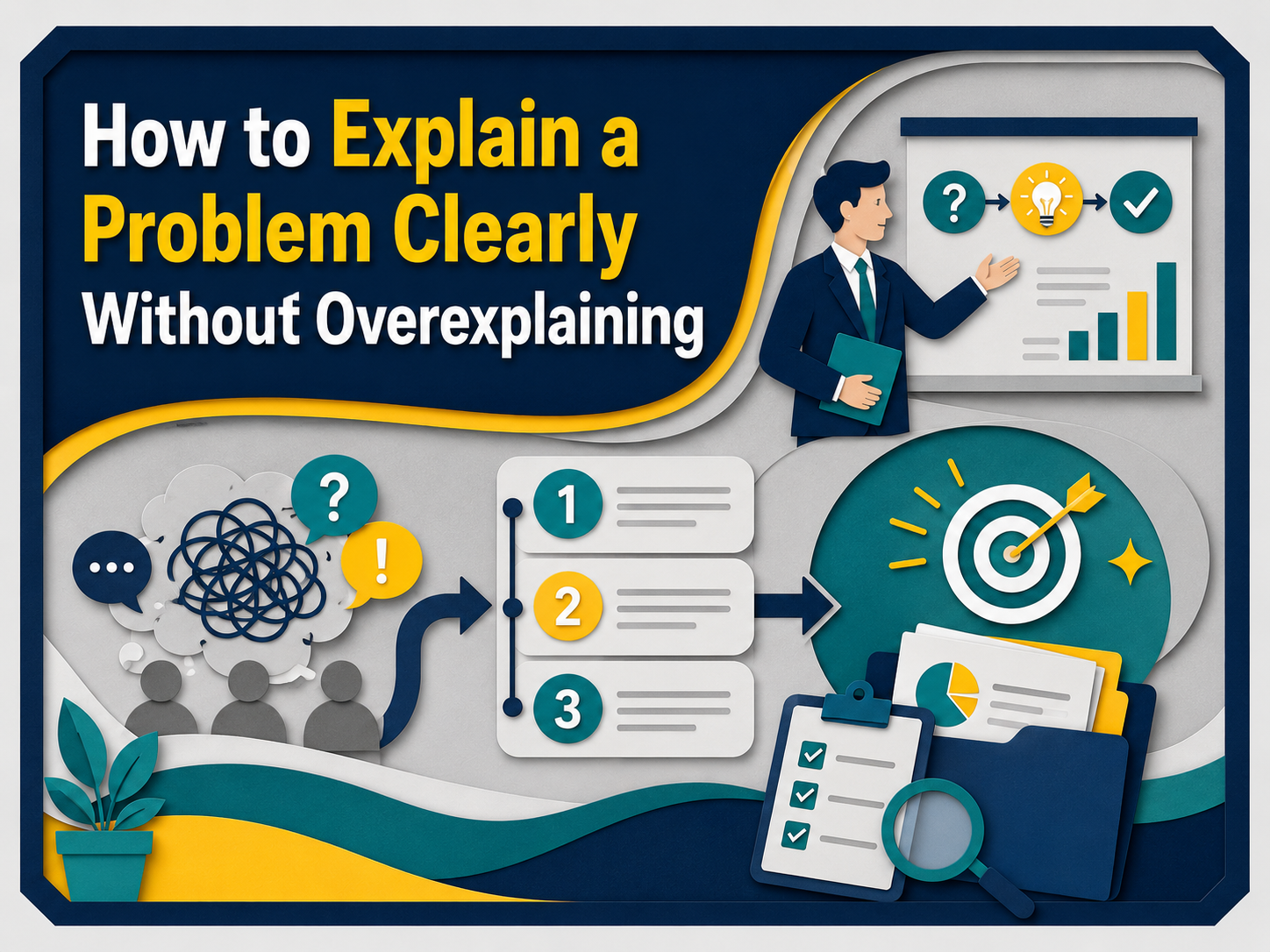
How to Explain a Problem Clearly Without Overexplaining 🧩
Advanced Level | June 17, 2026
혼자서 기사를 소리 내어 읽거나 튜터를 따라 각 단락을 반복해서 읽으세요. 레벨...
Explaining a problem clearly is one of the most valuable speaking skills you can build at work. Whether you are talking to your manager, updating a client, or joining a team meeting, people need to understand the problem quickly. But here is the tricky part: many professionals explain too much. They give every detail, every background point, and every possible reason. Before long, the listener looks lost, and the main point disappears like a missing file on someone’s desktop. Classic office magic.
If you want to explain a problem clearly, you need to organize your message before you speak. Clear problem explanation is not about saying more. It is about saying the right things in the right order. When you speak with structure, people can understand the issue, respond faster, and trust your judgment.
Why Clear Problem Explanation Matters
In business, unclear explanations waste time. Imagine a teammate says, “There is something wrong with the report, and maybe it started last week, but I’m not totally sure because we changed the system, and also the client sent new information…” After thirty seconds, nobody knows what the problem is. Now compare that with: “The report has incorrect sales numbers because the new system pulled last month’s data instead of this month’s data.” That is clear. It tells people what happened and why it matters.
Step 1: Start With the Main Problem
When you explain a problem, begin with the main issue first. Don’t start with the full history. Don’t describe every meeting that led to the problem. Start with one clear sentence: “The delivery is delayed because one supplier missed the deadline.” This helps the listener understand the situation immediately. After that, you can add supporting details if they are needed.
Step 2: Give Only the Necessary Context
Context is useful, but too much context becomes noise. A good rule is to ask yourself, “Does this detail help the listener understand the problem or make a decision?” If the answer is no, leave it out. For example, instead of saying, “We had several calls, and there were many discussions about the timeline,” say, “The timeline changed after the supplier confirmed a two-day delay.” Short, useful context keeps your explanation sharp.
Step 3: Separate Facts From Opinions
Advanced speakers sound more professional when they separate facts from opinions. A fact is something you know: “The client rejected the first draft.” An opinion is your interpretation: “I think they wanted a more detailed explanation.” Both can be useful, but don’t mix them together. Try saying, “The fact is that the client rejected the first draft. My understanding is that they wanted more detail.” This makes you sound careful, honest, and reliable.
Step 4: Explain the Impact
A problem becomes more important when people understand its impact. After explaining what happened, tell the listener why it matters. You can use phrases like, “This may affect…” or “The main risk is…” For example: “The main risk is that the client may not approve the project before Friday.” This helps your team focus on the result, not just the problem itself.
Step 5: Offer a Next Step
Don’t end with the problem floating in the air like a sad little balloon. Give a next step. You might say, “I recommend we contact the supplier today and update the client by tomorrow morning.” Even if you are not the final decision-maker, suggesting a next step shows responsibility. It also helps the conversation move from confusion to action.
A Simple Formula to Explain a Problem Clearly
Here is a useful structure you can practice:
Problem → Cause → Impact → Next Step
For example: “The report is delayed because we are still waiting for final numbers from finance. This may affect tomorrow’s client update. I recommend we send a short status message today and share the final report tomorrow.” This format is simple, professional, and easy to remember. When you use it often, you will learn to explain a problem clearly without overexplaining.
Vocabulary List
- Overexplain (verb) — To explain something with too many unnecessary details.
Example: He overexplained the issue, so the team lost focus. - Structure (noun) — An organized way of arranging information.
Example: A clear structure helps people understand your message faster. - Context (noun) — Background information that helps explain a situation.
Example: She gave enough context for the manager to understand the delay. - Necessary (adjective) — Needed or important.
Example: Please include only the necessary details in your update. - Reliable (adjective) — Able to be trusted.
Example: He sounds reliable because he explains problems clearly. - Impact (noun) — The effect or result of something.
Example: The delay may have a serious impact on the project timeline. - Risk (noun) — A possible problem or danger.
Example: The main risk is that the client may lose confidence. - Interpretation (noun) — Your understanding or opinion about what something means.
Example: My interpretation is that the client wanted a clearer proposal. - Decision-maker (noun) — A person who has the authority to make a decision.
Example: We need to explain the issue clearly to the decision-maker. - Recommend (verb) — To suggest a good action or choice.
Example: I recommend sending the client an update today.
5 Questions About the Article
- Why is explaining a problem clearly important at work?
- What should you say first when explaining a problem?
- Why can too much context become a problem?
- What is the difference between a fact and an opinion?
- What are the four parts of the problem explanation formula?
5 Open-Ended Discussion Questions
- When was the last time you had to explain a problem at work?
- What kinds of details do people often include even when they are not necessary?
- How can you sound professional when you are not completely sure about the cause of a problem?
- What phrases do you use when explaining risks or impact?
- Which part is hardest for you: explaining the problem, cause, impact, or next step?
📢 Want more tips like this? 👉 Sign up for the All About English Mastery Newsletter! Click here to join us!
Want to finally Master English but don’t have the time? Mastering English for Busy Professionals is the course for you! Check it out now!
Follow our YouTube Channel @All_About_English for more great insights and tips.


 한국어
한국어  English