

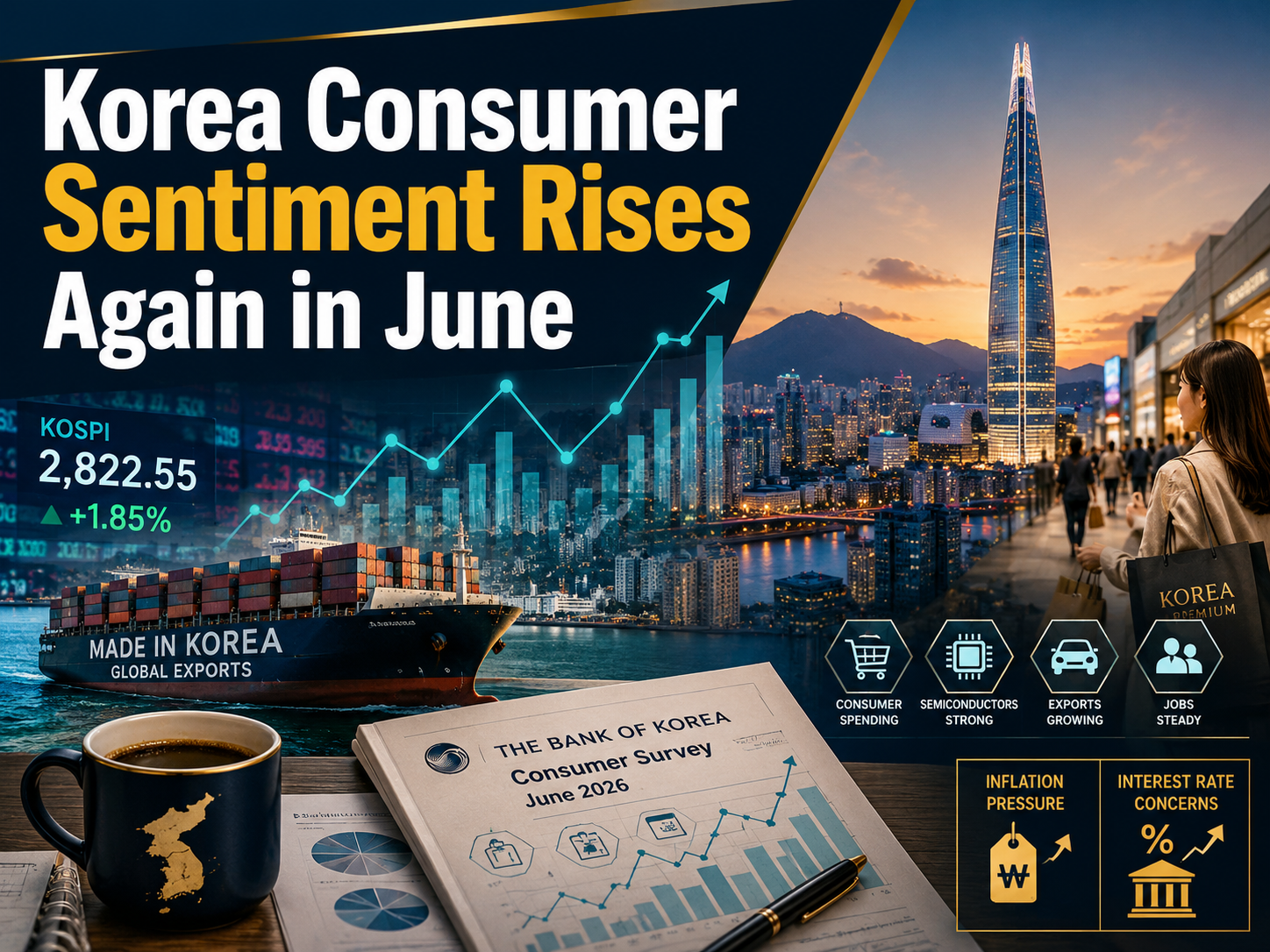
Korea Consumer Sentiment Rises Again in June
Intermediate | June 26, 2026
✨ 혼자서 기사를 소리 내어 읽거나 튜터를 따라 각 단락을 반복해서 읽으세요. 레벨...
Korea Consumer Sentiment Rises for a Second Month
South Korean consumers became a little more confident in June, according to new data reported by The Korea Times / Yonhap. The country’s Composite Consumer Sentiment Index, or CCSI, reached 106.6, up from 106.1 in May. That may sound like a small move, but it matters because it was the second month in a row that consumer sentiment improved. (The Korea Times / Yonhap)
The CCSI is a useful number because it shows how ordinary people feel about the economy. When the index is above 100, it means more people are optimistic than pessimistic. In simple English: more people are saying, “Things may be getting better,” instead of “Uh-oh, here we go again.” Financial News also noted that the survey was conducted from June 9 to 16 among 2,500 urban households. (Financial News)
Strong Exports Help Lift Confidence
One big reason for the better mood was South Korea’s strong export performance. According to government data from the Ministry of Finance and Economy, exports in May jumped 53.2% from a year earlier, helped by strong demand for semiconductors, computers, and ships. Average daily exports also rose sharply. (Ministry of Finance and Economy)
This is important because South Korea’s economy depends heavily on exports. When companies sell more goods overseas, especially high-value products like chips, it can support jobs, company profits, and investor confidence. For many workers, that can make the economy feel a little more stable.
The Stock Market Rally Also Helped
The Bank of Korea also pointed to the stock market rally as another reason consumer sentiment improved. When stock prices rise, people often feel more positive about the future. Some households may feel wealthier, and investors may feel that companies are moving in the right direction. (Bank of Korea)
This does not mean every family suddenly has more money in the bank. But confidence often works like a mood in the room. If exports are strong and stock prices are moving up, people may feel that the economy has some momentum. That kind of feeling can affect spending, saving, and business decisions.
But Inflation Is Still a Problem
Even with the better sentiment, the story is not all sunshine and victory music. Consumer prices rose 3.1% in May from a year earlier, which was the fastest increase in about 26 months, according to the government’s June economic report. Higher prices can make people nervous, especially when they are buying food, fuel, housing, or everyday goods. (Ministry of Finance and Economy)
The Bank of Korea has said it will work to control inflation. This matters because if prices keep rising too quickly, consumers may stop spending. In business terms, confidence can cool off fast if people feel their monthly budget is getting squeezed.
People Feel Better Now, But Worry About What Comes Next
The details inside the survey show a mixed picture. People’s view of current economic conditions improved, rising to 86, but their outlook for future economic conditions slipped slightly to 92. In other words, people may feel that things are better than before, but they are not completely relaxed about the road ahead. (Financial News)
There were also growing worries about interest rates and housing prices. The interest-rate outlook index jumped to 126, meaning many people expect rates to rise. The housing-price outlook index also climbed to 120, partly because apartment and jeonse prices have been rising in Seoul and Gyeonggi Province. (Financial News)
Why This Story Matters
The Korea consumer sentiment rises story is important because confidence affects real behavior. If people feel better about the economy, they may be more willing to spend, invest, or make long-term plans. But if inflation, interest rates, and housing costs keep rising, that confidence could become fragile.
For English learners, this is also a great business-news story because it connects many useful ideas: exports, inflation, consumer confidence, stock markets, and interest rates. These are the kinds of topics professionals discuss in meetings, reports, and casual business conversations. Not exactly coffee-machine gossip, but hey, it beats talking about the weather every day.
Vocabulary
- Consumer sentiment (noun) – how people feel about the economy.
Example: “Consumer sentiment improved in June because exports were strong.” - Index (noun) – a number used to measure changes in something.
Example: “The CCSI is an index that measures consumer confidence.” - Optimistic (adjective) – expecting good things to happen.
Example: “More consumers became optimistic about the economy.” - Pessimistic (adjective) – expecting bad things to happen.
Example: “A number below 100 means people are more pessimistic.” - Export (noun/verb) – a product sold to another country; to sell goods overseas.
Example: “South Korea exports semiconductors, ships, and computers.” - Semiconductor (noun) – a small electronic part used in computers, phones, cars, and AI technology.
Example: “Semiconductors helped drive Korea’s export growth.” - Stock market rally (noun phrase) – a period when stock prices rise strongly.
Example: “The stock market rally helped improve consumer sentiment.” - Inflation (noun) – a general rise in prices.
Example: “Inflation made many families worry about their monthly budget.” - Interest rate (noun) – the cost of borrowing money, usually shown as a percentage.
Example: “Higher interest rates can make loans more expensive.” - Momentum (noun) – movement or progress that continues to build.
Example: “Strong exports gave the economy positive momentum.”
Discussion Questions About the Article
- What happened to South Korea’s consumer sentiment index in June?
- Why is a CCSI reading above 100 important?
- What industries helped South Korea’s exports grow?
- Why can a stock market rally improve consumer confidence?
- What economic worries still remain, even though sentiment improved?
Discussion Questions About the Topic
- Do you think consumer confidence affects how people spend money? Why?
- How do rising prices change people’s daily decisions?
- Why are exports so important for countries like South Korea?
- Would higher interest rates make you more careful with money?
- What signs do you look for when deciding whether the economy is getting better or worse?
Related Idiom
“A mixed bag” – a situation with both good and bad parts.
Example: “South Korea’s June consumer sentiment report was a mixed bag: confidence improved, but inflation and interest-rate worries remained.”
📢 Want more practical English through real news stories? Sign up for the All About English Mastery Newsletter here: allaboutenglishmastery.com/newsletter
Want to build stronger English in less time? Check out Mastering English for Busy Professionals.
Follow our YouTube channel @All_About_English for more English tips and practice.
This article was inspired by: The Korea Times / Yonhap, Yonhap News Agency, Bank of Korea, Ministry of Finance and Economy, and Financial News


 한국어
한국어  English