

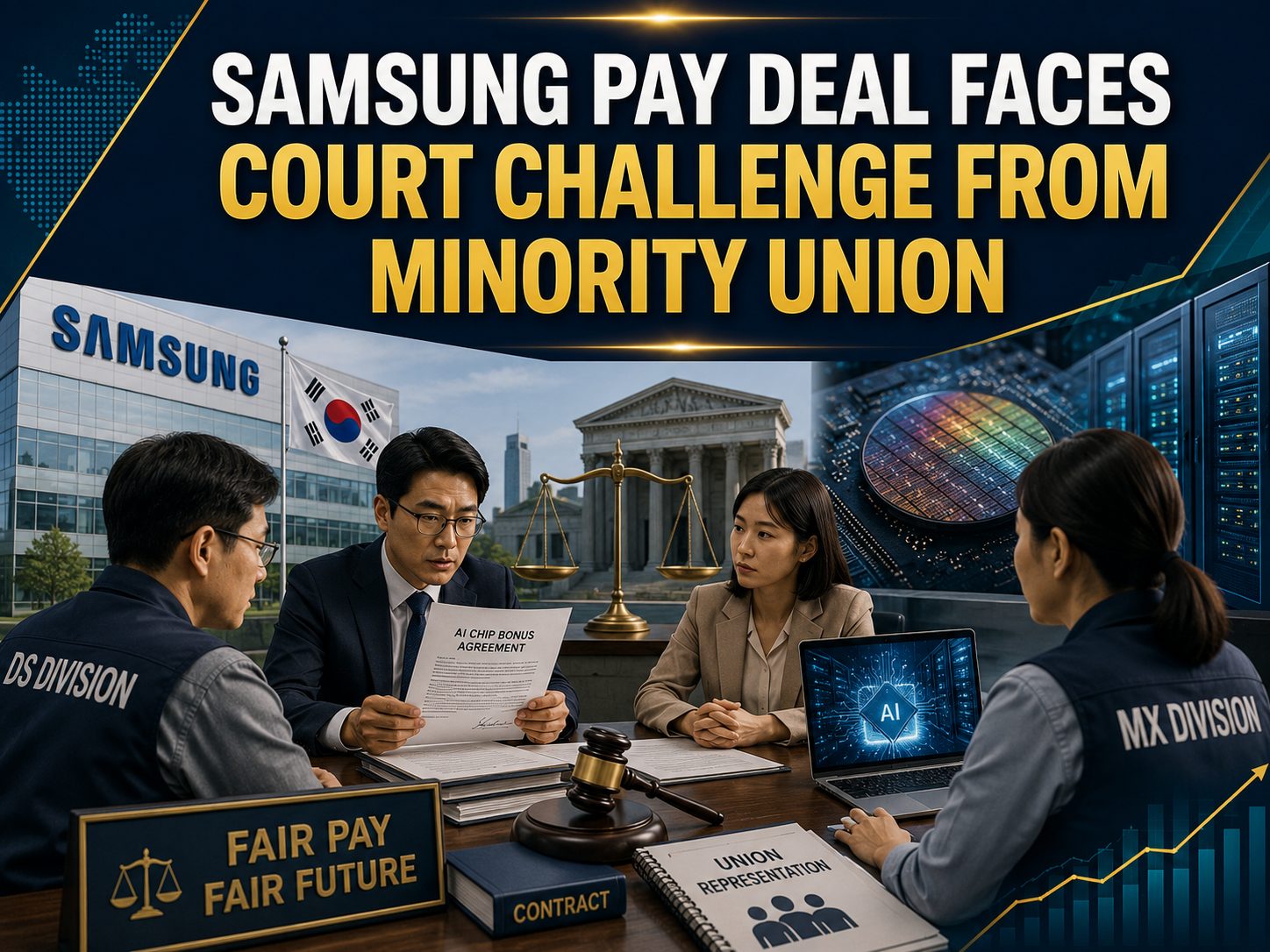
Samsung Pay Deal Faces Court Challenge From Minority Union
Intermediate | June 3, 2026
✨ 혼자서 기사를 소리 내어 읽거나 튜터를 따라 각 단락을 반복해서 읽으세요. 레벨...
Samsung Pay Deal Faces a New Legal Fight
A Samsung pay deal is now facing a court challenge from a minority labor union in South Korea. The Samsung Electronics Co Union, or SECU, represents about 13,000 workers, mostly from Samsung’s smartphone, TV, and home appliance divisions. According to Reuters, SECU plans to ask a South Korean court to suspend the implementation of a pay deal that mainly benefits employees in Samsung’s chip division. (Reuters)
The dispute started after two other unions, including Samsung’s biggest union, approved the agreement. The deal was important because it helped Samsung avoid a planned 18-day strike by 48,000 workers. That strike could have disrupted Samsung’s operations and caused problems for South Korea’s economy, since Samsung is one of the country’s most important companies. (Reuters)
Why the Samsung Pay Deal Is So Controversial
The Samsung pay deal is controversial because workers in different parts of the company may receive very different rewards. Samsung’s memory chip division has done extremely well because of the global AI boom. Demand for memory chips has increased as companies build more AI data centers and need more advanced hardware. Because of that, Samsung agreed to set aside 10.5% of its semiconductor operating profit for special bonuses for chip workers. (Reuters)
Some memory chip workers could receive bonuses of around $416,000 this year, mostly in stock. The Guardian reported that workers in Samsung’s memory chip division are expected to receive average bonuses of about £310,000, while other divisions, such as consumer electronics, may receive much smaller bonuses. That difference is at the heart of the conflict. (The Guardian, Reuters)
A Minority Union Says Its Rights Were Ignored
SECU says it was unfairly left out of the voting process. Reuters reported that the union first tried to block the vote with an injunction. After the vote passed, SECU said it would revise its legal documents and ask the court to suspend the deal’s implementation. A lawyer for the union said the court could make a ruling within about a month. (Reuters)
Yonhap News Agency reported that the union filed its request with the Suwon District Court, arguing that its members’ rights to equality and voting were not respected. The union said it would fight for a “rational alternative” for workers in the Device Experience, or DX, division. This division includes Samsung’s consumer-facing businesses, such as TVs and household appliances. (Yonhap News Agency)
AI Profits Create a Workplace Divide
This story is bigger than one company bonus plan. It shows how the AI boom is changing the workplace. Some workers are close to the most profitable parts of the AI supply chain, such as memory chips. Other workers are in important divisions, but they may not directly benefit from the same profit surge. That can create resentment inside a company.
Reuters reported that some workers outside Samsung’s memory chip division are frustrated by the gap. One chip foundry worker told Reuters that the atmosphere was “gloomy” and that many people had lost motivation. That is a powerful business lesson: even a generous pay deal can create problems if employees feel the system is unfair. (Reuters)
What This Means for Samsung and South Korea
For Samsung, the challenge is not only legal. It is also about trust, morale, and internal communication. The company may have avoided a major strike, but now it has to manage tension between different groups of workers. In business English, we might say Samsung has to bridge internal divides and restore employee confidence.
The issue could also affect other major companies in South Korea. Reuters reported that the Samsung agreement may encourage other unions to ask for a fixed percentage of operating profit as bonuses. Unions at companies such as Kakao, LG Uplus, HD Hyundai Heavy Industries, and Samsung Biologics have also pushed for profit-linked pay demands. In other words, this one Samsung pay deal may influence labor negotiations far beyond Samsung itself. (Reuters)
Vocabulary
- Minority union (noun) – a smaller union that represents fewer workers than the main union.
Example: The minority union challenged the pay deal in court. - Pay deal (noun) – an agreement about wages, bonuses, or benefits.
Example: Samsung workers voted on a new pay deal. - Suspend (verb) – to temporarily stop something from happening.
Example: SECU wants the court to suspend the agreement. - Implementation (noun) – the process of putting a plan into action.
Example: The union wants to stop the implementation of the pay deal. - Injunction (noun) – a court order that stops someone from doing something.
Example: The union filed an injunction to block the vote. - Semiconductor (noun) – a material or chip used in electronic devices.
Example: Samsung’s semiconductor division has benefited from the AI boom. - Operating profit (noun) – profit from a company’s normal business activities.
Example: Samsung agreed to use part of its semiconductor operating profit for bonuses. - Bonus (noun) – extra money paid in addition to regular salary.
Example: Some memory chip workers may receive very large bonuses. - Morale (noun) – the confidence, motivation, and mood of a group.
Example: Unequal bonuses can hurt employee morale. - Labor negotiation (noun) – discussions between workers or unions and management about pay and work conditions.
Example: The Samsung case could influence labor negotiations at other companies.
Discussion Questions (About the Article)
- What does SECU want the South Korean court to do?
- Which Samsung workers does SECU mostly represent?
- Why did many chip workers support the pay deal?
- Why are some workers outside the memory chip division unhappy?
- How could this dispute affect Samsung’s internal morale?
Discussion Questions (About the Topic)
- Should workers in more profitable divisions receive much larger bonuses?
- How can a company reward top-performing divisions without upsetting other workers?
- What role should unions play in large companies?
- Should bonuses be linked to operating profit? Why or why not?
- How might the AI boom change pay expectations in other industries?
Related Idiom
“A double-edged sword” – something that has both good and bad effects.
Example: “The Samsung pay deal is a double-edged sword: it rewards chip workers, but it also creates tension with other divisions.”
📢 Want more practical English through real news stories? Sign up for the All About English Mastery Newsletter here: allaboutenglishmastery.com/newsletter
Want to build stronger English in less time? Check out Mastering English for Busy Professionals.
Follow our YouTube channel @All_About_English for more English tips and practice.
This article was inspired by: Reuters, Reuters, Reuters, Yonhap News Agency, and The Guardian


 한국어
한국어  English