

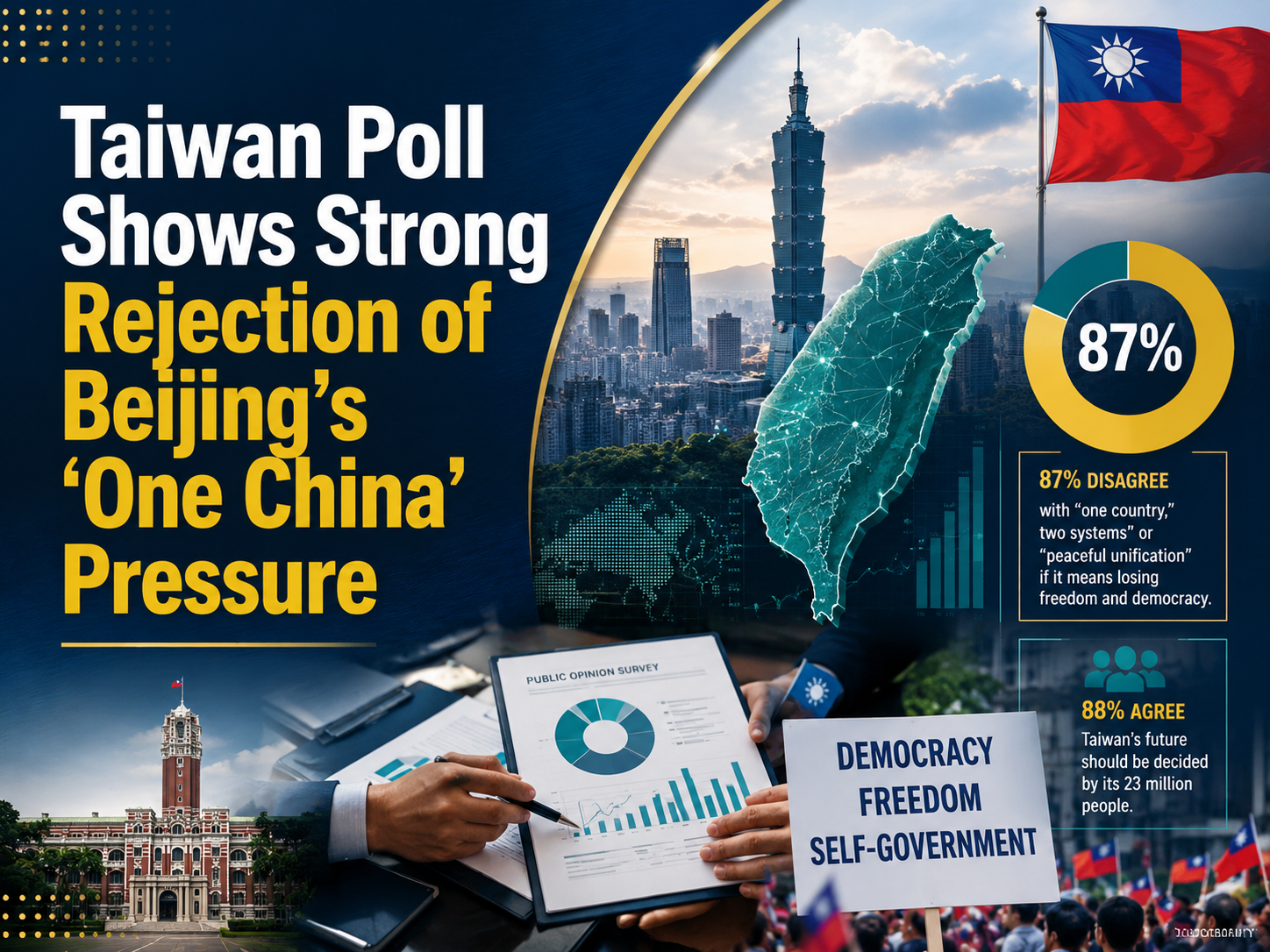
Taiwan Poll Shows Strong Rejection of Beijing’s “One China” Pressure
Intermediate | June 8, 2026
✨ 혼자서 기사를 소리 내어 읽거나 튜터를 따라 각 단락을 반복해서 읽으세요. 레벨...
A Clear Message from Taiwan
A new survey in Taiwan shows that many people strongly reject Beijing’s political pressure and its idea of “one country, two systems.” According to the Taipei Times, the poll was commissioned by Taiwan’s Mainland Affairs Council and conducted by Ipsos. It found that about 87 percent of respondents disagreed with accepting China’s “one country, two systems” proposal and “peaceful unification” if that meant losing freedom and democracy under Chinese Communist Party rule. (Taipei Times)
Why the Taiwan Poll Shows Strong Rejection
The Taiwan poll shows strong rejection not only of one policy idea, but also of Beijing’s view of Taiwan’s political status. The survey found that 79.7 percent of respondents did not agree with China’s description of Taiwan as a local government or a special administrative district instead of the Republic of China. In simple terms, many people in Taiwan do not accept the idea that Beijing has the right to define what Taiwan is. (Taipei Times)
Support for the Status Quo
The same survey found that nearly 86 percent of respondents agreed that maintaining the current cross-strait “status quo” is the most important thing for Taiwan right now. That means many people do not want sudden political change, military conflict, or forced unification. They want stability. In business English, we might say people want to “keep things steady” instead of making a risky move. (Taiwan News)
Taiwan’s Future: Who Gets to Decide?
One of the strongest findings was that 88 percent of respondents agreed Taiwan’s future should be decided by its 23 million people. This is an important idea in Taiwan’s politics. Beijing says Taiwan is part of China, but Taiwan’s government says only Taiwanese people have the right to decide their own future. Reuters also reported in April that President Lai Ching-te’s government rejected Beijing’s renewed campaign promoting unification. (Reuters)
Concerns About Beijing’s Actions
The survey also showed concern about Beijing’s recent actions. About 82 percent of respondents disapproved of Beijing’s obstruction of President Lai Ching-te’s overseas visit to Eswatini. In addition, 47.4 percent said China was disrupting peace in the Taiwan Strait, while 33.3 percent said both Taiwan and China were responsible for disrupting peace. That split is interesting because it shows people may agree on rejecting Beijing’s political plan, but they do not all explain the tensions in exactly the same way. (Taipei Times)
Defense and Cross-Strait Relations
The poll also found that 71.9 percent supported increasing Taiwan’s defense funding. Supporters likely see this as a way to make Taiwan safer and harder to pressure. Reuters reported that China regularly sends military aircraft and ships near Taiwan and refuses to rule out the use of force. Beijing says its actions are justified, while Taiwan sees them as pressure tactics. This is why defense, diplomacy, and public opinion are all connected in this story. (Reuters)
The Bigger Picture
For English learners, this story is useful because it includes many important words for discussing politics, public opinion, and international relations. It also shows how survey results can explain the mood of a country. The main takeaway is simple: many Taiwanese people want to protect their democracy, maintain stability, and decide their own future. That is not just a political position. It is a clear message about identity, security, and self-government.
Vocabulary
- Survey (noun) – a set of questions used to learn what people think.
Example: “The survey asked Taiwanese people about cross-strait relations.” - Reject (verb) – to say no to an idea, offer, or plan.
Example: “Many respondents rejected Beijing’s political proposal.” - Respondent (noun) – a person who answers questions in a survey.
Example: “Each respondent shared an opinion about Taiwan’s future.” - Proposal (noun) – a suggested plan or idea.
Example: “Beijing’s proposal was not accepted by most people in the poll.” - Status quo (noun) – the current situation.
Example: “Many Taiwanese people support maintaining the status quo.” - Unification (noun) – the act of joining two places or groups into one.
Example: “Beijing continues to promote peaceful unification with Taiwan.” - Democracy (noun) – a system where people choose their leaders through elections.
Example: “Many respondents said they did not want to lose democracy.” - Obstruction (noun) – an action that blocks or prevents something.
Example: “The survey asked people about Beijing’s obstruction of Lai’s overseas visit.” - Defense funding (noun) – money used to support a country’s military and security.
Example: “More than 70 percent of respondents supported increasing defense funding.” - Self-government (noun) – the ability of a place or people to govern themselves.
Example: “The poll showed strong support for Taiwan’s self-government.”
Discussion Questions (About the Article)
- What did the survey say about Taiwan’s view of “one country, two systems”?
- Why is the number 87 percent important in this story?
- What does “maintaining the status quo” mean in cross-strait relations?
- Why is the idea that Taiwan’s future should be decided by its 23 million people important?
- What did the survey show about Taiwanese views on defense funding?
Discussion Questions (About the Topic)
- Why do you think many people prefer stability during political tension?
- Should a country’s future be decided only by the people who live there? Why or why not?
- How can public opinion surveys influence government policy?
- Why do you think democracy and national identity are often connected?
- How should small or medium-sized democracies respond to pressure from larger powers?
Related Idiom
“Draw a line in the sand” – to set a clear limit and show that you will not accept something beyond that point.
Example: “For many Taiwanese people, rejecting ‘one country, two systems’ is like drawing a line in the sand about their future.”
📢 Want more practical English through real news stories? Sign up for the All About English Mastery Newsletter here: allaboutenglishmastery.com/newsletter
Want to build stronger English in less time? Check out Mastering English for Busy Professionals.
Follow our YouTube channel @All_About_English for more English tips and practice.
This article was inspired by: Taipei Times, Taiwan News, and Reuters


 한국어
한국어  English