

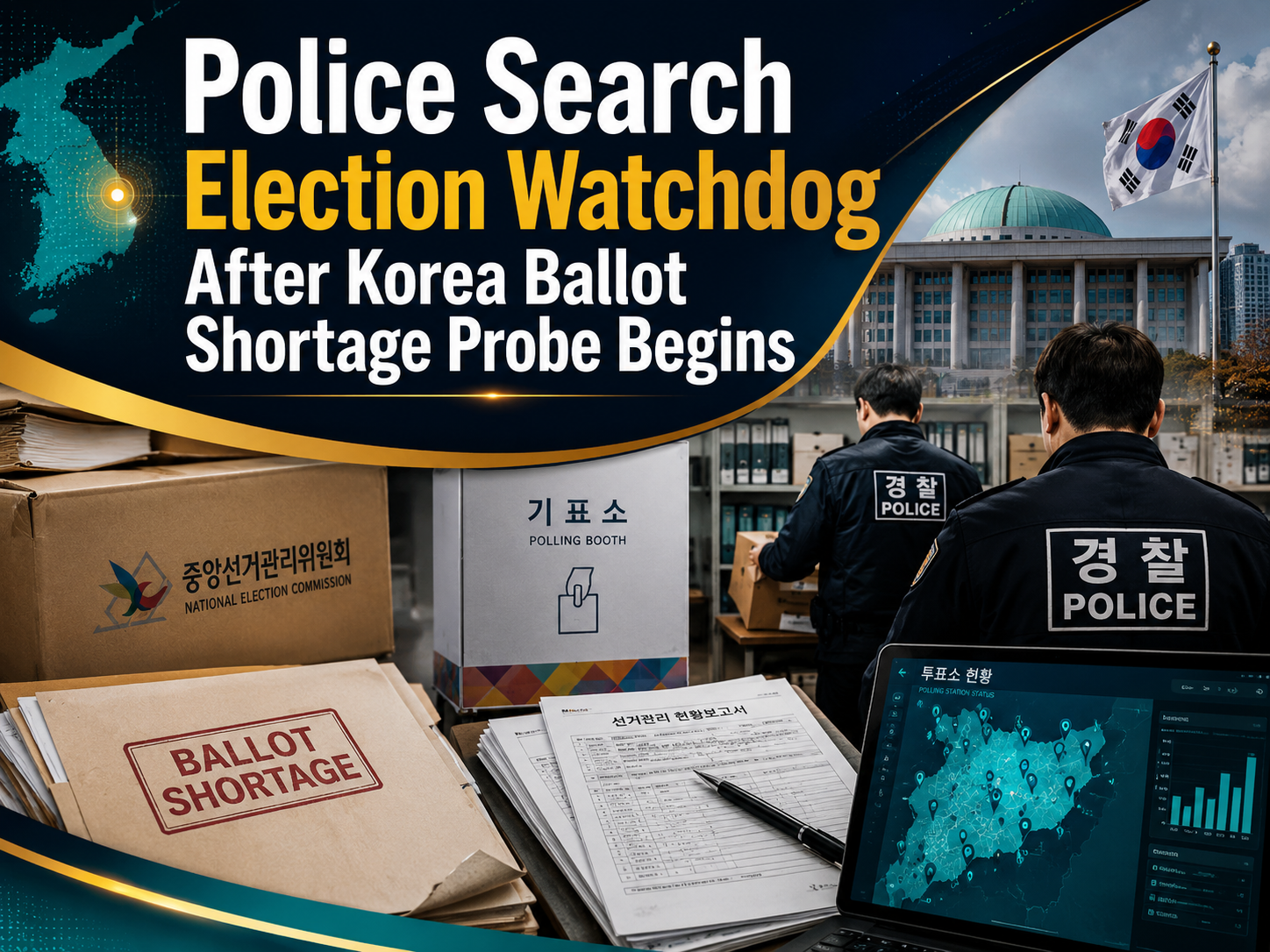
Police Search Election Watchdog After Korea Ballot Shortage Probe Begins
Intermediate | June 20, 2026
✨ Read the article aloud on your own or repeat each paragraph after your tutor.
A Serious Investigation After Local Election Problems
South Korea’s National Election Commission, or NEC, is facing a serious investigation after ballot shortages disrupted the country’s June 3 local elections. According to reports from The Korea Times and Yonhap News Agency, police raided the NEC headquarters in Gwacheon and several local election offices in Seoul on June 11, 2026.
The Korea ballot shortage probe began after some polling stations ran out of ballot papers during voting. This caused voting to stop temporarily at 26 polling stations nationwide, mostly in Seoul’s Songpa Ward. For voters, this was not just a small paperwork problem. It raised a bigger question: could every eligible citizen fully exercise their right to vote?
Why the Korea Ballot Shortage Probe Matters
Police said more than 100 investigators were involved in the search and seizure operation. The raid lasted about 13 hours and covered seven locations, including the NEC headquarters and local offices connected to the shortage. Investigators reportedly collected documents related to the ballot printing plan, including records showing how many ballots were printed and where they were stored on election day.
Police are looking into possible violations of the Public Official Election Act and possible dereliction of duty. In plain English, that means investigators want to know whether election officials failed to do their jobs properly. Former NEC Chairman Rho Tae-ak, who resigned after the controversy, was reportedly listed as a suspect in the search warrant.
Protests Grow as Voters Demand Answers
The ballot shortage also led to public anger. According to Reuters, the NEC said 50 of 14,300 polling stations ran out of ballots, and voting was temporarily suspended at 22 stations because replacement ballots were delayed. In Seoul’s Songpa district, a conservative-leaning area, delays were reported at several locations.
Thousands of people protested near a vote-counting site in Seoul, demanding a re-run of the elections. Reuters reported that around 10,000 people gathered at the SK Olympic Handball Stadium on June 6. Some protesters waved South Korean flags, sang the national anthem, and blocked NEC officials from leaving the site.
President Lee Calls for a Thorough Investigation
President Lee Jae Myung said he deeply regretted the ballot shortage and called for a full investigation. He said police and prosecutors would be involved and asked parliament to look into what happened. He also said the NEC’s explanations were not enough.
This is where the story becomes bigger than one election day mistake. Local elections choose mayors, local officials, and assembly members. These leaders make decisions about transportation, housing, education, and public services. So, when voters feel that the process was not handled properly, public trust takes a hit. And once trust is damaged, getting it back is not exactly a walk in the park.
Investigators Look for the Cause
Follow-up reporting from Yonhap said a joint team of police and prosecutors planned to question front-line NEC officials before questioning senior officials. Investigators also completed a search of NEC servers to secure internal messages and other records.
The key question is simple: was this just poor planning, or was there something more serious behind the shortage? Investigators are examining whether officials had undue influence over the printing of ballots and how they responded when polling stations began running out of papers.
A Lesson in Trust and Public Systems
The Korea ballot shortage probe is important because elections depend on trust. Even if the final results do not change, people need to believe the process was fair, organized, and transparent. When the system fails — even because of a logistical mistake — citizens naturally want answers.
For English learners, this story is also useful because it includes common business and civic vocabulary: investigation, shortage, transparency, accountability, and public trust. These words are not only useful for politics. You can also use them at work when discussing project problems, management issues, or decision-making processes.
Vocabulary
- Watchdog (noun) – an organization that checks whether rules are being followed.
Example: “The NEC is South Korea’s election watchdog.” - Ballot (noun) – a paper or system used to vote in an election.
Example: “Some polling stations ran out of ballots.” - Shortage (noun) – a situation where there is not enough of something.
Example: “The ballot shortage caused voting delays.” - Raid (noun/verb) – a sudden search by police or officials.
Example: “Police raided the election commission’s offices.” - Investigation (noun) – an official effort to find the truth about something.
Example: “The investigation will look into why ballots ran out.” - Dereliction of duty (noun phrase) – failure to do one’s official responsibility.
Example: “Officials may face questions about dereliction of duty.” - Polling station (noun) – a place where people vote.
Example: “Voting stopped temporarily at several polling stations.” - Transparency (noun) – openness and clarity in how decisions are made.
Example: “Citizens want more transparency from election officials.” - Accountability (noun) – responsibility for actions or mistakes.
Example: “The public is demanding accountability after the voting problems.” - Re-run (noun) – a second election or vote held again.
Example: “Some protesters demanded a re-run of the local elections.”
Discussion Questions About the Article
- What problem caused police to investigate the National Election Commission?
- How many polling stations temporarily suspended voting because of the ballot shortage?
- Why did protesters gather near the vote-counting site in Seoul?
- What role did President Lee Jae Myung play after the controversy?
- What are investigators trying to find out about the ballot shortage?
Discussion Questions About the Topic
- Why is trust important in elections?
- Should election officials face strong punishment for serious mistakes? Why or why not?
- What can governments do to prevent ballot shortages in future elections?
- How should officials communicate with the public during a voting problem?
- Have you ever experienced a situation where poor planning caused a big problem?
Related Idiom
“Drop the ball” – to make a mistake or fail to handle something properly.
Example: “Many voters believe the election commission dropped the ball when polling stations ran out of ballots.”
This idiom fits the story because the issue appears to involve poor planning or poor response during an important public event.
📢 Want more practical English through real news stories? Sign up for the All About English Mastery Newsletter here: allaboutenglishmastery.com/newsletter
Want to build stronger English in less time? Check out Mastering English for Busy Professionals.
Follow our YouTube channel @All_About_English for more English tips and practice.
This article was inspired by: The Korea Times, Yonhap News Agency, Reuters, and KBS World


 English
  한국어
한국어