

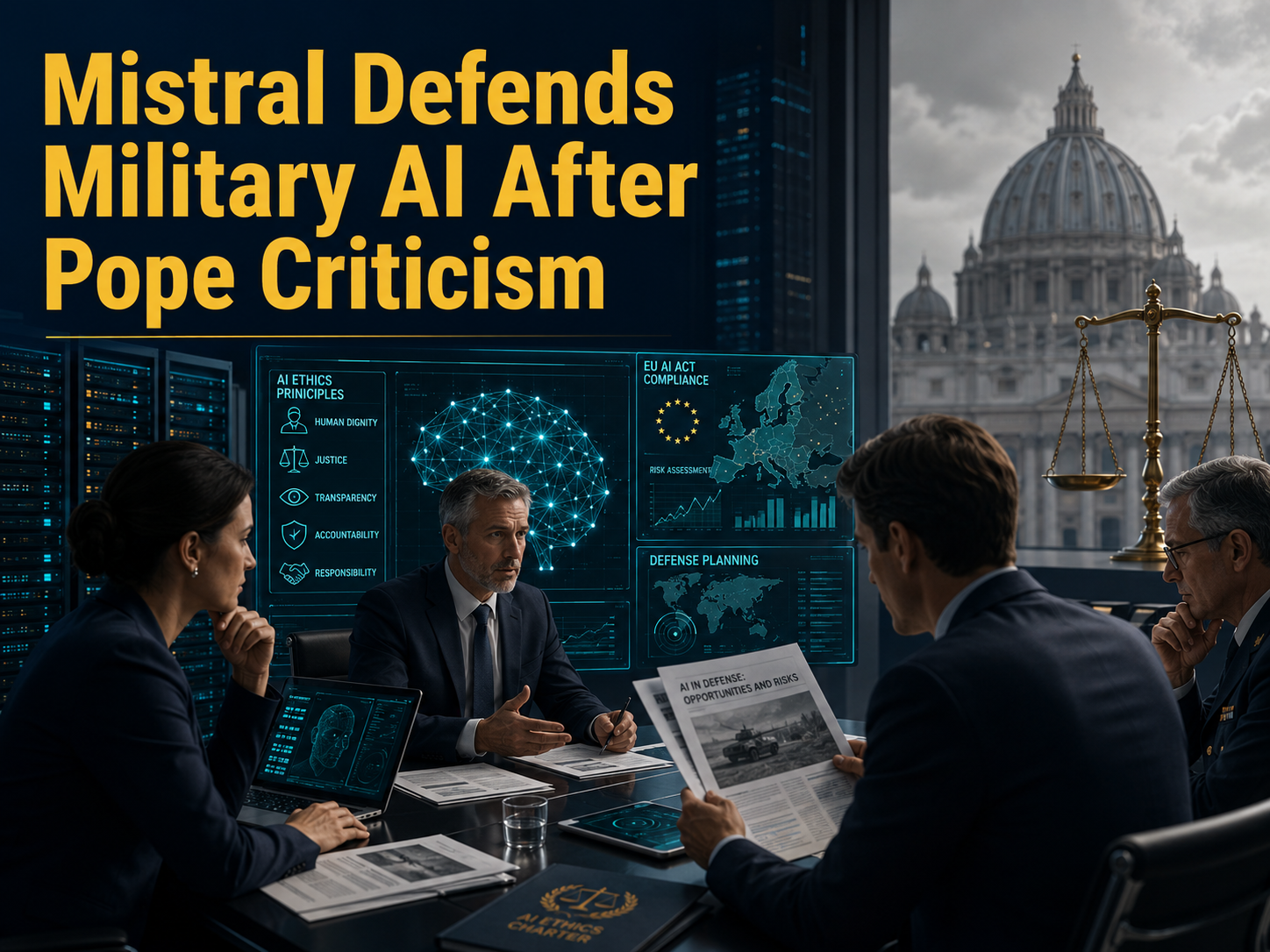
Mistral Defends Military AI After Pope Criticism
Advanced | June 2, 2026
✨ Read the article aloud on your own or repeat each paragraph after your tutor.
Mistral Military AI Debate Grows After Pope Warning
French AI company Mistral is defending its work with military artificial intelligence after criticism from Pope Leo XIV, who recently warned that AI could make modern warfare more dangerous. According to Reuters, Mistral CEO Arthur Mensch pushed back against the Pope’s comments, saying Europe needs its own AI tools because rivals and adversaries are already using the technology.
The debate over Mistral military AI is important because it sits at the intersection of technology, defense, business, and ethics. Mistral is one of Europe’s most important AI startups, and it already provides AI models to the French military. For supporters, that makes Mistral part of Europe’s technological sovereignty. For critics, it raises a serious question: how far should private AI companies go in supporting military systems?
Why the Mistral Military AI Story Matters
The Mistral military AI debate matters because artificial intelligence is no longer only about chatbots, search tools, or office productivity. Governments are increasingly interested in AI for intelligence, logistics, cybersecurity, surveillance, and battlefield decision-making. That means AI companies are now part of national security conversations, whether they want to be or not.
Mensch argued that Europe cannot simply stand back while other countries develop military AI. Reuters quoted him as saying that Mistral supports peace, but Europe still needs its own capabilities when rivals are using artificial intelligence. In business terms, this is a classic risk-management argument: if competitors or adversaries are investing in a powerful tool, ignoring it may create an even bigger risk.
Pope Leo Calls for Stronger AI Regulation
Pope Leo’s criticism came from his first major document on artificial intelligence, an encyclical called Magnifica Humanitas. According to Reuters, the Pope urged world leaders to slow down and regulate AI more carefully. He warned that AI systems could spread misinformation, increase conflict, and create weapons that operate beyond meaningful human control.
The Pope also criticized the use of AI in warfare and warned that modern technology could make war easier to start and harder to control. His concern was not only technical; it was moral. He argued that human dignity, human judgment, and responsibility must stay at the center of decisions involving powerful technology.
Mistral Expands Its Business and Defense Role
The timing of the debate is especially interesting because Mistral is also expanding quickly. Reuters reported that the company announced a new 10-megawatt data centre in Les Ulis, France, expected to open in the third quarter of 2026. The company has also announced data centre projects in Sweden and France as part of a broader €4 billion investment plan to reach 200 megawatts of computing power by the end of 2027.
Mistral also said Airbus had become a client across commercial, defense, and space sectors. That matters because Airbus is not just an airplane company; it is also a major aerospace and defense player. This shows how AI is becoming deeply connected to Europe’s industrial strategy, defense planning, and competition with U.S. and Chinese technology firms.
The Big Question: Defense Tool or Dangerous Shortcut?
Supporters of military AI say it can help countries defend themselves, process intelligence faster, protect soldiers, and respond to threats more effectively. They argue that democratic countries should not allow authoritarian rivals to dominate this technology. From that view, Europe needs companies like Mistral to stay competitive and secure.
Critics, however, worry that military AI could lower the barrier to war. If machines help identify targets, recommend attacks, or speed up decisions, human leaders may feel less hesitation before using force. That is why the Pope and many AI ethicists keep stressing human control, accountability, and international rules. The core issue is not whether AI can be useful. The issue is who controls it, how it is used, and what safeguards exist when things go wrong.
What This Means for Business, Ethics, and Security
For English learners, this story is useful because it combines business language with global issues. You will often see words like sovereignty, capability, regulation, ethics, data centre, and accountability in articles about AI and defense. These are not just technical words; they are now part of everyday business and policy discussions.
The Mistral military AI story also shows a larger trend: AI companies are becoming strategic players, not just software providers. Their choices may affect national defense, international competition, and public trust. As AI moves from the office to the battlefield, companies, governments, and citizens will have to decide where innovation should stop and human responsibility must begin.
Vocabulary
- Rebut (verb) – to argue against a claim or criticism.
Example: “Mistral’s CEO rebutted criticism from Pope Leo about military AI.” - Military AI (noun phrase) – artificial intelligence used for defense or warfare-related purposes.
Example: “Military AI can be used in intelligence, logistics, or battlefield planning.” - Sovereignty (noun) – a country’s ability to control its own decisions and systems.
Example: “Europe wants technological sovereignty in artificial intelligence.” - Adversary (noun) – an enemy or opponent.
Example: “Mensch said Europe’s adversaries are already using AI.” - Capability (noun) – the ability or power to do something.
Example: “Mistral says Europe needs its own AI capabilities.” - Regulation (noun) – official rules used to control an industry or activity.
Example: “Pope Leo called for stronger international AI regulation.” - Accountability (noun) – responsibility for actions or decisions.
Example: “Critics want accountability when AI is used in military decisions.” - Data Centre (noun phrase) – a facility that stores computer systems and powers digital services.
Example: “Mistral announced a new data centre in Les Ulis, France.” - Ethics (noun) – principles about what is right and wrong.
Example: “Military AI raises serious questions about ethics.” - Safeguard (noun) – a rule or system that protects against danger or misuse.
Example: “Strong safeguards are needed when AI is used in defense.”
Discussion Questions (About the Article)
- Why did Mistral defend its use of AI in military contexts?
- What concerns did Pope Leo raise about artificial intelligence?
- Why does Mistral believe Europe needs its own AI capabilities?
- What does the new Les Ulis data centre show about Mistral’s growth?
- Why is Airbus becoming a Mistral client important for this story?
Discussion Questions (About the Topic)
- Should private AI companies work with military organizations? Why or why not?
- How can countries balance security needs with ethical concerns?
- Should international rules control the use of AI in warfare?
- What kind of human oversight should be required for military AI?
- Can AI make war less dangerous, or does it make war easier to start?
Related Idiom
“A double-edged sword” – something that can have both good and bad effects.
Example: “Military AI is a double-edged sword because it may help countries defend themselves, but it could also make warfare faster and harder to control.”
📢 Want more practical English through real news stories? Sign up for the All About English Mastery Newsletter here: allaboutenglishmastery.com/newsletter
Want to build stronger English in less time? Check out Mastering English for Busy Professionals.
Follow our YouTube channel @All_About_English for more English tips and practice.
This article was inspired by: Reuters, Reuters on Pope Leo’s AI warning, Reuters on Pope Leo and military spending, The Guardian, and The New Yorker

 English
  한국어
한국어