

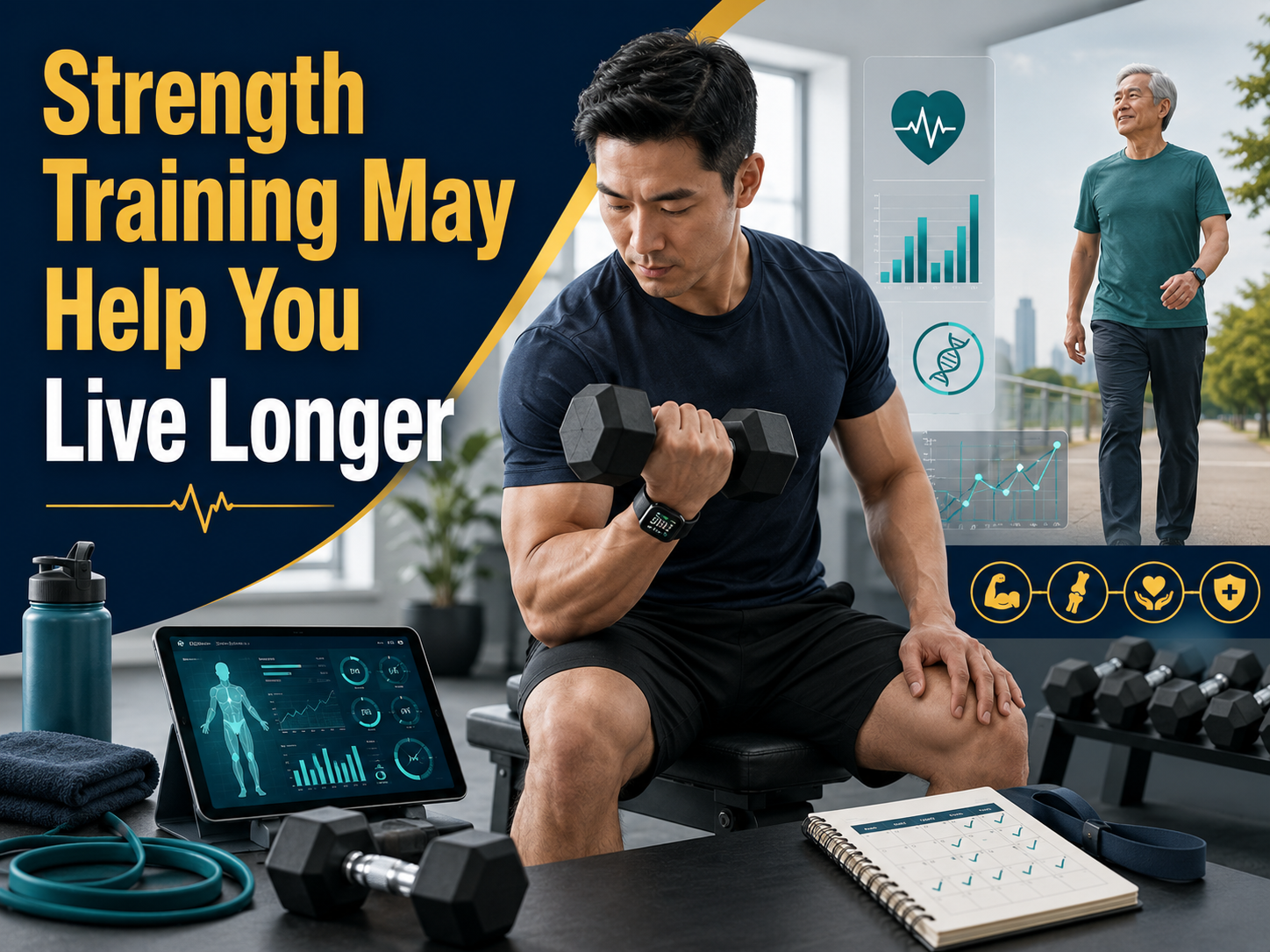
Strength Training May Help You Live Longer
Beginner | June 15, 2026
✨ Read the article aloud on your own or repeat each paragraph after your tutor.
Strength Training Longevity: A New Study Gets Attention
A new health study from Harvard T.H. Chan School of Public Health says that a moderate amount of strength training may help people live longer. The study found that adults who did about 90 to 120 minutes of strength training each week had a 13% lower risk of early death compared with people who did no strength training. The findings were published in the British Journal of Sports Medicine. (Fox News)
What the Researchers Studied
Researchers looked at data from 147,374 adults over a period of up to 30 years. These adults were part of three long-running health studies: the Health Professionals Follow-Up Study, the Nurses’ Health Study, and the Nurses’ Health Study II. Every few years, participants answered questions about their weekly resistance training and aerobic exercise. This gave researchers a long-term view of people’s habits. (Harvard T.H. Chan School of Public Health)
How Much Strength Training Helped?
The study found the strongest benefit around 90 to 119 minutes per week. People in that group had a 13% lower risk of death from any cause, a 19% lower risk of death from cardiovascular disease, and a 27% lower risk of death from neurological diseases, including conditions related to Alzheimer’s disease. Researchers also found that doing more than about 120 minutes per week did not seem to add extra benefit. In plain English: more is not always better. Your biceps may disagree, but the data does not seem impressed. (BMJ Group)
Strength Plus Cardio Worked Best
The study also found that people who combined strength training with aerobic exercise had some of the lowest risks. Aerobic exercise includes activities like walking, running, swimming, cycling, or tennis. Harvard reported that people who did both strength and aerobic training had up to a 45% lower risk of death than people who did little aerobic exercise and no resistance training. This supports a simple idea: your body likes variety. (Harvard T.H. Chan School of Public Health)
This Is Not Just About Looking Strong
One expert quoted by Fox News said strength training is not only about bodybuilding or appearance. It can help people keep muscle, protect bone strength, improve balance, and stay independent as they get older. This is especially important because people naturally lose muscle as they age. For many adults, the goal is not to look like a superhero. The goal is to carry groceries, climb stairs, travel, and enjoy life with less difficulty. (Fox News)
A Useful Story for English Practice
For English learners, this strength training longevity story is useful because it includes health, routines, habits, risk, and lifestyle choices. You can practice simple phrases like “build a routine,” “start slowly,” “stay consistent,” “lower the risk,” and “make small changes.” It is also a good reminder that healthy habits do not need to be extreme. Sometimes, a realistic routine beats a perfect plan that nobody actually follows.
Vocabulary
- Strength training (noun phrase) – exercise that builds muscle, often using weights, bands, or body weight.
Example: “Strength training can include pushups, squats, lunges, or weightlifting.” - Resistance training (noun phrase) – another name for strength training.
Example: “The study looked at resistance training and aerobic exercise.” - Longevity (noun) – living a long life.
Example: “The study connects strength training with longevity.” - Risk (noun) – the chance that something bad may happen.
Example: “The study found a lower risk of early death.” - Cardiovascular (adjective) – related to the heart and blood vessels.
Example: “Cardiovascular disease includes heart disease.” - Neurological (adjective) – related to the brain and nervous system.
Example: “Some neurological diseases are connected to dementia.” - Aerobic exercise (noun phrase) – exercise that raises your heart rate, such as walking, running, or swimming.
Example: “Aerobic exercise worked well when combined with strength training.” - Routine (noun) – a regular way of doing something.
Example: “Building a simple routine can help people exercise more often.” - Benefit (noun) – a good result or advantage.
Example: “The biggest benefit came from combining strength and cardio.” - Observational study (noun phrase) – a study that watches patterns but does not prove direct cause and effect.
Example: “This was an observational study, so it shows a connection, not proof.”
Discussion Questions About the Article
- How many minutes of strength training per week were linked to the biggest benefit?
- What was the lower risk of early death for people who did 90 to 119 minutes per week?
- What kinds of exercises can count as strength training?
- Why was combining strength training with aerobic exercise helpful?
- Why is it important to remember that this was an observational study?
Discussion Questions About the Topic
- Do you do any strength training now? Why or why not?
- What is easier for you: walking, running, swimming, or lifting weights?
- Why do many people stop exercising after a short time?
- How can busy professionals build a simple exercise routine?
- What healthy habit would you like to improve this month?
Related Idiom
“Use it or lose it” – if you do not use a skill or ability, it can become weaker.
Example: “Muscle strength is a good example of ‘use it or lose it.’ If people stop moving and training, their strength can slowly decline.”
📢 Want more practical English through real news stories? Sign up for the All About English Mastery Newsletter here: allaboutenglishmastery.com/newsletter
Want to build stronger English in less time? Check out Mastering English for Busy Professionals.
Follow our YouTube channel @All_About_English for more English tips and practice.
This article was inspired by: Fox News, Harvard T.H. Chan School of Public Health, and BMJ Group


 English
  한국어
한국어