

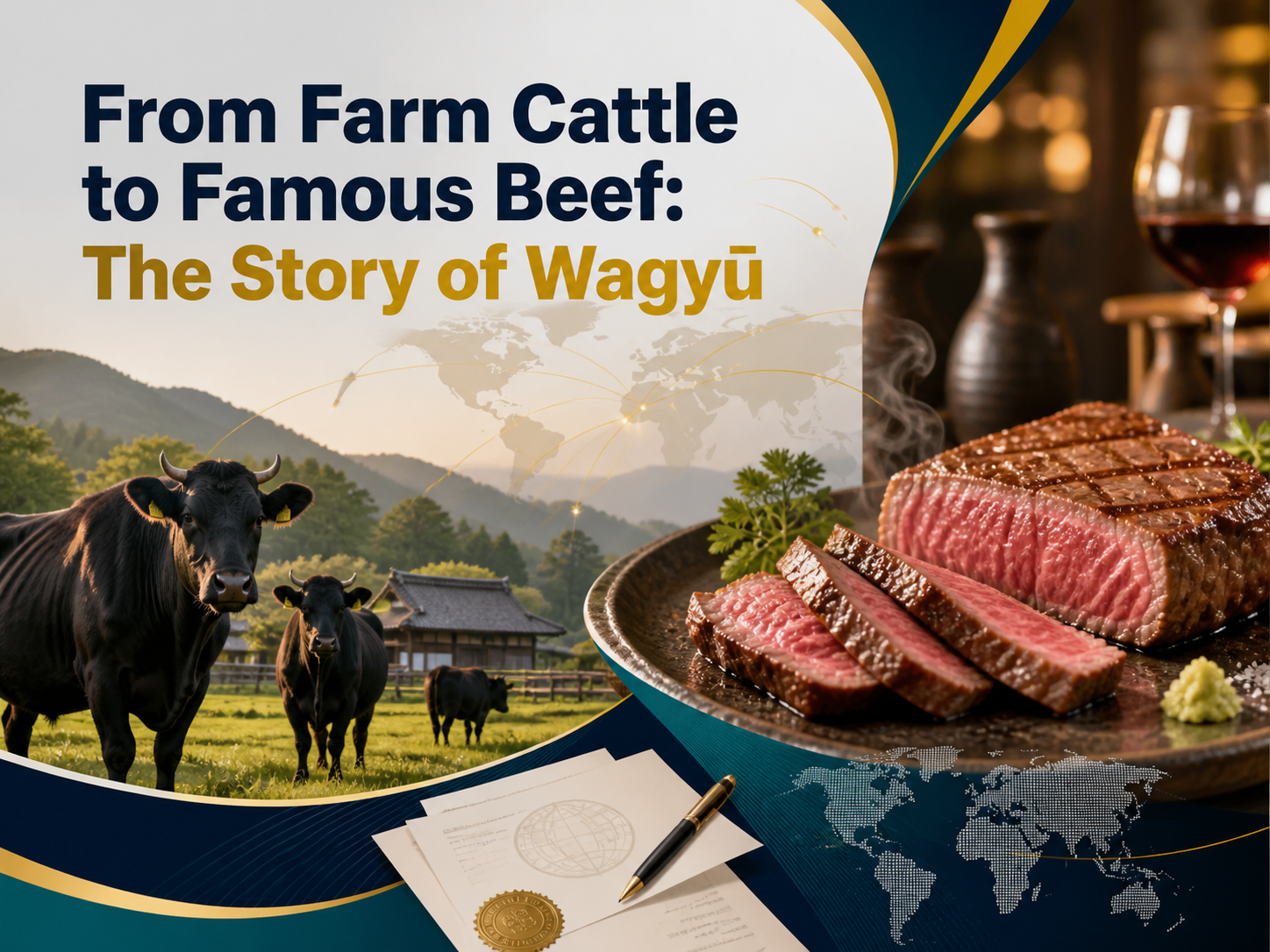
From Farm Cattle to Famous Beef: The Story of Wagyū
Beginner | May 3, 2026
✨ Read the article aloud on your own or repeat each paragraph after your tutor.
How Wagyū Became Famous Around the World
Wagyū beef is now famous around the world. Many people know it for its soft texture, beautiful marbling, and rich flavor. But the Wagyu beef history did not begin in expensive restaurants. It began with local cattle in Japan that helped farmers work in fields and pull carts for many years. According to Nippon.com, cattle were not mainly used for meat in Japan for most of Japanese history.
The Humble Roots of Wagyu Beef History
In the past, Japanese cattle were working animals. They were important for farming, so eating them was not common. Also, for a long time, Buddhist ideas made eating animal meat unusual in Japan. This started to change during the Meiji era, from 1868 to 1912. Japan modernized quickly, and Western food habits became more common. People began eating more beef and drinking more milk, so farmers started improving local cattle for both work and food. (Nippon.com)
Four Official Wagyū Breeds
Today, Japan recognizes four official wagyū breeds: Japanese Black, Japanese Brown, Japanese Shorthorn, and Japanese Polled. The most common one is Japanese Black, called Kuroge Washu in Japanese. This breed now makes up about 98% of all wagyū cattle raised in Japan. After Japan opened its beef market more in 1991, Japanese ranchers focused more on marbling to make their beef stand out from leaner foreign beef. (Nippon.com)
One Bull Changed the Wagyū Story
One of the most interesting parts of wagyū beef history is the story of a bull named Tajiri-gō. He was born in 1939 in the Ojiro district of Kami, a mountain area in Hyōgo Prefecture. Tajiri-gō became extremely important because of his strong bloodline. His breeding records say he fathered 1,463 calves during his 15-year life. In 2012, the Wagyū Registry Association found that 99.9% of all female Japanese Black cattle in Japan were descended from Tajiri-gō. In plain English: this bull was not just important — he was basically the grandfather of modern premium wagyū. (Nippon.com)
Wagyū Goes Global
Wagyū later spread outside Japan, but in limited ways. In 1967, wagyū semen was exported to Canada for artificial insemination. In 1976, two Japanese Black and two Japanese Brown bulls were sent to the United States for animal research. Exports grew in the 1990s, and by the end of 1998, Japan had sent 247 cattle and about 13,000 straws of semen to the United States before stopping exports to protect its special breeds. Australian ranchers also began importing wagyū genetic material in 1989 and used it to improve their own beef herds. (Nippon.com)
Why Japan Protects the Name
Today, Japan strictly controls the export of wagyū cattle and genetic material. Japanese producers also follow strong rules for bloodlines and meat quality. This matters because some beef sold overseas as “wagyu” may come from hybrid cattle. It may not have the same quality, tenderness, or marbling as Japanese wagyū. Kobe Beef has even stricter rules. It must come from Tajima cattle in Hyōgo Prefecture and meet special quality standards. (Nippon.com)
A Small Local Story Becomes a Big Global Brand
Wagyū is also big business now. Japan’s beef exports reached a record high in 2024, with export value rising 12% year on year to ¥64.8 billion. The United States, Taiwan, and Hong Kong were major buyers, showing strong interest in wagyū. Another Nippon.com report said “wagyu” was one of the top Japan-related product searches overseas in 2025, especially in the United States, Taiwan, and Hong Kong. That is the power of a strong food brand: it starts with local roots, but it can grow into a global name. (Nippon.com Beef Exports, Nippon.com Search Survey)
Vocabulary
- Marbling (noun) – thin lines of fat inside meat that make it soft and flavorful.
Example: “Wagyū beef is famous for its beautiful marbling.” - Breed (noun) – a type of animal with special shared features.
Example: “Japanese Black is the most common wagyū breed in Japan.” - Cattle (noun) – cows and bulls, especially animals raised on farms.
Example: “In the past, Japanese cattle helped farmers work in fields.” - Bloodline (noun) – a family line of animals or people.
Example: “Tajiri-gō had a very important bloodline.” - Descended (verb) – came from an earlier family member or ancestor.
Example: “Many Japanese Black cattle are descended from Tajiri-gō.” - Export (noun/verb) – a product sold or sent to another country.
Example: “Japan’s beef exports reached a record high in 2024.” - Hybrid (noun/adjective) – something made by mixing two different types.
Example: “Some overseas wagyu comes from hybrid cattle.” - Regulate (verb) – to control something with rules.
Example: “Japan regulates wagyū cattle exports carefully.” - Premium (adjective) – high quality and often expensive.
Example: “Kobe Beef is a premium type of wagyū.” - Brand (noun) – a name or image that people connect with a product.
Example: “Wagyū became a powerful global food brand.”
Discussion Questions (About the Article)
- What was the original job of cattle in Japan?
- When did beef eating become more common in Japan?
- What are the four official wagyū breeds?
- Why was Tajiri-gō so important to Japanese Black cattle?
- Why does Japan carefully protect wagyū bloodlines and quality standards?
Discussion Questions (About the Topic)
- Have you ever tried wagyū or another famous type of beef? What was it like?
- Why do some foods become luxury products?
- Should countries protect traditional food names and standards?
- What food from your country has become famous overseas?
- How can a local product become a global brand?
Related Idiom
“The real deal” – something genuine, high quality, or truly what people say it is.
Example: “Japanese wagyū is often seen as the real deal because of its strict bloodline and quality standards.”
📢 Want more practical English through real news stories? Sign up for the All About English Mastery Newsletter here: allaboutenglishmastery.com/newsletter
Want to build stronger English in less time? Check out Mastering English for Busy Professionals.
Follow our YouTube channel @All_About_English for more English tips and practice.
This article was inspired by: Nippon.com, Nippon.com Beef Exports, and Nippon.com Search Survey


 English
  한국어
한국어