

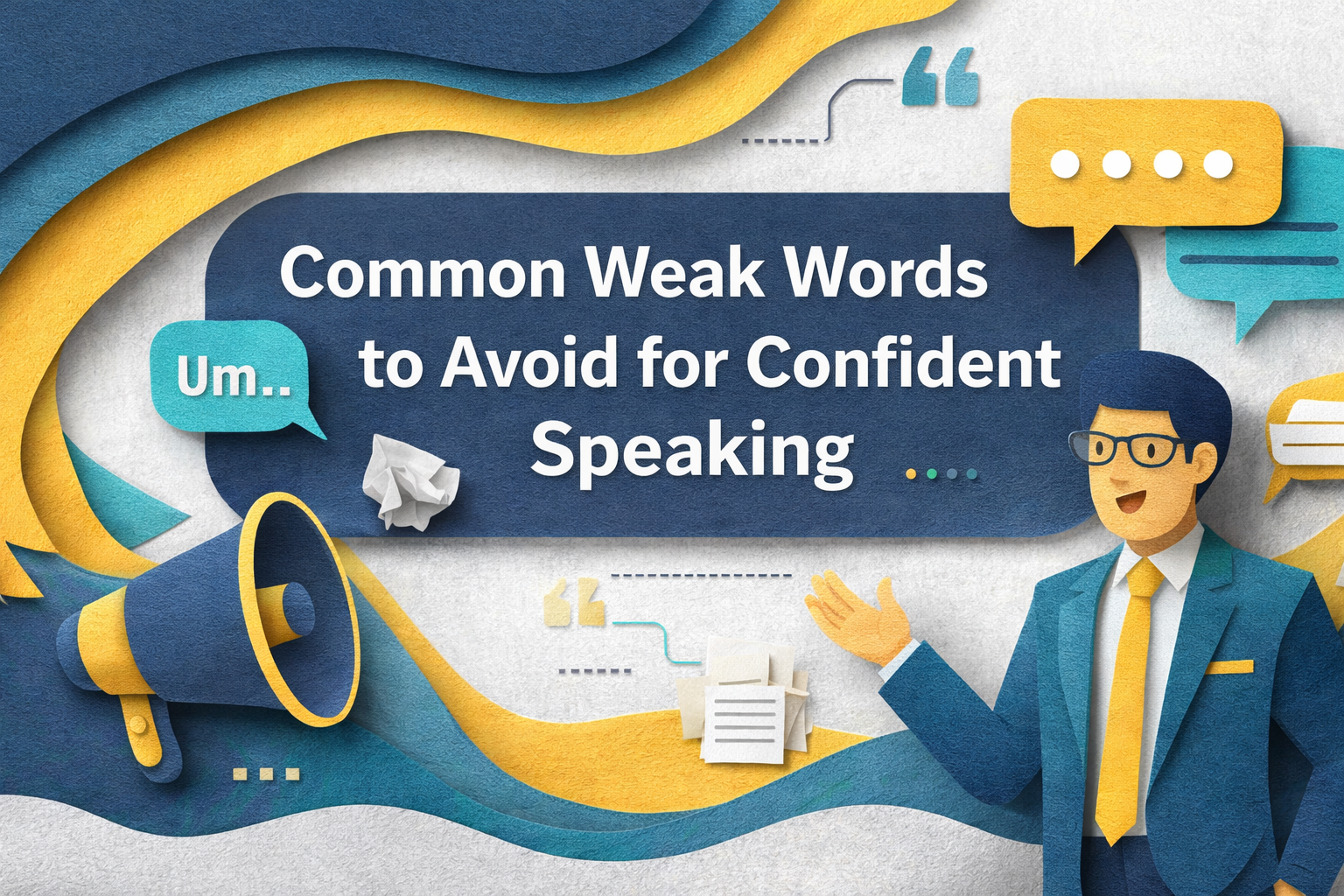
Common Weak Words to Avoid for Confident Speaking! 💬
Intermediate Level | February 28, 2026
Read the article aloud on your own or repeat each paragraph after your tutor.
If you’ve ever spoken in a meeting and felt like your message landed… softly… you might not need “better grammar.” You might just need stronger words. In professional English, confidence often comes from word choice, not perfect sentences—especially when you learn the weak words to avoid that quietly weaken your message.
Here’s the problem: many English learners (and plenty of native speakers too) lean on weak words when they feel nervous. Weak words aren’t “wrong,” but they make you sound unsure, indirect, or even unprepared.
These Weak Words Should Be Avoided in Professional English
Weak words are words that feel vague, small, or low-energy. They usually show up when you’re trying to be polite, avoid conflict, or buy time. In business settings, that can make you sound like you don’t believe your own idea.
Weak Word #1: “Just”
“Just” shrinks your message. Compare: “I’m just checking in” vs. “I’m checking in.” The first one sounds like you’re apologizing for existing. In a workplace email or conversation, “just” can quietly reduce your authority.
Weak Word #2: “Maybe” (When You Mean “I Recommend”)
“Maybe we should…” can sound hesitant. If you truly believe in your suggestion, upgrade it: “I recommend we…” or “My suggestion is to…” You can still be polite and sound confident.
Weak Word #3: “Kind of / Sort of”
These phrases create fog. “It’s kind of urgent” makes people wonder if it’s urgent or not. If it matters, say it clearly: “It’s urgent,” or “This needs attention today.” Clear language helps others act faster.
Weak Word #4: “I think” (Overused)
“I think” is fine sometimes—but if every sentence starts with it, you sound unsure. Try switching to:
- “From what I’ve seen…”
- “Based on the data…”
- “My conclusion is…”
Weak Word #5: “A little” (When the Problem Is Big)
“A little delay” might actually mean a 2-week schedule slip. If something is serious, be honest and specific. Confidence doesn’t mean sounding dramatic—it means sounding accurate.
Quick Upgrades You Can Use Today
Here are a few simple swaps that instantly strengthen your speaking:
- “I just wanted to ask…” → “I wanted to ask…”
- “Maybe we can…” → “I suggest we…”
- “It’s kind of confusing” → “It’s confusing” / “It’s unclear”
- “I think this will help” → “This will help because…”
The goal is not to sound aggressive. When you consistently remove the weak words to avoid, you sound clear, calm, and professional—without sounding rude. The goal is to sound clear, calm, and reliable—the kind of person people trust in meetings.
Vocabulary List
- Vague (adjective) — Not clear or specific.
Example: The plan sounded vague, so the team asked for details. - Hesitant (adjective) — Unsure or slow to act or speak.
Example: She sounded hesitant when she introduced her idea. - Authority (noun) — The power to influence decisions or be taken seriously.
Example: Removing weak words gave his voice more authority in meetings. - Direct (adjective) — Clear and to the point.
Example: A direct answer saves time and reduces confusion. - Accurate (adjective) — Correct and precise.
Example: It’s better to be accurate than overly polite in a status update. - Recommendation (noun) — A suggestion based on experience or judgment.
Example: My recommendation is to finalize the draft before Friday. - Clarify (verb) — To make something easier to understand.
Example: Can you clarify what you mean by “a little delay”? - Confident (adjective) — Sure of yourself; certain.
Example: He sounded confident because he used strong, specific words. - Tone (noun) — The feeling or attitude in your voice or writing.
Example: The tone of her email was calm but firm. - Upgrade (verb) — To improve something to a better level.
Example: Try to upgrade “maybe” into “I recommend” during meetings.
5 Questions About the Article
- What is a “weak word,” and why does it matter in professional English?
- How can the word “just” reduce your authority?
- Why can “kind of” cause confusion in business communication?
- What are two alternatives to starting a sentence with “I think”?
- What is one simple word swap you can use today to sound more confident?
5 Open-Ended Discussion Questions
- Which weak word do you use the most, and why do you think you use it?
- In your job, when do you need to sound more direct—emails, meetings, or presentations?
- What is the difference between sounding confident and sounding aggressive?
- Think of a recent meeting—how could stronger words have changed the outcome?
- What “upgrade phrase” will you practice this week (and in what situation)?
📢 Want more simple daily English habits? 👉 Sign up for the All About English Mastery Newsletter! Click here to join us!
Want to finally Master English but don’t have the time? Mastering English for Busy Professionals is the course for you! Check it out now!
Follow our YouTube Channel @All_About_English for more great insights and tips
 English
  한국어
한국어