

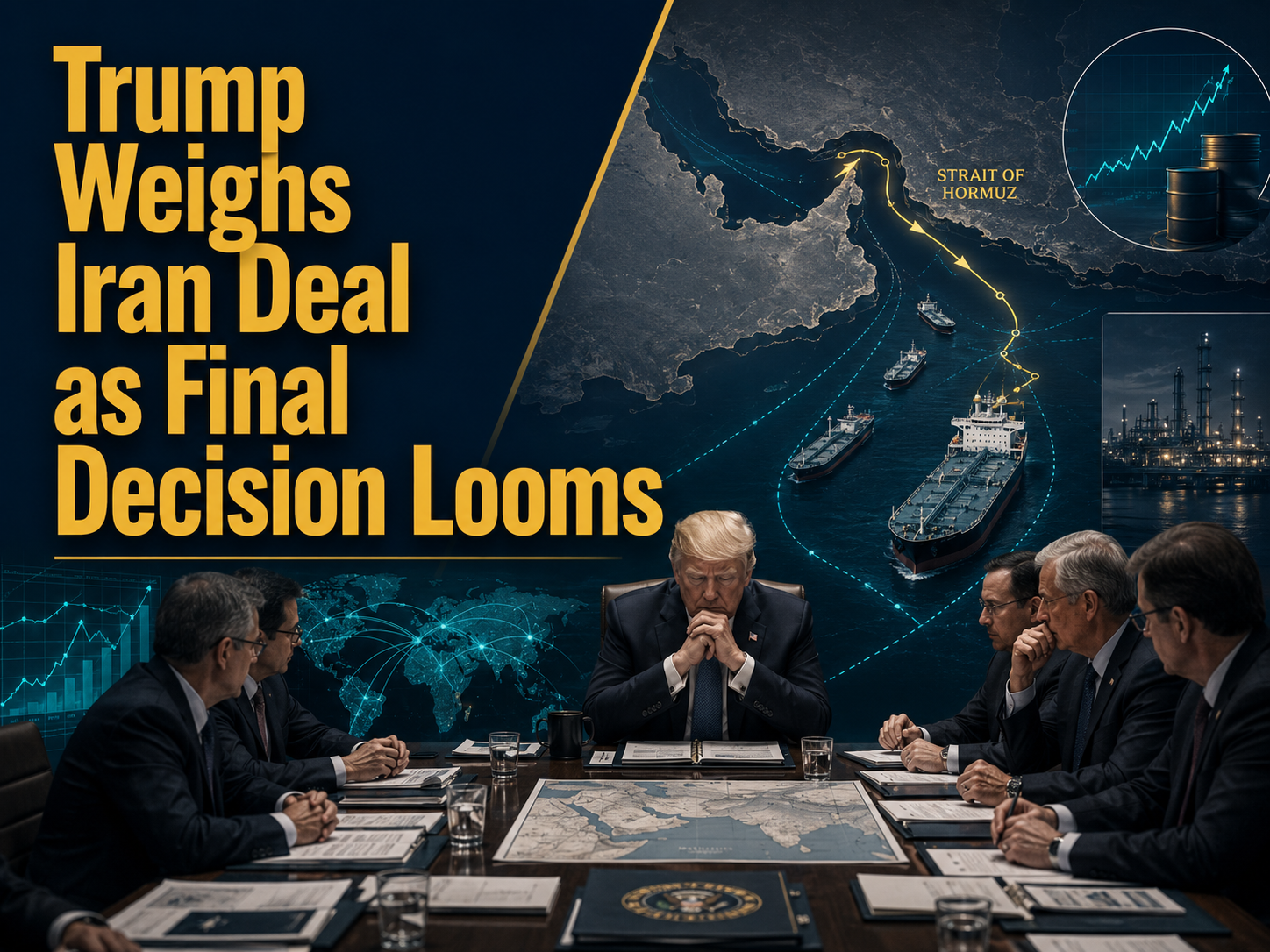
Trump Weighs Iran Deal as Final Decision Looms
Advanced | June 2, 2026
✨ Read the article aloud on your own or repeat each paragraph after your tutor.
Trump Iran Deal Talks Move to the Situation Room
President Donald Trump met with senior national security aides in the White House Situation Room on May 29 to discuss whether to move forward with a possible agreement with Iran. According to AP News, the meeting ended without a clear public decision, even though Trump had said he was preparing to make a “final determination.”
The possible Trump-Iran deal would extend a fragile ceasefire by 60 days while new talks continue over Iran’s disputed nuclear program. The agreement could also help reopen the Strait of Hormuz, one of the world’s most important shipping routes for oil and gas. In business terms, this is not just a diplomatic issue—it is also a global supply chain issue.
Why the Trump Iran Deal Matters for Global Markets
The Trump-Iran deal matters because the Strait of Hormuz is a major chokepoint for global energy trade. When tension rises there, oil markets can react quickly. Higher shipping risks, blocked routes, or military threats can push up fuel prices and create uncertainty for businesses around the world.
According to Reuters, Trump said any deal would need to include several conditions: Iran must not develop nuclear weapons, the Strait of Hormuz must reopen, sea mines must be removed, and Iran’s highly enriched uranium must be dealt with. Trump also said that “no money” would be exchanged at this stage.
What the Possible Deal Would Include
The proposed agreement appears to be a temporary framework, not a full peace deal. Axios reported that the agreement could be a memorandum of understanding, or MOU, that would extend the ceasefire and create room for more detailed nuclear talks later.
That means the deal may buy time rather than solve everything immediately. Iran would be expected to remove mines from the Strait of Hormuz and allow shipping to move more freely. The United States, meanwhile, could ease parts of its blockade or sanctions pressure so Iranian oil exports can resume more normally. For negotiators, the challenge is clear: both sides want benefits now, but neither side wants to look weak.
Iran Pushes Back on Trump’s Claims
Iran has not fully confirmed Trump’s version of the agreement. Al Jazeera reported that deep mistrust remains between Washington and Tehran. Iranian officials have suggested that Trump’s public comments may not match what Iran has actually accepted.
That is a major issue in diplomacy. Public statements can help build pressure, but they can also make negotiations harder if the other side feels misrepresented. The Guardian reported that Iranian officials rejected claims that a final agreement had already been reached, especially on sensitive nuclear issues.
The Nuclear Question Remains the Biggest Obstacle
The most difficult part of the possible deal is Iran’s nuclear program. AP reported that Iran holds a large amount of uranium enriched close to weapons-grade levels, which makes the issue especially urgent for the United States and its allies. Trump has said Iran must never be allowed to develop nuclear weapons.
But Iran has long insisted that its nuclear program is for peaceful purposes. That creates a classic negotiation problem: one side wants guarantees, while the other side wants respect, relief, and security. Until both sides agree on how to handle enriched uranium, inspections, sanctions, and future limits, the Trump Iran deal will remain uncertain.
What Happens Next
For now, the situation is still in a holding pattern. CBS News reported that the Situation Room meeting ended, but it was not clear whether Trump had made a final decision. That leaves diplomats, investors, and world leaders waiting for the next move.
This story is useful for English learners because it includes important professional and international vocabulary: ceasefire, framework, sanctions, negotiation, blockade, and strategic chokepoint. It also shows how one political decision can affect energy prices, shipping, diplomacy, and global business confidence at the same time.
Vocabulary
- Ceasefire (noun) – an agreement to stop fighting for a period of time.
Example: “The possible deal would extend the ceasefire by 60 days.” - Determination (noun) – a final decision or judgment.
Example: “Trump said he was meeting aides to make a final determination.” - Framework (noun) – a basic plan or structure for an agreement.
Example: “The agreement may be a framework for future nuclear talks.” - Memorandum of Understanding (noun phrase) – a formal but often temporary agreement between parties.
Example: “The deal could take the form of a memorandum of understanding.” - Chokepoint (noun) – a narrow place where movement can be blocked or controlled.
Example: “The Strait of Hormuz is a major energy chokepoint.” - Sanctions (noun) – penalties used by one country to pressure another country.
Example: “Iran wants relief from sanctions so it can export more oil.” - Blockade (noun) – an effort to stop ships, goods, or people from entering or leaving an area.
Example: “The United States could ease parts of its blockade under the deal.” - Enriched Uranium (noun phrase) – uranium processed for use in nuclear energy or weapons.
Example: “Enriched uranium remains one of the biggest issues in the talks.” - Negotiation (noun) – a discussion to reach an agreement.
Example: “The negotiation is difficult because both sides distrust each other.” - Diplomacy (noun) – the work of managing relationships between countries.
Example: “Diplomacy may help prevent the ceasefire from collapsing.”
Discussion Questions (About the Article)
- What was the purpose of Trump’s Situation Room meeting?
- How long would the proposed ceasefire extension last?
- Why is the Strait of Hormuz important for global markets?
- What conditions did Trump say Iran must accept?
- Why has Iran pushed back on Trump’s public claims?
Discussion Questions (About the Topic)
- Should temporary deals be used when countries cannot agree on a full peace deal?
- How can leaders build trust during difficult negotiations?
- Why do energy markets react so strongly to conflict in the Middle East?
- Should economic pressure, like sanctions, be used in diplomacy? Why or why not?
- What makes nuclear negotiations especially difficult?
Related Idiom
“Kick the can down the road” – to delay solving a difficult problem by making a temporary decision.
Example: “Some critics may say the Trump Iran deal only kicks the can down the road because it extends the ceasefire without fully solving the nuclear issue.”
📢 Want more practical English through real news stories? Sign up for the All About English Mastery Newsletter here: allaboutenglishmastery.com/newsletter
Want to build stronger English in less time? Check out Mastering English for Busy Professionals.
Follow our YouTube channel @All_About_English for more English tips and practice.
This article was inspired by: AP News, Reuters, Axios, Al Jazeera, CBS News, and The Guardian


 English
  한국어
한국어