

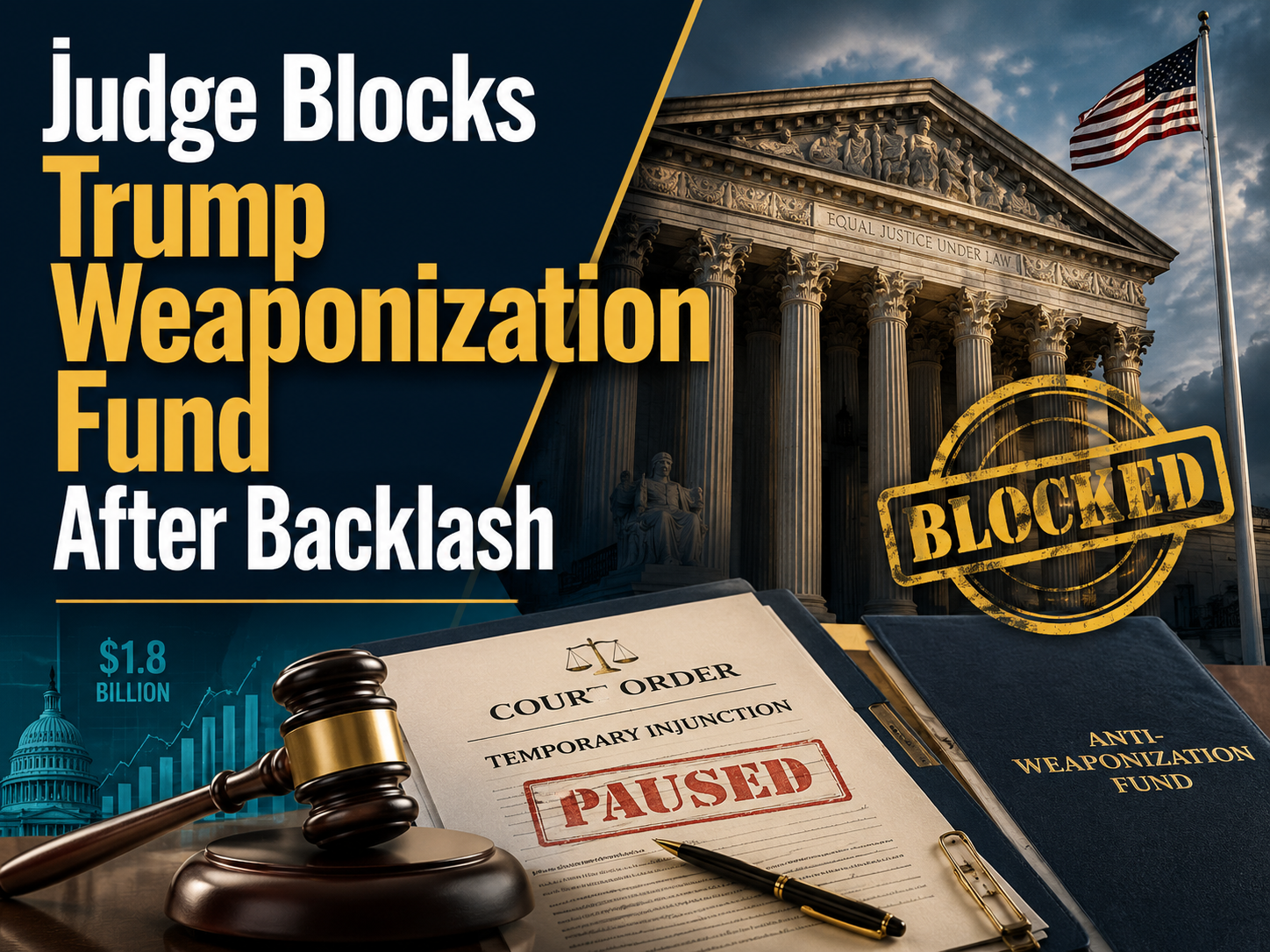
Judge Blocks Trump Weaponization Fund After Backlash
Advanced | June 2, 2026
✨ Read the article aloud on your own or repeat each paragraph after your tutor.
A Court Hits Pause on the Trump Weaponization Fund
A U.S. federal judge has temporarily blocked President Donald Trump’s nearly $1.8 billion “anti-weaponization” fund, a controversial plan designed to compensate people who say they were victims of political “lawfare” or government abuse. According to Reuters, Congress strongly opposed the fund, and several Republicans raised concerns about how officials might use the money.
The fund originated from a settlement tied to Trump’s lawsuit against the Internal Revenue Service. Trump filed the lawsuit after a former government contractor leaked his private tax records. On May 18, the Justice Department announced the fund and said it would establish a process to review claims from people who believed they had experienced “weaponization” and “lawfare.”
Why the Trump Weaponization Fund Became So Controversial
The Trump weaponization fund quickly sparked a political firestorm. Supporters argued that it could help people whom the government had unfairly targeted. Critics, however, argued that the fund resembled a “slush fund” that could benefit Trump allies, political supporters, or even people connected to the January 6 Capitol riot.
Those concerns created problems for the White House. AP News reported that some Republicans in Congress worried about weak oversight and the possibility that taxpayer-funded payouts could reach January 6 participants. In business terms, the administration faced a serious optics problem: even some Trump supporters viewed the plan as risky, messy, and difficult to defend.
Judge Brinkema Temporarily Blocks the Fund
On May 29, U.S. District Judge Leonie Brinkema of the Eastern District of Virginia temporarily blocked the administration from taking further steps to create or operate the fund. According to Al Jazeera, she scheduled a June 12 hearing to decide whether to extend the order.
Several individuals filed the lawsuit behind the Virginia order, arguing that the Trump administration could treat them as political opponents. One plaintiff, Andrew Floyd, previously served as an assistant U.S. attorney and worked on January 6-related prosecutions. The lawsuit claimed that the fund could favor Trump supporters while excluding people whom the administration viewed as political enemies.
The Justice Department Says It Will Comply
The Justice Department said it disagreed with the court rulings but would follow them for now. Reuters reported that federal judges in both Virginia and Florida had temporarily halted or questioned parts of the fund. The DOJ did not clearly state whether it would permanently cancel the fund and only confirmed that it would obey the court order.
As a result, the situation remains in a legal holding pattern. Officials have not paid out any money, and the commission responsible for reviewing claims has not fully advanced its work. For now, legal challenges, political pressure, and questions about the White House’s commitment to the program have stalled the fund.
What This Means for Politics and Public Trust
This story matters because it involves more than money. It raises questions about trust in government, the separation of powers, and the management of public funds. When a president has a personal connection to a legal settlement that creates a large compensation fund, people naturally ask difficult questions about fairness, conflicts of interest, and accountability.
For English learners, this story also offers useful business and political vocabulary that frequently appears in professional news reports: settlement, oversight, backlash, compliance, and conflict of interest. The key question now is whether officials will officially abandon the Trump weaponization fund, redesign it with stricter rules, or revive it after additional court proceedings.
Vocabulary
- Temporarily (adverb) – for a limited time, not permanently.
Example: “The judge temporarily blocked the fund until the next hearing.” - Fund (noun) – money set aside for a specific purpose.
Example: “The government created a fund to compensate certain claimants.” - Settlement (noun) – an agreement that ends a legal dispute.
Example: “The fund came from a settlement connected to Trump’s IRS lawsuit.” - Backlash (noun) – a strong negative reaction.
Example: “The proposal caused backlash from both Democrats and some Republicans.” - Oversight (noun) – supervision or review to make sure rules are followed.
Example: “Lawmakers wanted more oversight of how the money would be paid.” - Claimant (noun) – a person who says they have a legal right to money or help.
Example: “A claimant would need to show they were harmed by government action.” - Comply (verb) – to follow a rule, order, or request.
Example: “The Justice Department said it would comply with the court order.” - Payout (noun) – money paid to someone, often from a fund or settlement.
Example: “Critics worried that some payouts could go to political allies.” - Conflict of Interest (noun phrase) – a situation where personal interests may affect official decisions.
Example: “Critics said the settlement raised questions about a conflict of interest.” - Legal Challenge (noun phrase) – a court case that questions whether something is lawful.
Example: “Several legal challenges were filed against the fund.”
Discussion Questions (About the Article)
- What was the purpose of the Trump weaponization fund?
- Why did some Republicans object to the fund?
- Who temporarily blocked the fund, and what happens on June 12?
- Why were some people concerned about January 6 participants receiving payouts?
- What does it mean when the Justice Department says it will “comply” with a ruling?
Discussion Questions (About the Topic)
- Should presidents be allowed to create compensation funds connected to their own lawsuits? Why or why not?
- What kind of oversight should exist when public money is used for legal settlements?
- How can governments avoid conflicts of interest?
- Why do political “optics” matter, even when a plan may be legal?
- How should citizens judge whether a government program is fair?
Related Idiom
“Open a can of worms” – to create a complicated problem by starting something that leads to many more issues.
Example: “The Trump weaponization fund opened a can of worms because it raised questions about public money, political allies, and court oversight.”
📢 Want more practical English through real news stories? Sign up for the All About English Mastery Newsletter here: allaboutenglishmastery.com/newsletter
Want to build stronger English in less time? Check out Mastering English for Busy Professionals.
Follow our YouTube channel @All_About_English for more English tips and practice.
This article took inspiration from: Reuters, AP News, U.S. Department of Justice, and Al Jazeera
SEO
- Focus Keyphrase: Trump weaponization fund
- SEO Title: Trump weaponization fund blocked after political backlash
- Slug: trump-weaponization-fund-blocked
- Meta Description: Trump weaponization fund blocked by a judge after backlash over oversight, payouts, and political concerns.
- Tags: Trump, weaponization fund, DOJ, IRS lawsuit, January 6, federal judge, political backlash, government oversight, legal settlement, U.S. politics


 English
  한국어
한국어