

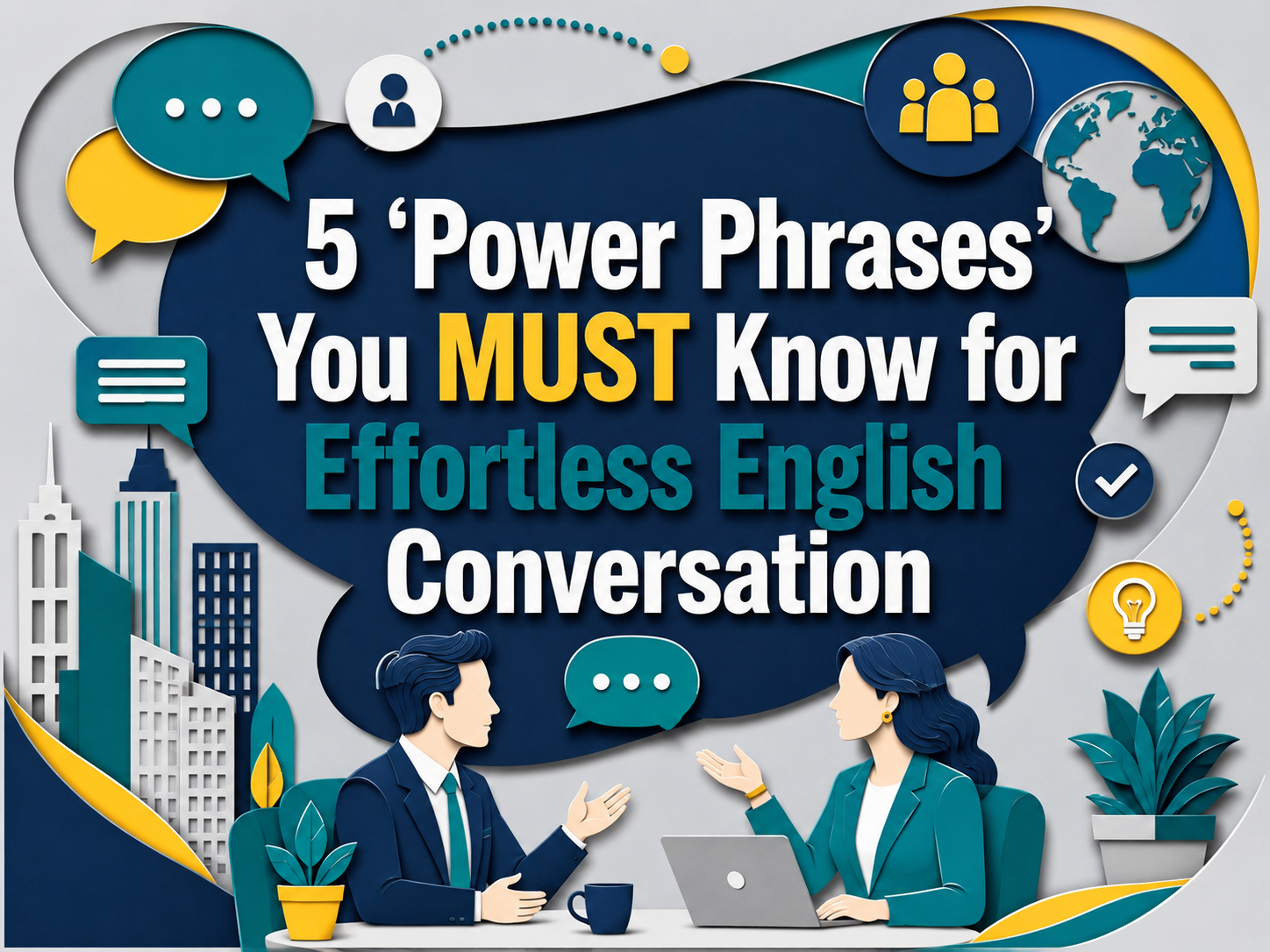
5 “Power Phrases” You MUST Know for Effortless English Conversation
Advanced Level | June 2, 2026
Read the article aloud on your own or repeat each paragraph after your tutor.
Strong English conversations do not happen because you know every word in the dictionary. They happen because you know what to say at the right moment. For busy professionals, this is especially important. You may not have time to study English for hours, but you still need to sound clear, confident, and natural in meetings, networking events, client calls, and everyday office conversations.
That is where power phrases for English conversation become extremely useful. A power phrase is a short, flexible expression that helps you respond smoothly, keep the conversation moving, and sound more professional. Think of it like a tool in your communication toolbox. You do not need 500 tools. You need the right five.
Today, let’s look at five power phrases for English conversation that can help you speak with more confidence and less hesitation.
Why Power Phrases Make Conversation Easier
Many English learners freeze because they are trying to build perfect sentences from scratch. That is like trying to build a boat while already floating in the ocean. Not ideal, Captain. Power phrases give you a ready-made structure, so your brain does not have to work so hard in the moment.
Instead of thinking, “What grammar should I use? Is this word correct? Do I sound strange?” you can use a phrase that already sounds natural. Then you simply add your own idea. This helps you respond faster, sound smoother, and stay focused on the person you are speaking with.
Power Phrase 1: “That’s a great point.”
This phrase is simple, professional, and incredibly useful. You can use it when someone shares an idea in a meeting, explains their opinion, or gives useful feedback.
For example, if your colleague says, “I think we should test this feature with a smaller group first,” you can respond, “That’s a great point. It would help us reduce risk before the full launch.”
This phrase does two things. First, it shows that you are listening. Second, it gives you a little extra time to organize your next thought. That is a nice bonus. It is professional English with a built-in thinking break. Beautiful.
Power Phrase 2: “Could you walk me through that?”
This is a polite and natural way to ask someone to explain something step by step. It sounds much better than simply saying, “I don’t understand.”
Imagine your manager explains a new reporting process, but the details are moving faster than a caffeinated squirrel. You can say, “Could you walk me through that one more time?” This shows that you want to understand clearly, not that you are lost.
Professionals use this phrase often because it sounds curious, respectful, and practical. It is especially useful in technical discussions, training sessions, project updates, and client meetings.
Power Phrase 3: “Let me make sure I understand.”
This is one of the most powerful phrases in business English. It helps you confirm information before responding. It also prevents misunderstandings, which is always cheaper than fixing mistakes later.
For example, you might say, “Let me make sure I understand. You’d like us to finish the first draft by Friday and send the final version next Wednesday. Is that right?”
This phrase shows careful listening. It also makes you sound organized and responsible. In professional settings, that matters. People trust the person who checks the details before running off in the wrong direction like a pirate chasing a fake treasure map.
Power Phrase 4: “What do you think would be the best next step?”
This phrase is excellent when you want to move a conversation forward. It works well in meetings, problem-solving discussions, and project planning.
Instead of giving an immediate opinion, you invite the other person to think with you. For example, after discussing a delay, you might say, “What do you think would be the best next step?”
This question sounds collaborative. It shows leadership without sounding bossy. It also encourages the other person to participate, which makes the conversation more balanced and productive.
Power Phrase 5: “I see what you mean.”
This phrase helps you show understanding without necessarily saying that you fully agree. That is very useful in professional situations.
For example, if a client says, “We are worried the timeline may be too short,” you can respond, “I see what you mean. The schedule is tight, but we may be able to adjust the first milestone.”
This phrase keeps the conversation calm. It shows that you respect the other person’s concern, while still giving you space to offer another idea. That is a powerful skill in business communication.
How to Practice These Power Phrases for English Conversation
Do not try to memorize these phrases silently. That is the classic “study hard but still freeze later” trap. Instead, say each phrase out loud three times. Then create your own example sentence for each one.
You can also practice with real situations from your work. Think about your next meeting, email, client call, or team discussion. Which phrase could you use? The goal is not to sound fancy. The goal is to sound ready.
When you practice these five phrases, you will begin to feel more comfortable entering conversations, responding to ideas, asking for clarity, and moving discussions forward. That is how you build effortless English conversation—one useful phrase at a time.
Vocabulary List
- Flexible (adjective) — Able to change or be used in different situations.
Example: This phrase is flexible because you can use it in meetings, calls, and casual conversations. - Hesitation (noun) — A pause caused by uncertainty or nervousness.
Example: Power phrases can reduce hesitation when you speak English. - Respond (verb) — To answer or react to something someone says.
Example: She responded clearly during the client meeting. - Structure (noun) — An organized form or pattern.
Example: A useful phrase gives your answer a simple structure. - Clarify (verb) — To make something easier to understand.
Example: He asked a question to clarify the project deadline. - Collaborative (adjective) — Involving people working together.
Example: Her collaborative question helped the team choose the next step. - Concern (noun) — A worry or issue that someone has.
Example: The client shared a concern about the short timeline. - Milestone (noun) — An important point or stage in a project.
Example: We need to finish the first milestone by Friday. - Confirm (verb) — To check that something is correct.
Example: Let me confirm the meeting time before I send the email. - Effortless (adjective) — Feeling easy or natural.
Example: With practice, English conversation can feel more effortless.
5 Questions About the Article
- What is a power phrase?
- Why do power phrases help busy professionals?
- When can you use “Could you walk me through that?”
- Why is “Let me make sure I understand” useful in business English?
- Which phrase helps you show understanding without fully agreeing?
5 Open-Ended Discussion Questions
- Which of these five phrases would be most useful in your job? Why?
- What situations make you hesitate when speaking English?
- How could you use “That’s a great point” in your next meeting?
- What is one work situation where you need to ask for clarification?
- How can short phrases help you sound more confident in English?
📢 Want more tips like this? 👉 Sign up for the All About English Mastery Newsletter! Click here to join us!
Want to finally master English but don’t have the time? Mastering English for Busy Professionals is the course for you! Check it out now!
Follow our YouTube Channel @All_About_English for more great insights and tips.
 English
  한국어
한국어