

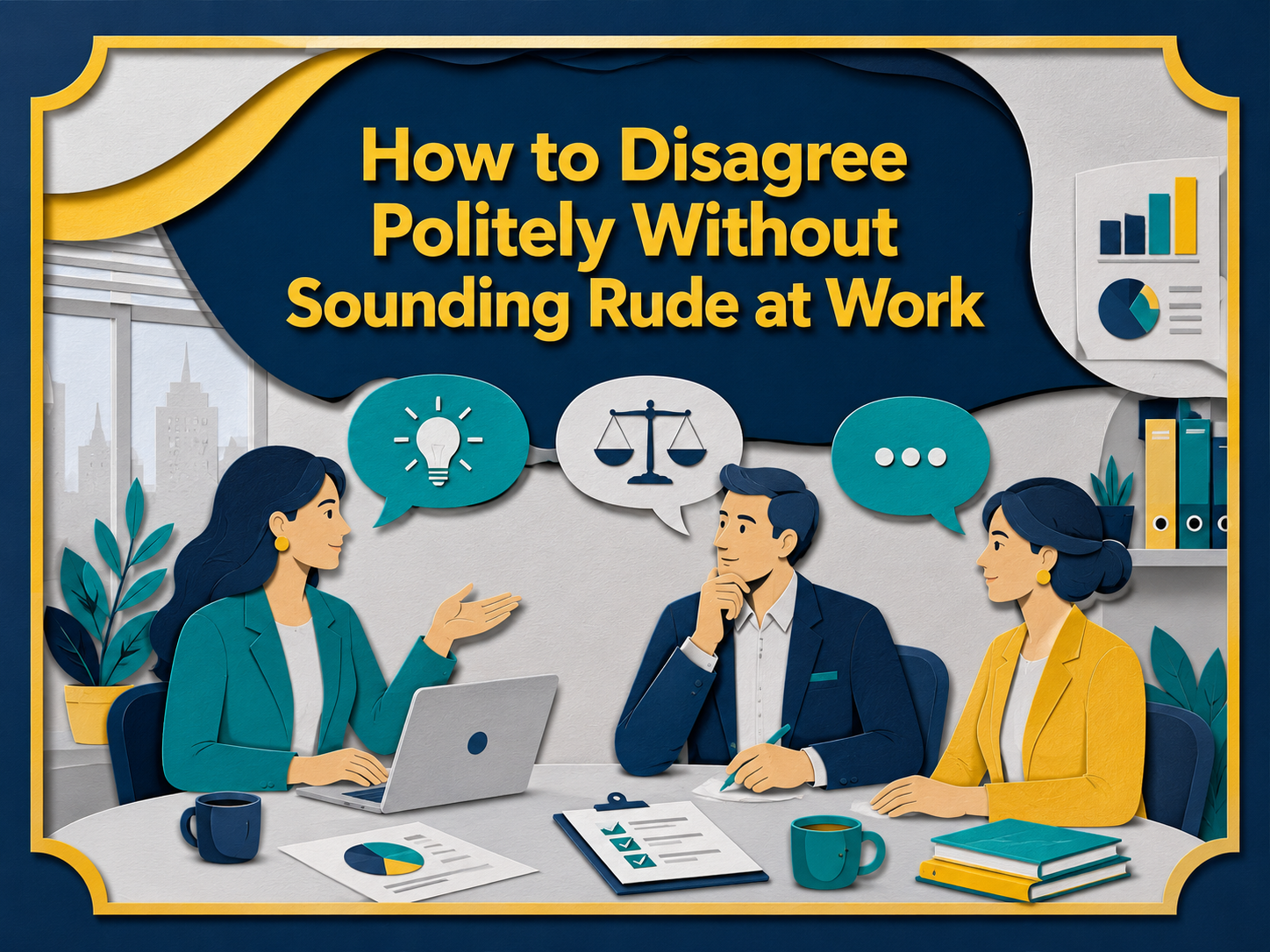
How to Disagree Politely Without Sounding Rude at Work 🤝
Intermediate Level | June 6, 2026
Read the article aloud on your own or repeat each paragraph after your tutor.
Disagreeing in English can feel dangerous. You may worry that people will think you are rude, negative, or difficult to work with. But in professional life, disagreement is normal. In fact, if you know how to disagree politely, you can show confidence, respect, and leadership at the same time.
Many English learners try to avoid disagreement completely. They smile, nod, and say, “Yes, I agree,” even when they do not agree at all. That may feel safe in the moment, but it can create bigger problems later. Your team may miss important information, your ideas may stay hidden, and people may not understand your real opinion.
Why Learning How to Disagree Politely Matters
In business, disagreement does not have to mean conflict. It can mean teamwork. When people share different ideas, the team can find better solutions. The key is how you say it. If you say, “That’s wrong,” people may feel attacked. But if you say, “I see your point, but I have a different concern,” the conversation stays respectful.
A useful first step is to acknowledge the other person’s idea before you share your own. For example, you can say, “That’s an interesting point,” or “I understand why you see it that way.” This shows that you are listening. It also lowers tension before you introduce a different opinion.
Use Softening Phrases Before You Disagree
Softening phrases help your disagreement sound more natural and polite. Instead of saying, “I disagree,” you can say, “I’m not sure I see it the same way,” or “I have a slightly different view.” These phrases give your words a softer landing. Think of them as bubble wrap for your opinion. Same message, fewer broken dishes.
Another strong technique is to explain your reason clearly. Don’t just reject the idea. Give useful information. For example, say, “I’m concerned that this deadline may be too short because the design team still needs two more days.” This sounds professional because you are not attacking the person. You are focusing on the problem.
You can also turn disagreement into discussion by asking a question. Instead of saying, “That plan won’t work,” try, “How would we handle the client’s feedback if they ask for changes?” A question invites people to think with you. It keeps the conversation open and helps others feel respected.
Professional Phrases to Disagree Politely
Here are a few phrases you can use in meetings:
“I see your point, but I’m wondering if there’s another option.”
“That makes sense, although I have one concern.”
“I agree with the main idea, but I’m not sure about the timeline.”
“Could we look at it from another angle?”
“I may be missing something, but I see it a little differently.”
Notice that these phrases do not sound weak. They sound thoughtful. Polite disagreement is not about hiding your opinion. It is about sharing your opinion in a way that keeps the relationship strong.
The next time you need to disagree politely, remember this simple pattern: acknowledge, soften, explain, and invite discussion. You can say, “I understand your point. I have a slightly different view because of the schedule. Could we look at another option?” That sentence is clear, respectful, and useful.
Professional English is not only about grammar. It is about handling real moments with confidence. When you learn how to disagree without sounding rude, you become easier to trust, easier to work with, and more valuable in every conversation. The more you practice how to disagree politely, the easier it becomes to share your opinion without damaging the relationship.
Vocabulary List
- Disagree (verb) — To have a different opinion from someone.
Example: I disagree with the timeline because it may be too short. - Politely (adverb) — In a respectful and kind way.
Example: She disagreed politely during the meeting. - Conflict (noun) — A serious disagreement or argument.
Example: Clear communication can help avoid conflict. - Acknowledge (verb) — To show that you understand or recognize something.
Example: He acknowledged her idea before sharing his concern. - Tension (noun) — A feeling of stress or discomfort between people.
Example: A soft phrase can lower tension in a difficult conversation. - Softening phrase (noun) — A phrase that makes your message sound less direct or harsh.
Example: “I’m not sure I see it the same way” is a useful softening phrase. - Concern (noun) — A worry or possible problem.
Example: My main concern is the project deadline. - Reject (verb) — To say no to an idea, offer, or suggestion.
Example: Don’t reject the idea too quickly; explain your reason first. - Perspective (noun) — A way of seeing or thinking about something.
Example: Let’s look at this issue from the client’s perspective. - Respectful (adjective) — Showing care for other people’s feelings or opinions.
Example: A respectful disagreement can improve teamwork.
5 Questions About the Article
- Why can disagreeing in English feel difficult for learners?
- Why is disagreement sometimes useful in business?
- What should you do before sharing a different opinion?
- Give two examples of softening phrases from the article.
- What is the simple pattern for polite disagreement?
5 Open-Ended Discussion Questions
- Do you find it easy or difficult to disagree in English? Why?
- What phrases do you usually use when you disagree at work?
- How can polite disagreement improve teamwork?
- What is worse in a meeting: staying silent or disagreeing too strongly?
- Think of a recent disagreement. How could you express your opinion more politely next time?
📢 Want more tips like this? 👉 Sign up for the All About English Mastery Newsletter! Click here to join us!
Want to finally Master English but don’t have the time? Mastering English for Busy Professionals is the course for you! Check it out now!
Follow our YouTube Channel @All_About_English for more great insights and tips.

 English
  한국어
한국어