

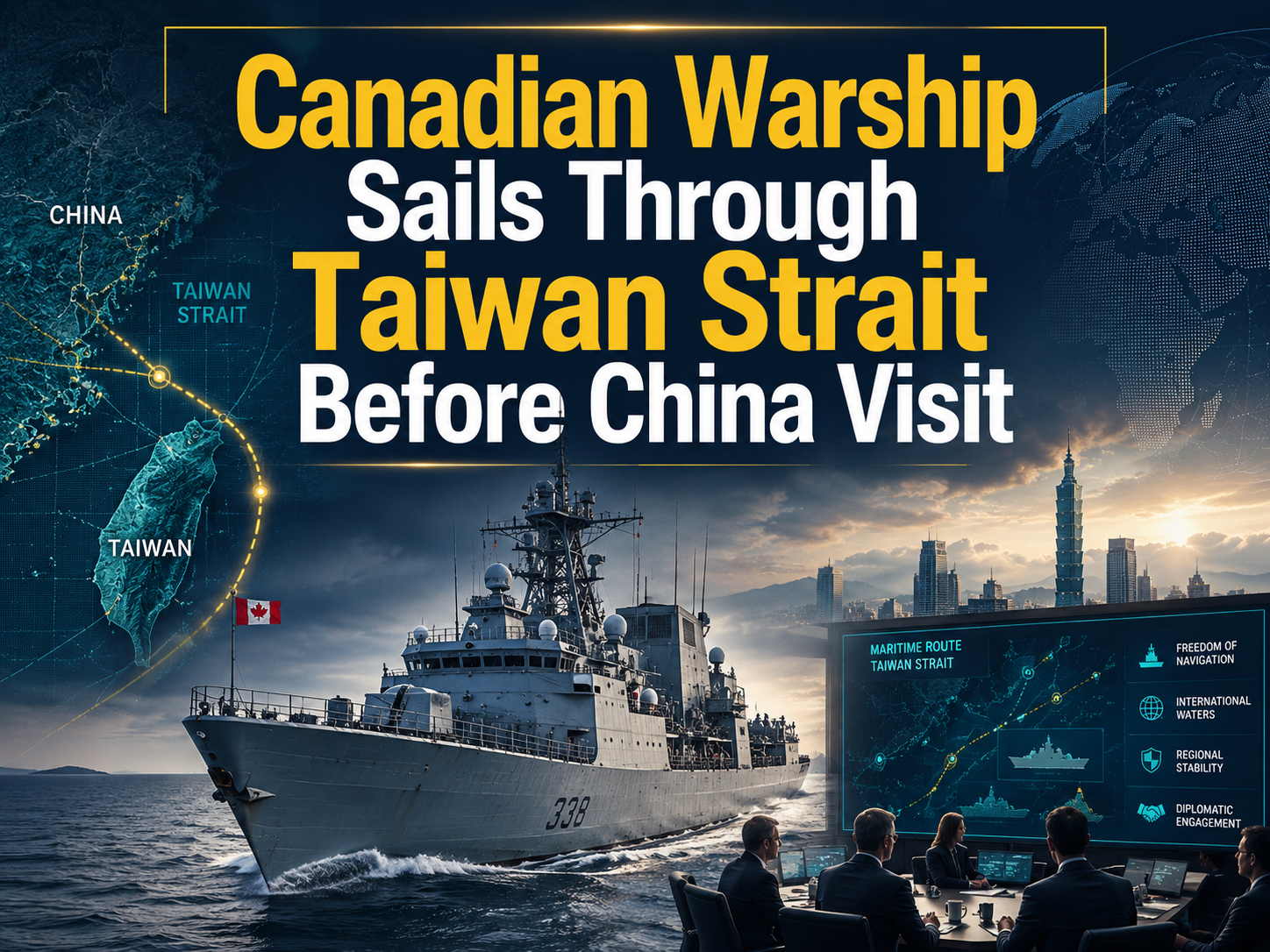
Canadian Warship Sails Through Taiwan Strait Before China Visit
Intermediate | June 12, 2026
✨ Read the article aloud on your own or repeat each paragraph after your tutor.
A Canadian Warship Taiwan Strait Transit Gets Attention
On May 22–23, 2026, the Canadian warship Taiwan Strait transit began when HMCS Charlottetown sailed through the narrow waterway between Taiwan and China. Canada’s Department of National Defence called it a routine transit, meaning it was a normal military passage. But the timing made the story more sensitive: it happened shortly before Chinese Foreign Minister Wang Yi arrived in Canada for a three-day visit. (Taipei Times, Reuters)
Why the Taiwan Strait Matters
The Taiwan Strait is one of the most important and sensitive waterways in Asia. Taiwan says the strait is an international waterway, where countries have the right to sail. Canada has also said it sees the Taiwan Strait as international waters. China, however, claims Taiwan as part of China and strongly dislikes foreign warships passing through the area. That makes every naval transit more than just a ship moving from Point A to Point B—it becomes a political message. (Reuters, Taiwan News)
China Pushes Back
China responded by saying it opposes any country using “freedom of navigation” to hurt China’s sovereignty and security. Chinese Foreign Ministry spokesperson Mao Ning said China respects navigation rights under international law, but does not accept actions it sees as a challenge to Chinese control. In plain English: China was saying, “You can sail, but don’t use that as an excuse to pressure us.” (Reuters, China Daily)
Canada Balances Trade and Security
This story also came during an important diplomatic moment. Wang Yi’s visit to Canada was the first visit by a Chinese foreign minister in about 10 years. Canada and China were discussing trade, investment, human rights, and foreign interference. Wang even suggested that Canada’s exports to China could double, while Canadian Foreign Minister Anita Anand said Canada wants to grow its economy and diversify trade relationships. In business terms, Canada was trying to keep the door open for trade while still standing firm on security issues. (Reuters)
A Signal to Beijing
The transit also followed warnings from China’s ambassador to Canada. In late April, Chinese Ambassador Wang Di warned that Canadian warships sailing through the Taiwan Strait—or Canadian lawmakers visiting Taiwan—could damage the new relationship between Canada and China. Canadian lawmaker Michael Chong, who had recently visited Taiwan and met President Lai Ching-te, supported the warship transit. He said Canada needed to show that it would not follow what he called Beijing’s “unreasonable demand.” (Taipei Times, Taiwan News)
What This Means Going Forward
For English learners, the Canadian warship Taiwan Strait story is useful because it shows how countries often speak in careful diplomatic language. Words like routine, sovereignty, international waters, and freedom of navigation may sound technical, but they carry a lot of meaning. Canada is trying to show that it supports open sea routes and international law. China is trying to show that it will defend its claims. Taiwan is trying to show that the strait should remain open. In short, one ship created a big conversation. Welcome to diplomacy—where even a “routine” trip can start a full meeting-room headache.
Vocabulary
- Transit (noun/verb) – the act of passing through a place.
Example: “The warship completed a transit through the Taiwan Strait.” - Warship (noun) – a military ship used by a navy.
Example: “The Canadian warship sailed through the strait.” - Routine (adjective) – normal or regular.
Example: “Canada called the passage a routine transit.” - Waterway (noun) – a body of water used for travel or shipping.
Example: “The Taiwan Strait is an important waterway.” - Sovereignty (noun) – a country’s right to control its own territory.
Example: “China said the transit affected its sovereignty.” - Navigation (noun) – the movement of ships, aircraft, or vehicles from one place to another.
Example: “Freedom of navigation is important for global trade.” - Diplomatic (adjective) – related to relationships between countries.
Example: “Wang Yi’s visit was an important diplomatic event.” - Bilateral (adjective) – involving two countries or groups.
Example: “Canada and China discussed bilateral cooperation.” - Diversify (verb) – to add variety or reduce dependence on one thing.
Example: “Canada wants to diversify its trade relationships.” - Firm (adjective) – strong and not easily changed.
Example: “Canada kept a firm position on the Taiwan Strait.”
Discussion Questions — About the Article
- What did HMCS Charlottetown do on May 22–23, 2026?
- Why was the timing of the transit sensitive?
- How did China respond to the Canadian warship’s passage?
- Why is Canada trying to balance trade and security with China?
- What position does Taiwan take on the Taiwan Strait?
Discussion Questions — About the Topic
- Should warships from other countries sail through the Taiwan Strait? Why or why not?
- Why do countries use naval movements to send political messages?
- How can countries protect trade relationships while disagreeing on security issues?
- What makes the Taiwan Strait important for Asia and the world?
- How should smaller democracies respond when larger countries pressure them?
Related Idiom
“Walking a tightrope” – trying to manage a difficult situation where one mistake could cause problems.
Example: “Canada is walking a tightrope by trying to improve trade with China while still supporting freedom of navigation in the Taiwan Strait.”
📢 Want more practical English through real news stories? Sign up for the All About English Mastery Newsletter here: allaboutenglishmastery.com/newsletter
Want to build stronger English in less time? Check out Mastering English for Busy Professionals.
Follow our YouTube channel @All_About_English for more English tips and practice.
This article was inspired by: Taipei Times, Reuters, Reuters Canada-China Visit, Taiwan News, and China Daily


 English
  한국어
한국어