

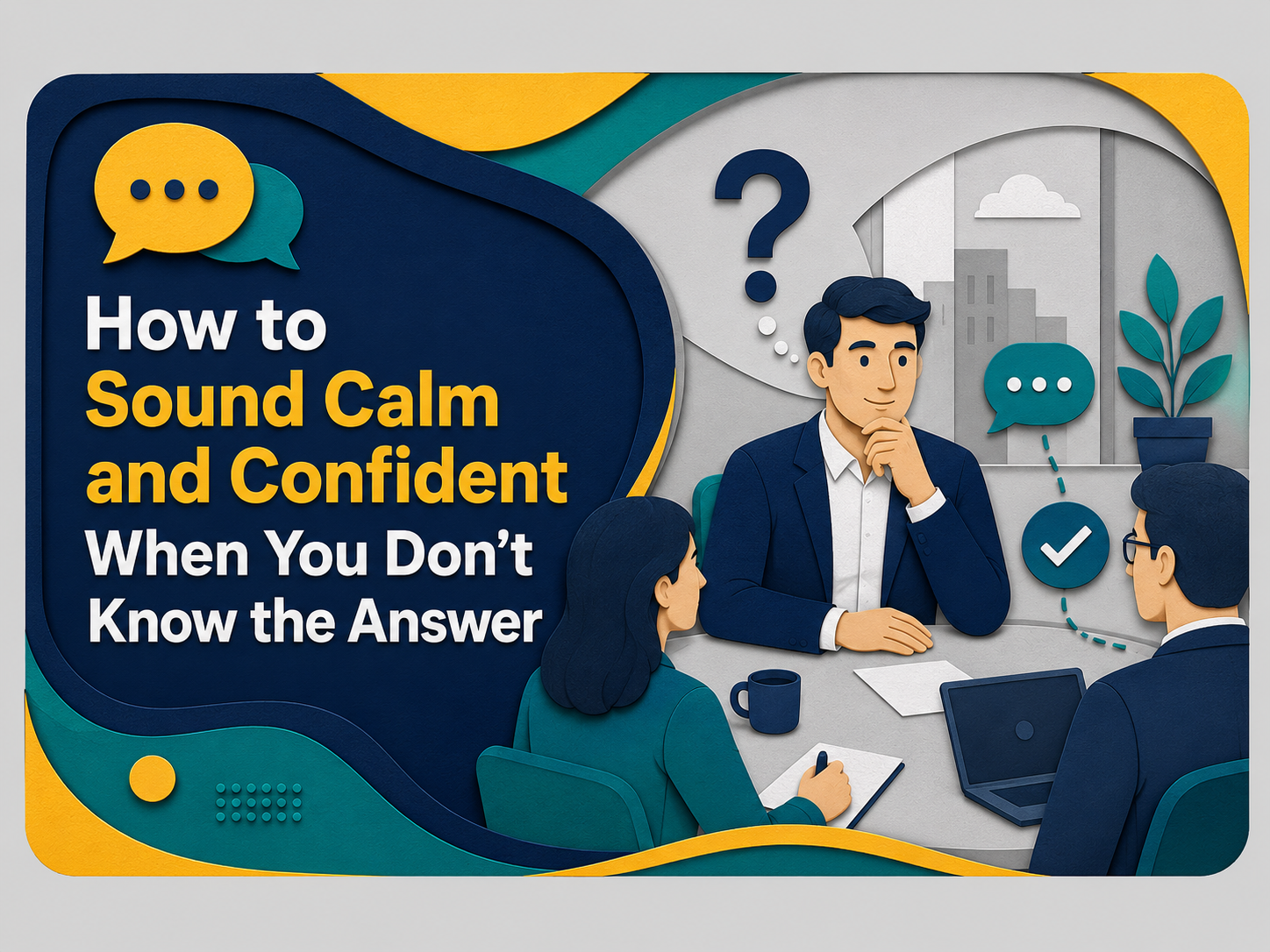
How to Sound Calm and Confident When You Don’t Know the Answer
Intermediate Level | June 12, 2026
Read the article aloud on your own or repeat each paragraph after your tutor.
Everyone has been there. You are in a meeting, your manager asks you a question, and suddenly your mind goes blank. You know some information, but not enough. You want to answer clearly, but inside your brain is waving a tiny white flag. This is a normal moment in professional communication. The key is learning how to sound calm and confident even when you don’t know the answer.
Many English learners think they must answer immediately. They believe silence makes them look weak. But confident professionals do not always know everything. They simply know how to respond under pressure. They pause, stay calm, and use clear phrases that show responsibility.
Why Knowing How to Sound Calm and Confident Matters
When you don’t know the answer, your words can either create trust or create confusion. Saying “I don’t know” too quickly may sound unprepared. But pretending to know the answer can be worse. In business, honesty matters. A calm and professional response shows that you are reliable, even if you need more time.
For example, instead of saying, “I don’t know,” you can say, “I don’t have that information right now, but I can check and follow up with you.” This sentence is honest, clear, and responsible. You are not hiding the truth. You are showing that you can handle the situation.
Step 1: Pause Before You Answer
A short pause can make you sound more confident. Many people rush when they feel nervous. They speak too fast, use filler words, or give unclear answers. A pause gives your brain a moment to organize your thoughts. It also tells the listener that you are thinking carefully.
Try using a phrase like, “That’s a good question. Let me think for a moment.” This gives you a few seconds and keeps the conversation professional. You are not running away from the question. You are taking control of the moment.
Step 2: Be Honest, But Not Helpless
There is a big difference between sounding honest and sounding helpless. Compare these two answers:
“I don’t know.”
“I don’t have the exact answer right now, but I can find out and get back to you.”
The second answer sounds much stronger. It shows that you are honest, but also active. You are not just admitting a problem. You are offering a next step. This is one of the best ways to sound calm and confident in professional English.
Step 3: Use Professional Phrases
Good phrases help you stay calm when pressure rises. You don’t need long or complicated sentences. In fact, simple phrases are often better. Try these:
“I’ll need to confirm that before I give you a final answer.”
“I want to make sure I give you accurate information.”
“Let me check the details and follow up after the meeting.”
These phrases work because they sound responsible. They show that you care about accuracy, not just speed. In business, that matters.
Step 4: Give What You Do Know
Sometimes you may not know the full answer, but you know part of it. In that case, share what you can. You might say, “I don’t have the final numbers yet, but I know the team is still reviewing the report.” This gives useful information without pretending that you know everything.
This approach is especially helpful in meetings. It keeps the conversation moving and shows that you are paying attention. You are not silent. You are contributing honestly.
Step 5: Follow Up Later
The most important part comes after the meeting. If you say you will check something, actually check it. Then send a short message or email with the answer. This builds trust. People remember professionals who follow through.
You can write, “Hi David, I checked the numbers after our meeting. The final report will be ready by Friday.” Simple. Clear. Professional. No drama. No panic. Just good communication.
Final Thoughts
Learning how to sound calm and confident when you don’t know the answer is an important speaking skill for professionals. You don’t need to be perfect. You don’t need to know everything. You need to stay calm, be honest, and give a clear next step.
The next time someone asks you a difficult question, don’t panic. Pause. Breathe. Use a professional phrase. Share what you know. Then follow up. That is how confident professionals handle pressure—and yes, it works much better than pretending to be a human encyclopedia.
Vocabulary List
- Confident (adjective) — Feeling sure about yourself or your ability.
Example: She sounded confident during the client meeting. - Calm (adjective) — Relaxed and not nervous or angry.
Example: He stayed calm when the manager asked a difficult question. - Pause (verb/noun) — To stop for a short time before continuing.
Example: Take a short pause before you answer. - Pressure (noun) — Stress or difficulty caused by an important situation.
Example: Many professionals feel pressure during presentations. - Reliable (adjective) — Someone people can trust to do what they promise.
Example: A reliable employee follows up after meetings. - Accurate (adjective) — Correct and exact.
Example: I want to give you accurate information. - Confirm (verb) — To check that something is true or correct.
Example: I need to confirm the schedule before I answer. - Follow up (phrasal verb) — To contact someone again with more information.
Example: I’ll follow up with you after I check the details. - Admit (verb) — To say that something is true, especially something difficult.
Example: He admitted that he didn’t know the final answer. - Handle (verb) — To manage or deal with a situation.
Example: She handled the question professionally.
5 Questions About the Article
- Why do many English learners feel nervous when they don’t know the answer?
- Why is pretending to know the answer dangerous in business?
- What is one professional phrase you can use when you need more time?
- Why should you share what you do know?
- Why is following up after the meeting important?
5 Open-Ended Discussion Questions
- Have you ever been asked a question at work and didn’t know the answer? What happened?
- What phrase from this article would be most useful for you?
- How can a short pause make someone sound more professional?
- Do you think it is better to answer quickly or accurately? Why?
- How do people in your workplace usually react when someone says they don’t know?
📢 Want more tips like this? 👉 Sign up for the All About English Mastery Newsletter! Click here to join us!
Want to finally Master English but don’t have the time? Mastering English for Busy Professionals is the course for you! Check it out now!
Follow our YouTube Channel @All_About_English for more great insights and tips.

 English
  한국어
한국어